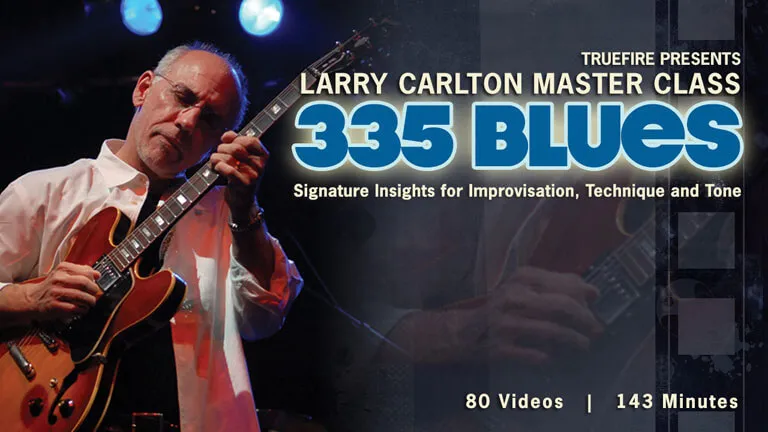

335 Blues

Signature Insights for Improvisation, Technique and Tone

Marty FriedmanTommy EmmanuelSteve VaiEric GalesEric Johnson

Get this course and 1,000+ more with All Access

Try 14 days free. Cancel any time.

Purchase Individual Course for $24.99
335 Blues

About this course

Nineteen-time Grammy nominee and four-time Grammy winner, Larry Carlton is perhaps the most versatile and accomplished guitarist walking the planet to day. With over 3,000 sessions, 200 hit records and 100 gold albums to his credit, Carlton has his fingerprints indelibly imprinted on virtually every genre of music.

Mr. 335 also plays the blues like nobody's business. Better yet, Larry possesses an extraordinary ability to brilliantly communicate both the art and science of blues guitar. 335 Blues, Larry's first course in twenty years, imparts Carlton's philosophical, technical and musical approach in a genre rich with expression and improvisation - the blues.

335 Blues is a hands-on, playing course. No tedious theory or exercises here. You'll be playing something new and majorly cool within fifteen minutes of digging in. But, put your time in and 335 Blues will likely remodel your entire approach to and understanding of blues guitar.

Larry presents 335 Blues in three main sections. First up, you'll play your way through a series of blues grooves in a variety of feels, keys and tempos. For each groove, Carlton demonstrates three choruses worth of comping and three choruses of improvisational soloing. Each performance is followed by an explanation of what he played and more importantly, why he played it. Then it's your turn. Use the video, charts, tab, notation and practice rhythm tracks to make the material your own. TrueFire's player controls make working with the curriculum a breeze.

Carlton drills down on essential techniques and improvisational approaches in the next section. Bending and vibrato (in fact, four types of vibrato) are demonstrated and broken down in unprecedented detail. Use of motifs, space and phrasing are likewise presented in an amazing, ear-opening fashion. Other gems of insight in this section include use of the melodic minor in blues, "knuckle voicings" and recommendations for how to approach both practice and playing.

The third section covers a wide variety of topics ranging from the technical to the philosophical. Tone and how to go about tweaking your equipment to achieve it, is presented comprehensively. Insight on recording, jamming and performing with other musicians is likewise addressed. A few anecdotes and even a little show and tell on the Steely Dan studio rig make this section one you'll likely watch over and over again.

"If you love electric blues guitar, then 335 Blues may be a dream come true for you, " says Jude Gold of Guitar Player Magazine. All in all, 335 Blues raises the bar on blues instruction with its innovative approach, articulate presentation and enough tasty moves to last a lifetime.

What you'll learn

  • Execute sideways vibrato with proper technique
  • Use index finger support behind the vibrato finger
  • Apply direct fingerboard pressure for sustained vibrato
  • Learn Larry Carlton's specific Dumble amplifier settings and philosophy
  • Learn how to route effects separately from main guitar tone (studio approach on stage)
Release date: 10/19/2007 • 3h 07m runtime
Start Course
Sample lessons
A Shuffle
A Shuffle
Rhythm
A Shuffle
A Shuffle
Solo
Stormy
Stormy
Rhythm
Stormy
Stormy
Rhythm Insight

What's included

82 lessons • 20 charts • 20 Jam Tracks

335 Blues
Welcome to 335 BLUES! I'm very excited about this course, my first in over twenty years! I get asked all of the time about my blues playing and finally I get a chance to share what I've learned over the years. I particularly love the blues because of the freedom that the format provides a musician for expression and improvisation. You don't have to navigate your way through complicated arrangements, key changes and progressions - you get to play your heart out! 335 BLUES is a hands-on, playing course. No tedious theory or exercises here, although we will spend some serious time on important techniques like bending and vibrato, essential expressions in the blues. For the most part we will play our way through the material I present here. We'll start by working through a series of blues grooves that I've prepared for you in a variety of feels, keys and tempos. For each groove, I'll demonstrate an approach for comping and soloing over three choruses. Loop the video and work with the tab and notation until you can play along with me at tempo. Then jump on the practice rhythm tracks and replace my parts. This is not to have you learn my licks in particular; rather it will better illustrate my approach to building a solo and supporting a soloist in a musical context. The purpose of this course is to have you develop a better understanding for improvisation, rhythm playing and soloing skills so that you can cultivate your own voice.
A Shuffle
In the next big section of 335 BLUES, we'll drill down on essential techniques and improvisational approaches. We'll cover bending and vibrato (in fact, four types of vibrato) and the use of motifs, space and phrasing. We'll also have a look at using the melodic minor scale in blues, "knuckle voicings" and a few recommendations approaching practicing, playing and performing. The third section covers a wide variety of topics ranging from the technical to the philosophical. We'll talk about tone and how I go about tweaking my rig to achieve my sound. We'll also discuss recording, jamming and performing with other musicians. I added a few more surprises for you here as well. So, enough talk. Let's get busy with a shuffle in the key of A and work on how we might approach comping over this progression. Good rhythm is all about good timing. Keeping your ears glued to a drummer's hi-hat and snare helps establish a sense for where the time is and where your rhythm parts need to fall. The "bubble" parts I play here - the muted, single-note stabs - are played with very strict attention to the hi-hat. A strict sense of time doesn't mean that your playing is going to sound stiff! Instead, a good sense for where beats fall gives you a lot more room to add "feel" into your rhythm parts. Try your own bubble part over the jam track. Once you're comfortable with the groove, you can start to add more color with accents and comping chords.
A Shuffle
In the next big section of 335 BLUES, we'll drill down on essential techniques and improvisational approaches. We'll cover bending and vibrato (in fact, four types of vibrato) and the use of motifs, space and phrasing. We'll also have a look at using the melodic minor scale in blues, "knuckle voicings" and a few recommendations approaching practicing, playing and performing. The third section covers a wide variety of topics ranging from the technical to the philosophical. We'll talk about tone and how I go about tweaking my rig to achieve my sound. We'll also discuss recording, jamming and performing with other musicians. I added a few more surprises for you here as well. So, enough talk. Let's get busy with a shuffle in the key of A and work on how we might approach comping over this progression. Good rhythm is all about good timing. Keeping your ears glued to a drummer's hi-hat and snare helps establish a sense for where the time is and where your rhythm parts need to fall. The "bubble" parts I play here - the muted, single-note stabs - are played with very strict attention to the hi-hat. A strict sense of time doesn't mean that your playing is going to sound stiff! Instead, a good sense for where beats fall gives you a lot more room to add "feel" into your rhythm parts. Try your own bubble part over the jam track. Once you're comfortable with the groove, you can start to add more color with accents and comping chords.
A Shuffle
As we learned in the first two videos, you'll need to listen carefully to the drummer to keep good time. You also have to be aware of what the bass player is doing so that you don't conflict harmonically with his part. While these ideas are fundamentals for playing rhythm, they also pay off nicely once you're ready to start soloing. For demonstration purposes, the solo I play here is played in the fifth position; that is, my index finger never really leaves the 5th fret. Once you start trying the same key in other positions, you'll see how quickly your soloing possibilities multiply. For starters, take a simple lick that you know well and try finding it in different positions and in different octaves on the neck. Differences in tone and the feel of the strings under your fingers change everything! Anyone who has fiddled around with a basic blues scale knows that you can make a lot of music without a lot of movement. What makes one guy sound hipper than the next? It's not how many notes or positions he plays, it's how he expresses himself with the notes that he plays. A simple, four-note phrase can be played a hundred different ways. Listen to how much a phrase changes when you add bends and vibrato, or when you use pull-offs and hammer-ons rather than picking each note. Try to move out of your own comfort zone, too - if you're used to bending notes with just your third (ring) finger, try bending and using vibrato with every finger. As you develop melodic phrases, think about where you might have to take a breath if you were singing the part. Thinking like a singer can also help you structure your solos well. Rather than coming in with both guns blasting, start simply, as a singer might begin a song. Give the listener time to digest what you're saying.
A Shuffle
As we learned in the first two videos, you'll need to listen carefully to the drummer to keep good time. You also have to be aware of what the bass player is doing so that you don't conflict harmonically with his part. While these ideas are fundamentals for playing rhythm, they also pay off nicely once you're ready to start soloing. For demonstration purposes, the solo I play here is played in the fifth position; that is, my index finger never really leaves the 5th fret. Once you start trying the same key in other positions, you'll see how quickly your soloing possibilities multiply. For starters, take a simple lick that you know well and try finding it in different positions and in different octaves on the neck. Differences in tone and the feel of the strings under your fingers change everything! Anyone who has fiddled around with a basic blues scale knows that you can make a lot of music without a lot of movement. What makes one guy sound hipper than the next? It's not how many notes or positions he plays, it's how he expresses himself with the notes that he plays. A simple, four-note phrase can be played a hundred different ways. Listen to how much a phrase changes when you add bends and vibrato, or when you use pull-offs and hammer-ons rather than picking each note. Try to move out of your own comfort zone, too - if you're used to bending notes with just your third (ring) finger, try bending and using vibrato with every finger. As you develop melodic phrases, think about where you might have to take a breath if you were singing the part. Thinking like a singer can also help you structure your solos well. Rather than coming in with both guns blasting, start simply, as a singer might begin a song. Give the listener time to digest what you're saying.
G Shuffle
A major part of the rhythm player's job description is to support the soloist. We want the soloist to know that he can rely on the rhythm section, not just for keeping good time but for feeding him ideas. I'll demonstrate three choruses of comping here in this shuffle, in the key of G. Each has a different approach, and you'll notice how they progress nicely from one chorus to the next. The first chorus has a kind of pulsing energy to get the soloist started, and it's rock solid because parts of it lock in with the bass. In the second chorus, classic blues voicings ride along on top of the bass part, providing new rhythms and some harmonic possibilities for the soloist to sink his teeth into. For the last chorus, I opted to give the soloist a lot of space. With big gaps between rhythm stabs - and a dependable comping part that keeps coming back around - the soloist has a lot of room to cut loose.
G Shuffle
A major part of the rhythm player's job description is to support the soloist. We want the soloist to know that he can rely on the rhythm section, not just for keeping good time but for feeding him ideas. I'll demonstrate three choruses of comping here in this shuffle, in the key of G. Each has a different approach, and you'll notice how they progress nicely from one chorus to the next. The first chorus has a kind of pulsing energy to get the soloist started, and it's rock solid because parts of it lock in with the bass. In the second chorus, classic blues voicings ride along on top of the bass part, providing new rhythms and some harmonic possibilities for the soloist to sink his teeth into. For the last chorus, I opted to give the soloist a lot of space. With big gaps between rhythm stabs - and a dependable comping part that keeps coming back around - the soloist has a lot of room to cut loose.

+ 75 more lessons

Start Course

Reviews

17 results

Troggman

Verified buyer

01/24/26

Excellent lessons from. a master

drcart1

Verified buyer

10/16/24

BUT: I got to 1:4 and it remains locked and i can’t move on with the rest of the 335 Improv Master Class i paid for Sept 28th. 604 434 8966. Help.

Marharr

Verified buyer

08/16/22

Larry Carlton is a legend and explains his playing really well. I haven't had a chance to really dig in to it yet but TF keep sending review requests. All I can say is that on the first pass it looks fantastic but needs a lot more attention than I have given it so far for a comprehensive comment. It will keep me busy for some time.

Coltranetime

Verified buyer

03/19/22

Tons of insights and cool thinks to pickup on right from the man himself.

335soun

Verified buyer

01/14/22

Masterclass from the great larry Carlton

Highly recommended course from one of the best guitarists of all time. Larry teaches you how to add colors, good guitar melodies and rhythmic possibilities to your blues solos. It is not a licks course, it is a guide on how to design your own licks and give your own personality. Highly recommended.!!!

Stop searching. Start improving with All Access.

Try 14 days free. Cancel any time.