Solo Acoustic Jazz Playbook

5 Jazz Standards for Solo Acoustic Guitar

Marty FriedmanTommy EmmanuelSteve VaiEric GalesEric Johnson

Get this course and 1,000+ more with All Access

Try 14 days free. Cancel any time.

Purchase Individual Course for $14.99
Solo Acoustic Jazz Playbook

About this course

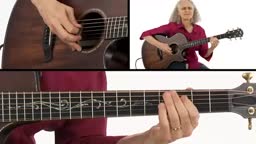
Send the band home, put the arch-top away, and grab your acoustic — in this Solo Acoustic Jazz Playbook from Mimi Fox, you’ll learn how to play solo acoustic guitar arrangements for It Don’t Mean A Thing (If It Ain't Got That Swing), Take The A Train, Night & Day, Fruitvale Avenue Stop, and Getaway Blues.

”Each arrangement includes a set of 7 video lessons: an overview, a Melody lesson, a Chords, and Harmony lesson, a Soloing Approaches lesson, and then 3 Performance Studies; a Basic Melody version, an Embellished version, and a version demonstrating how I would play it on stage.”

Mimi designed the course with a “one-size-fits-all” curricular approach. Each arrangement is presented in a progressive series of lessons starting with overviews and demonstrations of the basic chords and melody — ideal for players just starting their solo guitar learning journey.

Next set of lessons illustrate how to “jazz up” the melody and harmony with embellishments. Next up, soloing approaches with lots of demonstrations and explanations. Mimi punctuates the set of lessons with a full-length performance of the arrangement, which includes all of the elements she taught in the preceding lessons.

You’ll have all of TrueFire’s advanced learning tools at your finger tips to personalize your workspace and learn at your own pace.

You can loop, slow down, or speed up any section of a lesson. Plus, all of the tab and notation is synced to the videos for the optimal learning experience. You’ll also get tab and standard notation files to print out and Guitar Pro files as well.

Grab your acoustic, and let’s go solo with Mimi Fox!

What you'll learn

  • Observe advanced jazz improvisation techniques applied to a standard
  • See integration of melody, harmony, and soloing concepts in practice
  • Learn to combine melody, harmony, and bass in solo guitar context
  • Understand how to approach learning complex solo guitar arrangements
  • Develop ability to extract and adapt ideas from advanced performances
Release date: 07/06/2023 • 1h 34m runtime
Start Course
Sample lessons
It Don't Mean a Thing (If It Ain't Got That Swing)
Overview
The Melody & Embellishments
Demonstration
The Harmony & Chords
Demonstration
It Don't Mean a Thing (If It Ain't Got That Swing)
Performance

What's included

35 lessons • 20 charts

Solo Acoustic Jazz Playbook
Hi, Mimi Fox here, and welcome to the Solo Acoustic Jazz Playbook.

Send the band home, put the arch-top away, and grab your acoustic — in this playbook, you’ll learn how to play solo acoustic guitar arrangements for It Don’t Mean A Thing (If it Ain't Got That Swing), Take The A Train, Night & Day, Fruitvale Avenue Stomp, and Getaway Blues.

Each set of lessons includes an overview, a Melody lesson, a Chords and Harmony lesson, a rundown of some of my favorite soloing approaches for the tune, and finally, a performance study demonstrating how I would play the tune myself.

We’ve synced the tab and notation to the video. You can also slow down or loop any section to practice and play these arrangements at your own pace.

Let's dig in!
How to Work With This Course
I'm thrilled to present this new course for all of you. I'm really hoping that it will spark all kinds of intriguing ideas, inspiring you to craft your own arrangements for solo acoustic jazz. The goal is to dive in as a player, possibly even as a composer, and start exploring these arrangements in depth.

There's much to learn in this course. Essentially, I've selected five compositions: three standards and two of my originals, one of which hasn't been recorded until now. We're going to dissect these tunes. I'm going to discuss playing the melody, the harmony, and all of the chord changes. And then we'll move to soloing, which includes single line playing and walking bass lines.

Finally, there will be a performance for each of the five pieces. Because TrueFire is such an excellent platform, you'll have the ability to loop different sections. If you come across a passage that really speaks to you, you'll be able to loop it. You have the option to slow things down. When you create a loop, you'll have the opportunity to play along with me. In this course, I'm going to explain in detail everything that goes into crafting a solo acoustic jazz arrangement.

So, there's a wealth of useful information here and hopefully a lot of exciting music for you to dive into. I hope you enjoy it.
It Don't Mean a Thing (If It Ain't Got That Swing)
This piece is genuinely a joy to play, and I've had a blast crafting this unique arrangement. "It don't mean a thing if it ain't got that swing" - truer words were never spoken by Duke Ellington.

I want to note, for all the pieces I'm working on in this acoustic course, it's crucial to seek out the original recordings, as there are so many fantastic versions of this tune.The classic rendition, of course, is by Duke Ellington. It also boasts excellent lyrics that I strongly suggest you learn. It aids in understanding the true meaning and intent of the song.

This song is loads of fun, and we're going to delve into it and methodically break it down piece by piece. Let's get going!
The Melody & Embellishments
We're going to kick off with this fantastic song by diving into the melody. When learning any song, it's vital to start with the melody. This element is what characterizes the song above all else. As a jazz musician, or any improvisational musician, the way you interpret the melody and infuse your own spin on it is truly crucial. With so many versions of these great standards out there, your unique interpretation helps you stand out, bringing the piece to life in a refreshing manner. To do this, it's important to study the melody and find a way to contribute something new to it. To accomplish this, you must first listen to recordings of the melody and learn it more or less as it is.
The Harmony & Chords
The harmony for "It Don't Mean a Thing (If It Ain't Got That Swing)" is truly delightful. The main progression of the song is commonly found in many different styles of music and various songs. It's characterized by a descending chromatic pattern against a G minor chord.There are numerous songs in jazz with this feature, and while it's most typically found in Latin Jazz, bands like The Beatles and Led Zeppelin have also utilized it in the songs "Michelle" and "Stairway To Heaven".
Soloing Approaches
Now we're approaching the segment some of you may have been eagerly waiting for: how do I solo over this song, and what concepts am I utilizing? When soloing on a guitar, especially when you're playing alone, several elements come into play.

One common challenge students encounter is how to keep everything moving seamlessly. Sometimes it involves incorporating chord hits amidst playing a melody. Occasionally, you might observe in performances that I transition into a walking bassline figure even while delivering a melody. This technique is employed to enrich the sound, giving the listener (and sometimes myself) a clear understanding of what's happening in the piece, and to create a sense of cohesion.

As you delve into the harmony of the piece, you'll notice that you can apply various scales. However, the real starting point, as anyone familiar with my other TrueFire courses would attest, revolves around referencing the blues, a topic I often emphasize due to its fundamental importance.
It Don't Mean a Thing (If It Ain't Got That Swing)
So, we've gone over all the different concepts I've utilized to develop this arrangement and solo over it. We've covered the melody, the harmony, and my ideas for soloing. Now, the proof of concept is in the performance. You're going to hear all the different ideas I've discussed across the three segments – the melody, the harmony, the chords of the tune, and then the soloing ideas.

I believe there's plenty of material here for you to dive into, but do remember that this was a performance where I played freely. I let it flow, which might seem a bit overwhelming at first. But there are still digestible bits you can latch onto and delve into.

Be patient with yourself during the learning process. I wish when I was first learning jazz that I had resources like these TrueFire courses to work with. I hope you appreciate the abundance of knowledge available to you here, but it's also crucial to understand that proficiency won't come overnight. You need to be patient and tackle each segment, each manageable chunk, one piece at a time.

Remember to enjoy it and have fun, because it's about your personal musical journey. Keep that in mind, maintain a positive attitude, and work on everything at a slow pace. Now, let's take a look at this performance.

+ 28 more lessons

Start Course

Reviews

2 results

1jimmy4u

Verified buyer

01/07/25

Master Crafter

I’m a jazz dabbler and Mimi is a freight train of rhythm and technique and she supplies my need to feed my perverbial core!


Habehabe

Verified buyer

08/02/23

A cornucopia of ideas

This course is a great addition to build up your solo performance repertoire. It focuses on the acoustic guitar but, of course, the content is transferable to the electric guitar. The recipe to build up a solo piece is seemingly simple: 1. Learn the melody (at various positions plus embellishments). 2. Learn the harmonic structure and the respective chords. 3. Add options provided by the guitar to enhance the sound and impact of the performance (e.g. via open strings, harmonics, bass lines). 4. Provide an appropriate mix of the above to overcome the orchestral limitations of the guitar for a solo guitar performance. Mimi Fox uses 5 songs (3 standards, 2 own compositions) to apply this recipe. It is interesting to watch how she develops various versions of segments of the songs. The intention is clear: it is less about copying her playing note for note but to provide a segue to apply her thinking to make songs your own. In addition to the analysis of each song and suggestions how to tackle it, there is a performance of every song by Mimi. These performances are quite extensive with a playtime of about 4 minutes each except for one song whose performance lasts even for 7 minutes. So we get a lot of material to study and to use it as a quarry for ideas. To quote Mimi: “When listening to my solo performance, please remind yourself that your goal is to pick out segments or ideas that really resonate with you.“ In summary, this is a great package which will take time for me to digest! A final point: This course is clearly not for beginners as a certain level of knowledge regarding this type of music and regarding playing skills of the instrument are a must. However, the good news are that TF offers also specific song lessons on “It don‘t mean a Thing…“, “Night and Day“ and “Take the A Train“ taught by Frank Vignola that may be perfect starting points before moving on to Mimi‘s course.

Stop searching. Start improving with All Access.

Try 14 days free. Cancel any time.