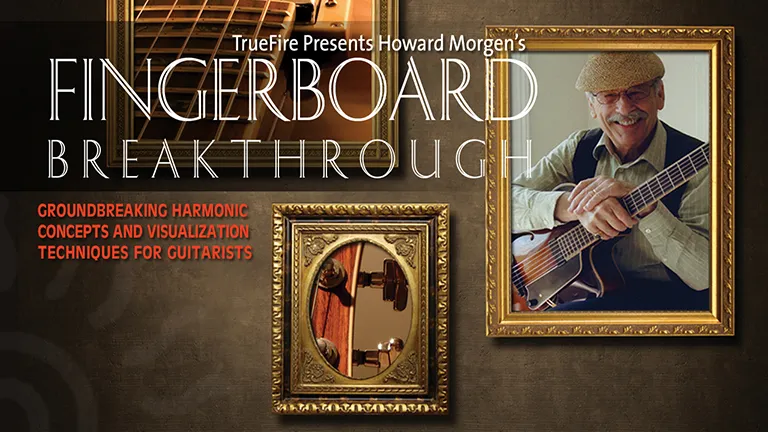
Although he was one of the very few bona fide masters of jazz guitar who walked the planet, Fingerboard Breakthrough is NOT a jazz course. Morgen was also one of the most highly respected arrangers in the biz and an accomplished fingerstyle solo guitarist; however Fingerboard Breakthrough is NOT a fingerstyle course, nor is it a solo guitar or method course. So what exactly is Fingerboard Breakthrough and why is it good for you?
Imagine basing everything you know about world geography on one of those old world maps such as the Al-Idrisi Mappa Mundi created in 1154, and then all of a sudden, you’re handed a modern world atlas. Everything you thought you knew is turned upside down, while at the same time everything becomes crystal clear. Fingerboard Breakthrough will likewise enlighten your understanding of harmony and the fingerboard in a way that can only be described as “breakthrough.”
Morgen’s system for applying harmonic concepts and visualizing the fingerboard stemmed from over 40 years of study, arranging, performance and teaching. “As guitarists, we've all experienced that sense of frustration and helplessness that occurs when, while playing, the fingerboard starts to shut down, dissolving into an elusive maze of strings and frets. Just what is it that makes viewing musical relationships on guitar so difficult? Actually, there are a number of factors all of which we’re going to address and remedy in Fingerboard Breakthrough.”
The harmonic concepts and visualization techniques in Fingerboard Breakthrough can be applied to any style and are particularly useful when working with sheet music and chord symbols. “One obstacle is a misconception acquired during the earliest stages of learning to play. The misconception is that chord symbols represent isolated, unrelated finger “grips.” While this is a necessary approach for a beginner, later on, encountering more harmonically complex material, thinking of chord symbols as isolated and unrelated finger grips tends to obscure the closely interdependent horizontal flow and function of chords within a progression.”
“The guitar’s irregular, unequal standard tuning system is another major impediment to harmonic understanding that all guitarists encounter from the moment we first pick up a guitar. That obstacle (which is also a double-edged sword since it has advantages as well as disadvantages) makes the guitar fingerboard elusive and difficult to visualize, frequently obscuring musical relationships.” The visualization techniques and triad applications in Fingerboard Breakthrough make it much easier to visualize and conceptualize chord construction, embellishment, and substitution, as well as voice leading techniques and advanced harmonic and improvisational concepts.
Morgen organized the course into 23 sections, each featuring a full-length video lesson and corresponding section in the accompanying 125-page PDF manual.
Sections include: The Irregular Standard Tuning System, Triad Shapes, Landmark Octave Shapes, Triad Applications, Triad Inversion Defined, 2nd Inversion Triads, Third Inversion Voicings, Chord Embellishment, Slash Chords, Standard Chord Symbols, Recognizing Chord Patterns, Cycle Patterns, Diminished Seventh & Dominant 7th b9, Chromatic Approach Chords, Walking Bass Lines, Re-Harmonization Techniques, Chord Embellishment and Personalizing the Arrangement. Worth the price of admission alone, the manual features hundreds of charts, chord grids, illustrations, standard notation and tab.
To demonstrate the concepts in a musical context for optimal comprehension, Morgen uses very familiar songs, progressions and melodies as excerpts, chord accompaniments and solo instrumentals, depending on the topic being discussed and demonstrated;
Amazing Grace, America the Beautiful, Aura Lee, Blues For Hy, Cockles and Mussels, Danny Boy, Greensleeves, Home on the Range, Loch Lomond, My Bonnie Lies Over the Ocean, My Old Kentucky Home, Saint James Infirmary, Sometimes I Feel Like a Motherless Child, Still Crazy After All These Years, Swing Low, Sweet Chariot, Twinkle, Twinkle Little Star, Waltzing Matilda and When Johnny Comes Marching Home.
Is this course for you? Yes, this is a must-have reference and course of study for ALL intermediate and advanced players. Intermediate players will significantly improve their understanding and application of harmony both musically AND visually on the fingerboard. Advanced players will experience epiphany after epiphany as they assimilate Morgen’s approach for re-harmonization and visualizing the fingerboard. Trade in your old world map for Fingerboard Breakthrough and enlighten thyself!
What you'll learn
Apply multiple voicings to the same progression for different textures
Use common tones in the bass to reveal hidden melodic lines
Harmonize diatonic scales to create chord progressions
Recognize line-dependent chord progressions by identifying common tone roots
Understand how chord symbols can represent the same harmony in different ways
As guitarists, I think we've all experienced that sense of frustration and helplessness that occurs when, while playing, the fingerboard starts to shut down, dissolving into an elusive maze of strings and frets. Just what is it that makes viewing musical relationships on guitar so difficult? Actually, there are a number of factors that are responsible and during this course we are going to address and hopefully remedy all of them.
One obstacle is the result of a misconception and habit of thought acquired during the earliest stages of learning to play that is carried over into later playing situations. That misconception is that chord symbols represent isolated, unrelated finger “grips”. For example, when playing a simple folk song, each chord symbol is treated as representing a finger grip to be strummed until the next chord symbol is spotted above the lyric. (This is an example of vertical thinking.) While this is a fine and necessary approach for a beginner, later on, encountering more harmonically complex material, thinking of chord symbols as isolated and unrelated finger grips tends to obscure the closely interdependent horizontal flow and function of chords within a progression. Let me give you some examples.
Progression for Danny Boy, Loch Lomond
D Dmaj7 D6 D G Gmaj7 Em7 A7 D (Above progression with isolated finger grips.) (Above Progression with good voice leading showing the descending moving bass line on the 6th string.)
Notice how the beautiful moving line implied by these chord symbols was obscured when I approached each chord symbol as an isolated and unrelated finger grip. Try to keep lines moving in the same direction as long as possible.
Now, to acquire the skills necessary to interpret chord symbols as a guide to accessing moving lines, you'll need to become thoroughly familiar with triads which are the building blocks of chords, chord construction formulas and chord voicings in all inversions and locations along and across the fingerboard.
Part One of this course will introduce you to all these topics. Part Two will cover the application of chord symbols to the process of finding moving lines for accompaniment and solo playing, and Part Three features an in depth discussion of chord substitution.
But first, in preparation for these insights, we'll need to look closely at why and how chord shapes appear as they do on the fingerboard. This is directly related to another built in obstacle to the visualization of musical relationships that we... > Continued in manual (click Chart button above).
2Download Complete Manual
Please use the CHART button above to downlaod the complete 132 page manual as one file.
3Lesson 2
Let's look at a major impediment to harmonic understanding that all guitarists encounter from the moment we first pick up a guitar. That obstacle (which is also a two edged sword since it has advantages as well as disadvantages) is the guitars irregular, unequal Standard tuning system. It has evolved independently of other instruments and their notational systems, and is based largely on pattern recognition, tablature and fingering considerations. Unlike the piano, with its musically accessible and repetitive pattern of symmetrically spaced black and white keys that graphically depict the musical alphabet, the guitar fingerboard is... > Continued in manual (click Chart button above).
4Lesson 3
A triad is a chord formed by three tones stacked in successive major third and/or minor third intervals. The lowest tone, which names the triad alphabetically, is called the root; the middle tone the third; and the top tone the fifth. Stacking major and minor thirds in all their possible combinations produces four distinct types (or qualities) of triads called major, minor, augmented, and diminished. The four triad qualities provide the harmonic foundation for all further chord construction. As such, a thorough working knowledge of how they are formed, their spellings, and inversions is absolutely indispensable for all musicians.
As a guitarist, you'll find that paying special attention to the shapes generated on the fingerboard by triads located on all string sets will make it much easier to visualize and to conceptualize chord construction, embellishment, and substitution, as well as the voice leading techniques and more advanced harmonic and improvisational concepts that will be developed as these lessons evolve. Figures 1, 2, and 3 illustrate how... > Continued in manual (click Chart button above).
5Lesson 4
Shapes formed by the perfect octave interval can be used as landmarks for the further visualization of all kinds of harmonic and melodic relationships on the fingerboard. These shapes can be used as checking devices after tuning up, and as stepping stones for instantly finding any given note along and across the entire fingerboard.
The perfect octave interval, which separates... > Continued in manual (click Chart button above).
6Lesson 5
Combining triad shapes with the landmark octave shapes can help clarify how and why higher tension chord shapes (major 7ths, minor 7ths, 13ths, 9ths, etc.) appear as they do on the fingerboard. For example, major 7th, dominant 7th, and major 6th shapes can be formed on the fingerboard by adding a 7th, b7th, and 6th respectively to a major triad shape. Similarly, minor major 7th, minor 7th, and minor 6th shapes can also be formed by adding 7th, b7th, and 6th scale tones to a minor triad shape. It's easy to visualize the location of the added scale tones by first creating an octave shape from the desired chord root, and then lowering the 8th (octave) one fret at a time to... > Continued in manual (click Chart button above).
7Lesson 6
When the lowest note of any of the four qualities of triad (major, minor, augmented, or diminished) is other than the root, the triad is said to be inverted. Triads voiced with the third in the bass is said to be in 1st inversion.
Figure 1 and 1a illustrate how a root position (R – 3 – 5) A major triad voiced on the fourth set of three strings (4/3) can be converted into a 1st inversion (3 – 5 – R) A major triad, voiced on the third set of three strings (3/3). The root position shape is inverted (for the first time) by simply... > Continued in manual (click Chart button above).
It is where i should have started when i learnt guitar
A
AlexGLuque
05/22/26
Here's everything you need
In this course you would find everything you might possibly need in your guitar journey. To take the most out of it I would suggest you better have clear vision of where are the notes in the fretboard and the intervals in a major scale. I wish I would've had this course back when I started.
G
golovanevsky
Verified buyer
01/27/26
Excellent course. The fingerboard is explained in a practical and logical way, perfect learning pace, too.
G
g0j0e
Verified buyer
08/29/25
Love the help from a experenced player.
L
Lauri
03/09/25
Loved it
Great basics, great explanations, useful for any guitar player to know.