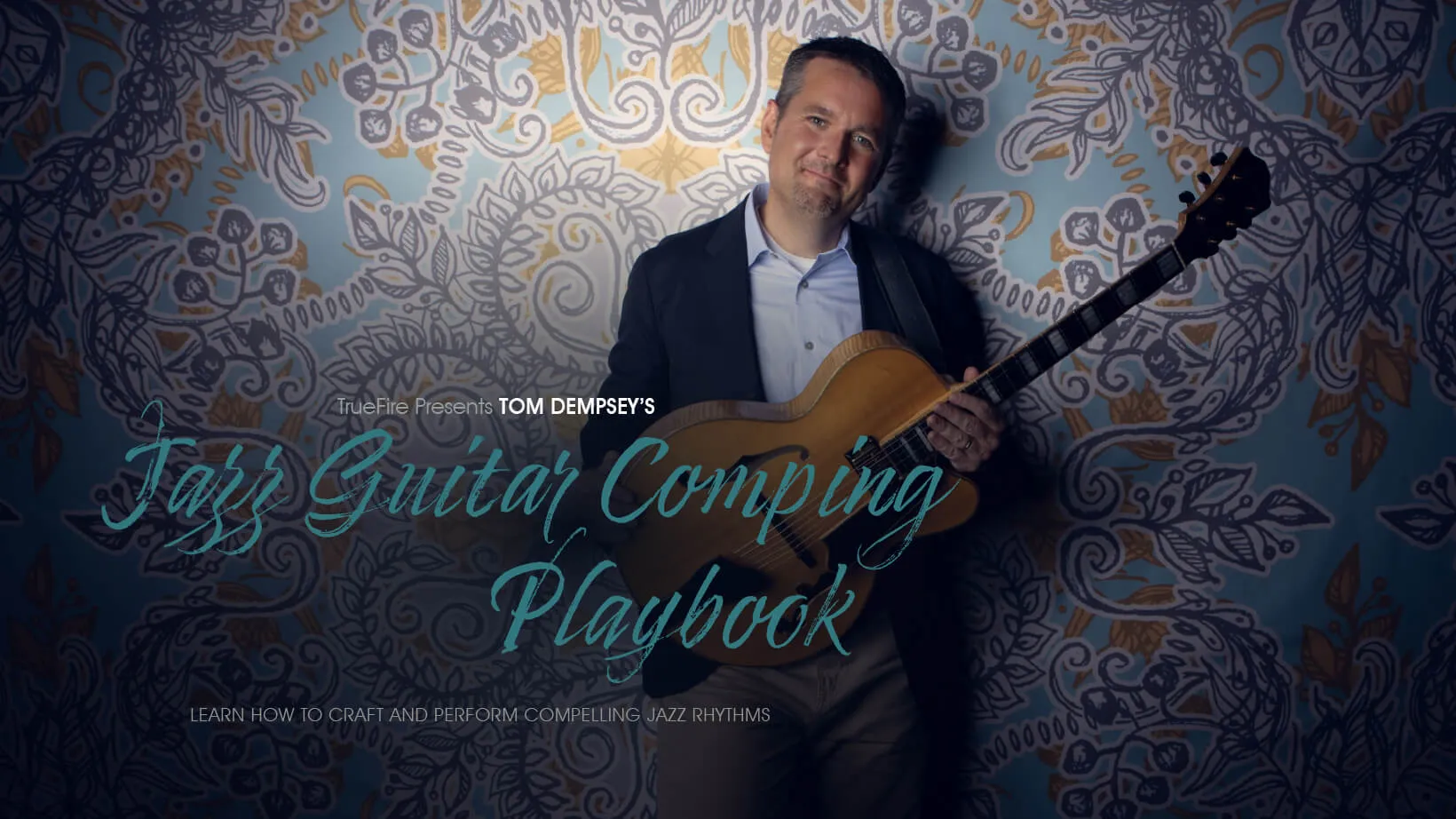
Jazz Guitar Comping Playbook

Learn How to Craft and Perform Compelling Jazz Rhythms

Marty FriedmanTommy EmmanuelSteve VaiEric GalesEric Johnson

Get this course and 1,000+ more with All Access

Try 14 days free. Cancel any time.

Purchase Individual Course for $9.99
Jazz Guitar Comping Playbook

About this course

If you think about it, your primary role as a Jazz Guitarist is to be a great accompanist. Players like Kenny Burrell, Wes Montgomery and Freddie Green all possess a wide variety of comping rhythms, voicing options, and chordal embellishments to draw from whether they’re supporting a vocalist, an instrumental group or even a big band.

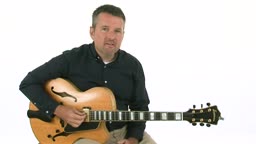
Tom Dempsey’s Jazz Guitar Comping Playbook examines essential techniques and harmonic approaches for playing twenty-five of the most important comping rhythms and techniques you need to know when playing jazz.

”We’ll explore concepts like the Charleston rhythm, rootless voicings, Freddie Green style comping, modal comping techniques, quartal harmony, guide-tones, Bossa Nova, Samba, and many other concepts. Then we’ll learn how to modify and apply them over some of the most popular jazz standard progressions.”

For each comping approach, Tom will first demonstrate and break down the comping rhythm and chord voicings over a simple backing track and then he will show you how to connect each comping pattern to a standard jazz chord progression.

Tom will explain and demonstrate all of the key concepts and approaches along the way. You’ll get standard notation and tabs for all of the performance studies. Plus, you’ll be able to use TrueFire’s learning tools to sync the tab and notation to the video lesson. You can also loop or slow down the videos so that you can work with the lessons at your own pace. All of the backing tracks are included to work with on your own as well.

Grab your guitar and let’s comp with Tom Dempsey!

What you'll learn

  • Play sophisticated jazz chord voicings for 'Someday My Prince Will Come'
  • Play rootless minor 7 flat 5 voicings
  • Apply waltz comping rhythm to a jazz standard progression
  • Voice lead from ii to V in minor keys
  • Feel waltz time in one rather than counting three beats
Release date: 03/19/2020 • 3h 35m runtime
Start Course
Sample lessons
Blues Comping Rhythm
Demo: Comping Study 3
KB's Bluesy Groove
KB's Bluesy Groove
Apply: Comping Study 3
ii-V Rootless Voicings
Demo: Comping Study 10
Like Wes
Like Wes
Apply: Comping Study 10

What's included

54 lessons • 51 charts • 25 Jam Tracks

Jazz Guitar Comping Playbook
Hi, I'm Tom Dempsey. Welcome to the Jazz Guitar Comping Playbook. If you think about it, your primary role as a jazz guitarist is to be a great accompanist. Players like Kenny Burrell, Wes Montgomery, and Freddie Green all possess a wide variety of comping rhythms, voicing options, and chordal embellishments to draw from. Whether they are supporting a vocalist, an instrumental group, or even a big band.

In this course, we'll explore how to play some twenty five of the most important comping rhythms and techniques that you need to know when playing jazz. We'll explore concepts like the Charleston rhythm, rootless voicings, Freddie Green style comping, modal comping techniques, quartal harmony, guide tones, Bossa Nova, Samba, and many other concepts. Then we'll learn how to modify and apply them over some of the most popular jazz standard progressions. For each comping approach, I'll first demonstrate and break down the comping rhythm and chord voicings over a simple backing track. Then I'll show you how to connect each comping pattern to a standard jazz chord progression.

All of the performances are tabbed and notated. You'll be able to sync the tab and notation to the video using TrueFire's learning tools. I also include the backing tracks so you can loop or slow down the tracks so that you can work with the material at your own pace. So, grab your guitar and lets get going.
Reference Manual
In this course, I've also includes a reference manual which is going to be an overview of all of the different rhythms that I'm going to present throughout the course. Now if you're familiar with an earlier course of mine called Fretboard Phenom, that course came with a pretty substantial reference manual. This one is not that large but it's really appropriate for this course. It will give you all the different rhythms in one handy hand out and you can refer to it throughout this course course. You can also use it in other areas of your practicing. So make sure you download that reference manual before you get started.
Charleston Rhythm
The first rhythm I want to show you is the Charleston rhythm. I think the Charleston rhythm is one of the most important jazz guitar comping rhythms you should know. It's basically a dotted quarter note followed by an eighth note. For this demonstration we're going to take this Bb 7 chord in 6 position.
Smooth Benny
Smooth Benny. This next example is going to be based on the chord changes to the Benny Golson classic "Killer Joe." Benny Golson is a great tenor saxophonist and composer. We're going to be playing the Charleston rhythm than as applied to essentially the A section of "Killer Joe." I'm going to be playing two different kinds of chords that are actually the same actual fingering moved into two different parts of the neck. The chords are Bb13 and Ab13. The basic progression moves back and forth between these chords.
Charleston Rhythm Variation
This next rhythm I want to show you is a variation on the Charleston rhythm. It's basically kind of inverting it. For this rhythm we're going to take an F9 chord in 7th position. You'll remember that the Charleston rhythm that I showed you began on beat one with the syncopation on the and of beat two. Here we begin with the syncopation on the and of beat one and then coming in on beat three. We're essentially displacing the syncopation.
Light Breeze
In "Light Breeze" we're going to build upon the Charleston variation we saw previously to change between an F13 and F9 chord with a simple move. Moving between related chords like these can be very helpful to your comping vocabulary. Taking this basic progression and changing it around in simple ways offers many opportunities to simply expand your comping vocabulary.
Blues Comping Rhythm
The next comping rhythm I'm going to show you is how we can start to take some rootless-chord-voicings and play them in both the harmonic and melodic way to recreate a strong bluesy jazz sound. This lesson is a break down of a F blues progression into three distinctive parts. The rhythm and chord fingerings are similar. But here I show you how to transfer them to other parts of the neck to create that blues sound. This will be the foundation for the next lesson so make sure you get these concepts down here. You dig?

+ 47 more lessons

Start Course

Reviews

6 results

HaroldLens

Verified buyer

10/31/24

All jazz guitar courses of Tom Dempsey

Tom Dempsey is a marvelous educator

sindibad

03/15/22

Tom Dempsey's Jazz Guitar Comping Playbook

This book gives the motivation to work in depth the feelings of the music.

jerome888

Verified buyer

02/26/22

Very good!

Robert R.

12/26/21

Thank you Ton

As someone who has jumped into jazz guitar I am trying to catch up with an ensemble that is a lot more knowledgeable. Tom has been such a help to me. He does a great time spelling out the fundamentals of jazz guitar in a very interesting and exciting way. I also love the way he describes a lot of the Jazz great, and the distinctive elements of their playing.

Kevin

04/24/20

Tom is a great teacher

I just started this course and I am learning some great things from it. There are numerous errors in the materials that go along with it however. I have contacted Truefire to ask about getting them corrected. There seems to be a lack of proofreading going on.

Stop searching. Start improving with All Access.

Try 14 days free. Cancel any time.