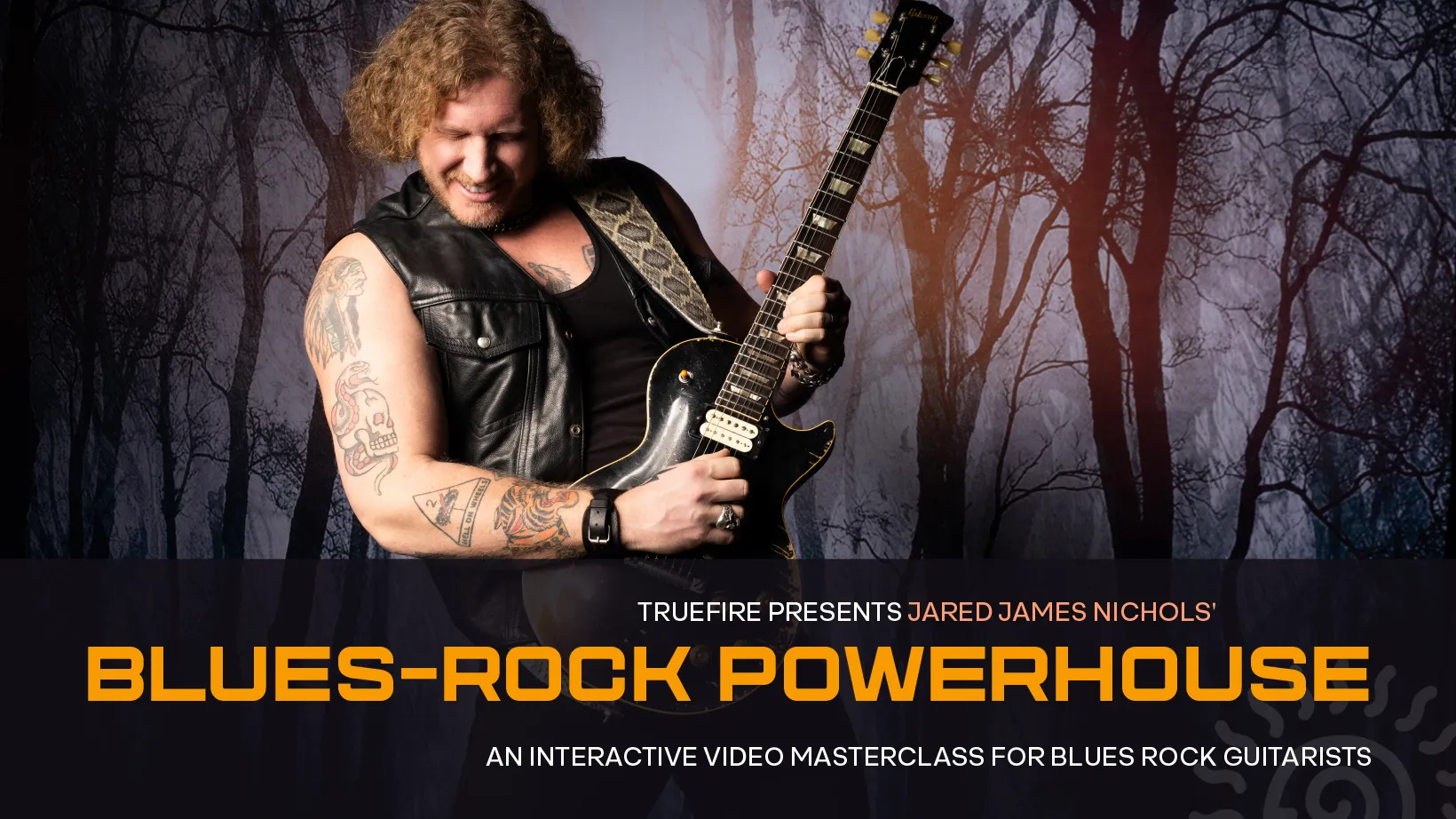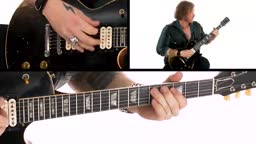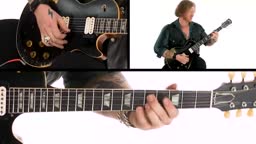
Blues-Rock Powerhouse

An Interactive Video Masterclass for Blues-Rock Guitarists

Marty FriedmanTommy EmmanuelSteve VaiEric GalesEric Johnson

Get this course and 1,000+ more with All Access

Try 14 days free. Cancel any time.

Purchase Individual Course for $19.99
Blues-Rock Powerhouse

About this course

Known for his high-octane performances, ferocious playing style, relentless energy, and unmistakable sound, Jared James Nichols has earned wide critical acclaim, an exploding fanbase, the respect of his peers, and the admiration of many notable artists.

Jared’s Blues Rock Powerhouse examines every aspect of Nichols's distinctive playing style, particularly emphasizing his expressive, pick-free technique. He shares 30 signature techniques and creative approaches, demonstrating them across 26 rhythm and lead performance studies, using backing tracks for musical context.

”Blues Rock Powerhouse fully breaks down the exact techniques, musical concepts, and framework that make up my own signature sound and style. I’ve organized the course using a framework of 26 rhythm and lead guitar performances. I play over backing tracks based on some of my own songs and favorite grooves to jam on, and each of the studies also includes detailed breakdowns.

I’ll show you 30 of my go-to techniques and creative approaches, including a variety of right-hand techniques, left-hand techniques to expand your expressive palette, how to craft rhythm parts, use motifs when soloing, and dozens of other ways to make your guitar playing more distinctive and interesting for your audience.

Education and teaching are at the heart of my passion for music. It’s much more than just passing on techniques; it’s about igniting that same fire in others that has driven me.

Helping someone discover their own unique sound and watching them grow as musicians is incredibly rewarding. I believe that sharing knowledge and inspiring the next generation is one of the most powerful ways to keep the spirit of music alive.”


You’ll have TrueFire’s interactive learning tools at your fingertips, allowing you to personalize your workspace and learn at your own pace.

The demonstrations and performances are tabbed, notated, and synced to the video with controls for looping, slow motion, fretboard animation, and many other tools designed to accelerate learning.

You’ll also get tab and standard notation files to print out, Guitar Pro files, and backing tracks to practice with.

Grab your guitar, and let’s head to the ‘powerhouse’ with Jared James Nichols!

What you'll learn

  • Create chord voicings that combine barre chords with open strings
  • Apply Mixolydian mode over dominant seventh chords
  • Create bass line embellishments under chord voicings
  • Play sparse, intentional blues phrases with effective use of space
  • Develop phrasing that works with (not over) rhythm parts
Release date: 09/19/2024 • 6h 50m runtime
Start Course
Sample lessons
Lit up Momma in D
Lit up Momma in D
Performance Study Overview
Lit up Momma in D
Lit up Momma in D
Performance | Rhythm 1
Lit up Momma in D
Lit up Momma in D
Performance | Rhythm 2
Lit up Momma in D
Lit up Momma in D
Rhythm Guitar Breakdown

What's included

91 lessons • 58 charts • 36 Jam Tracks

Powerhouse Blues Rock Masterclass
Hey guys, Jared James Nichols here. Blues Rock Powerhouse fully breaks down the exact techniques, musical concepts, and framework that make up my own signature sound and style. I've organized the course using a framework of 26 rhythm and lead guitar performances. I play over backing tracks based on some of my own songs and my favorite grooves to jam.

I'll show you 30 of my go-to techniques and approaches, including a variety of right-hand and left-hand techniques to expand your expressive palette. We're going to talk about how to craft rhythm parts, use motifs when soloing, and dozens of other ways to make your guitar playing more distinctive and interesting for your audience.

Are you ready to get started? Grab your guitar and let's dig in!
Drop D Tuning for Chords & Riffing
Okay, let's talk about drop D tuning. For me, it's a big part of my riffs and a way to rethink the guitar. If you're unfamiliar with drop D, you've definitely heard it on some of your favorite songs. It’s simple: you drop your sixth string from E down a whole step to D. You can do this by matching the pitch of your E string to your D string. Once tuned, you can strum those low three strings open for a power chord without barring across the fretboard. This tuning opens up a new dimension of riffing, allowing you to create cool ideas that might be harder to achieve in standard tuning. Plus, it gives your guitar a heavier, chunkier sound that adds weight to your playing. If you want to play chords from standard tuning, just move up two frets on the low string. Drop D is a simple yet effective way to give your riffs and solos extra punch, get out of a creative rut, and surprise yourself with new possibilities.
Mixing Pentatonics for Melodicism
Let’s talk about melodic pentatonics and the importance of finding your third. In the key of E, for example, the third is G sharp, and understanding this note's role can really shape the feel of your playing—whether it's major and happy, or minor and sad. As a guitar player, especially in blues, blues rock, funk, and heavy rock, recognizing and manipulating these thirds allows you to move beyond the basic minor pentatonic and adds depth to your music. By switching between major and minor thirds, even just a half-step bend, you can create powerful, expressive riffs that tell a story and break out of that one-dimensional box. Finding and playing around these thirds is a game-changer for improvisation and creativity.
Right Hand Technique & Pickless Approach
I often get asked why I don’t use a guitar pick, and it all goes back to being a lefty. When I first picked up a guitar at 14, I played a right-handed guitar upside down because it felt natural. When I finally got my first electric guitar and a free lesson, the teacher convinced me to play right-handed for practicality. He handed me a pick and showed me how to use it, but it just didn’t feel right. I preferred using my thumb, as it felt more natural and unblocked the connection between my fretting hand and the sound, especially since I was into classic rock like Pink Floyd, Led Zeppelin, and Black Sabbath at the time.
Lit up Momma in D
I'm going to play a track for you that's not only heavy with crushing riffs but also very melodic. I'll walk you through my approach to both rhythm and lead. The track is in drop D, with the six-string tuned down a whole tone, creating a foundation with a heavy, fun, and edgy riff that transitions into an open space perfect for improvisation. There's a supplemental rhythm track that complements the foundation, adding variation and a voice for the higher-end riffs, opening up more interpretive possibilities for soloing. As a lead player, it's exciting to explore the blend of major and minor pentatonics, weaving in blue notes to make the track feel like it can go anywhere. Now, let's break it all down.
Lit up Momma in D
I'm going to play a track for you that's not only heavy with crushing riffs but also very melodic. I'll walk you through my approach to both rhythm and lead. The track is in drop D, with the six-string tuned down a whole tone, creating a foundation with a heavy, fun, and edgy riff that transitions into an open space perfect for improvisation. There's a supplemental rhythm track that complements the foundation, adding variation and a voice for the higher-end riffs, opening up more interpretive possibilities for soloing. As a lead player, it's exciting to explore the blend of major and minor pentatonics, weaving in blue notes to make the track feel like it can go anywhere. Now, let's break it all down.
Lit up Momma in D
I'm going to play a track for you that's not only heavy with crushing riffs but also very melodic. I'll walk you through my approach to both rhythm and lead. The track is in drop D, with the six-string tuned down a whole tone, creating a foundation with a heavy, fun, and edgy riff that transitions into an open space perfect for improvisation. There's a supplemental rhythm track that complements the foundation, adding variation and a voice for the higher-end riffs, opening up more interpretive possibilities for soloing. As a lead player, it's exciting to explore the blend of major and minor pentatonics, weaving in blue notes to make the track feel like it can go anywhere. Now, let's break it all down.

+ 84 more lessons

Start Course

Reviews

5 results

SaturnSpins

Verified buyer

03/04/26

Absolutely having a blast with this course!
thomasbernier06

Verified buyer

05/06/25

Jared rocks!

Jared is an excellent teacher and an even better musician!

petew1108

Verified buyer

12/22/24

Well done!

Great stuff! Jared shows that you don't have to be a shred maniac to be a good guitar player. Well done!

ChMartiny

Verified buyer

11/04/24

Blues-Rock Powerhouse

Super tricks for all of those who want to get deeper into Jared's way to play with the fingers.

Masterofkame

09/27/24

Almost Perfect for Blues/Rock Intermediates!

I love Jared's sound and style without a pick! Incredibly dynamic and expressive. I would buy all of his courses in a heartbeat, even just to learn some solos and fast runs. The only drawback is the sometimes poor tablature for solo passages, so you have to listen and see how he plays the solos correctly. Otherwise it's not possible to play the solos so quickly. Therefore 4/5.

Stop searching. Start improving with All Access.

Try 14 days free. Cancel any time.