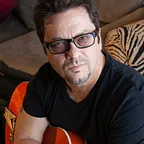
There are more guitar players today with incredible technical chops then ever before. Yet, so many of their solos and improvisations sound a bit dry and lifeless. This is often because they’re too focused on developing technical skills and strictly following harmonic rules and rhythmic approaches rather than letting their ears and emotions guide their note choices and phrasing.
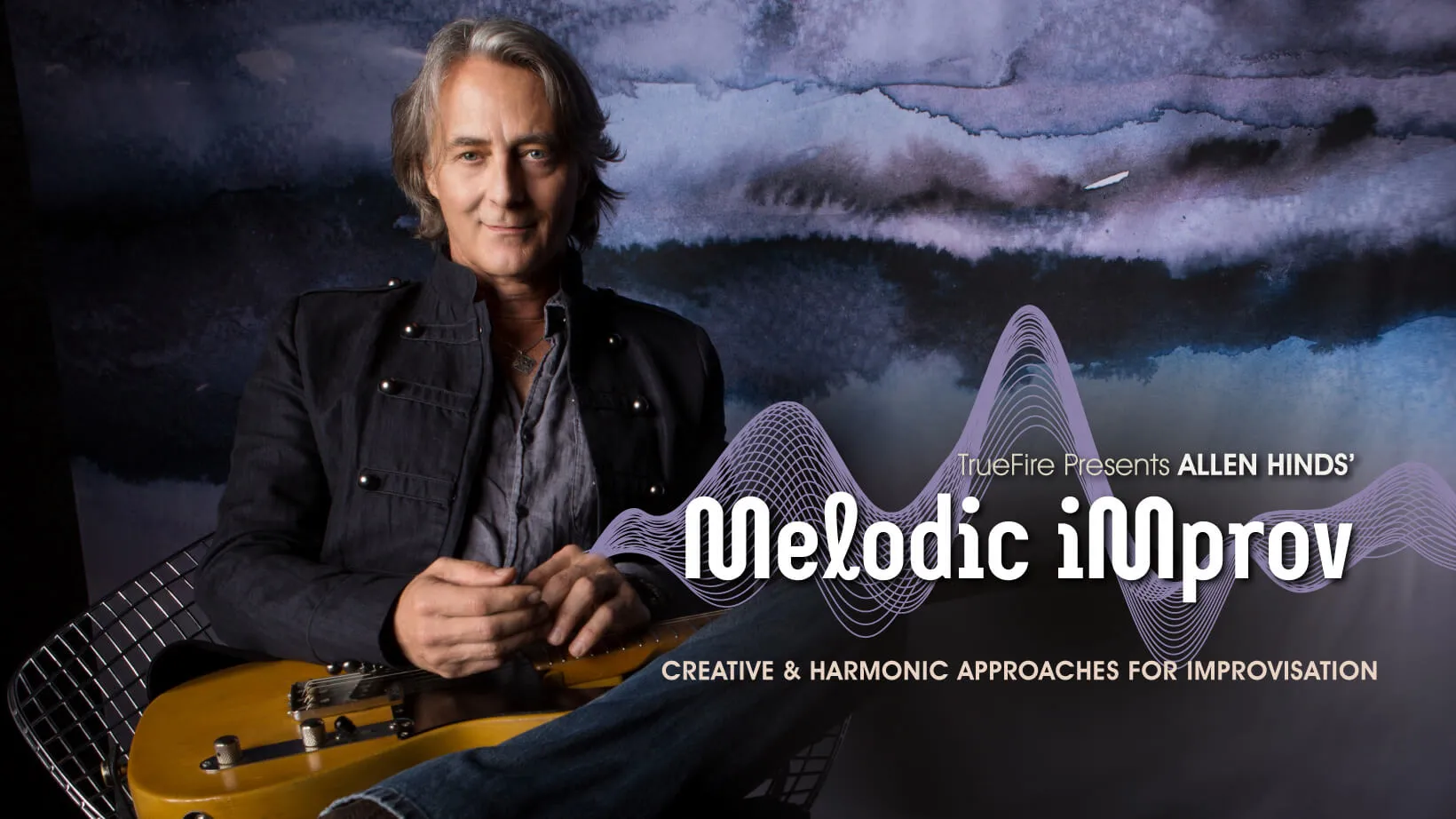
Allen Hind’s Melodic Improv will guide your improvisational musicality beyond just technical skills and by-the-book harmonic rules. ”Of course, it's important to learn harmony and theory, but you can't let that part of it override the musicality. It's easy to forget how much fun playing guitar can and should be. That's what we’ll focus on in this course. We'll start off examining some innovative new approaches to harmony and chords, then move on to rhythm and timing.”
Allen Hinds has performed and/or recorded with jazz and R&B luminaries including Randy Crawford, Gino Vannelli, Patti Austin, Roberta Flack, BeBe and CeCe Winans, The Crusaders, Bobby Caldwell, James Ingram, Marilyn Scott, Boney James, and many, many others. An active studio musician as well as live performer, Allen has written songs for Larry Carlton, Patti Austin, Jeff Kashiwa as well as many popular TV shows. He's also a passionate educator and has taught at Musicians Institute for 30+ years. We're thrilled to welcome Allen to the family with his first TrueFire course, Melodic Improv!
"We'll explore applications of major scales and modal concepts, then we'll dig deep into soloing and improvisational techniques such as building on motifs. We'll work on emphasizing chord tones when playing over changes, and we'll also look at interesting altered scale options for playing over dominant chords. Those are just a few of the improvisational approaches we'll work through, but we'll also spend some time developing your legato technique to add fluidity and motion to your lines.”
Allen will guide you through a curriculum including: Crafting Rhythm Guitar Parts Rhythm & Time, Visualizing Major Scales & Modes, Modal Analysis for Licks, Learning to Express Yourself, Confidence & Positivity, Connect the Fretboard with Motifs, Expand on Your Motifs, Boo’s Jam Study, Playing Changes & Chord Tones, Chord Tone Training, Falling Up Solo Study, Yonder Hills Solo Study, Five Chord Options, The Beauty of Legato, Simple Legato Exercises, More Involved Legato Exercises, Strength Building Exercises , and a series halted to Confianca.
You’ll complete the course by applying all of the previously mentioned key concepts and techniques over 3 soloing performance studies.
Allen will explain and demonstrate all of the key concepts and approaches along the way. You’ll get standard notation and tabs for the key examples and performance studies. Plus, Allen includes all of the rhythm tracks for you to work with on your own. In addition, you’ll be able to loop or slow down any of the performances so that you can work with the materials at your own pace.
Grab your guitar and let's get melodic with Allen Hinds!
What you'll learn
Navigate the fretboard using geometric shapes
Understanding when to use blues scale vs. chord tones over changes
Construct melodic narratives in improvisation
Learning to navigate key changes within a blues-based solo
Hi, I'm Allen Hinds, and welcome to Melodic Improv. I've been teaching at Musicians Institute for 30+ years, and I've seen a lot of incredible players with incredible chops, but often their solos and improvisations sound a bit dry and lifeless. I think maybe this is because they follow harmonic rules and rhythmic approaches out of a book rather than let their ears and emotions guide their note choices and phrasing.
Of course, it's important to learn harmony and theory, but you can't let that part of it override the musicality. It's easy to forget how much fun playing guitar can and should be, and that's what I try to focus on in this course.
We'll start off examining some innovative new approaches to harmony and chords, then moving on to rhythm and timing. We'll explore applications of major scales and modal concepts, then we'll dig deep into soloing and improvisational techniques such as building on motifs. We'll work on emphasizing chord tones when playing over changes, and we'll also look at interesting altered scale options for playing over dominant chords. Those are just a few of the improvisational approaches we'll work through, but we'll also spend some time developing your legato technique to add fluidity and motion to your lines.
We'll put all these ideas to work over three performance studies and I'll break down select lines and highlights in detail, all of them based on original tunes of mine: "Confianca", "Falling Up", and "Just Get In". And the cool thing is, a lot of these examples and performances are tabbed and notated. You'll have the backing tracks to work with on your own. Plus, you can loop or slow down the video, tab and notation so you can work with the content at your own pace. So, grab your guitar, and let's have fun!
2Creative Approaches for Guitar
Guitar has evolved in a lot of interesting ways since I first started playing in the late '60s. These days, I look at guitar as a "frisbee", something that everyone has in their garage. This is because guitar is so much fun to pick up and make something musical happen right away. This evolves into learning chords and learning patterns - and before you learn theory, there's a lot of fun that can be had on guitar. There's a lot of people that have made great careers by using their ears.
What I'd like to give you here is what I've gathered in my 30+ years of teaching, specifically some techniques and concepts that can help students who are using their ears evolve and get further without getting into the nitty gritty of it all. There's lots of fun to be had by just being creative.
3Harmonized 3rds
Here's an exercise that's easy and doesn't require a lot of theory. Start by making a loop or play to a CD that stays in one tonal center, in this case let's take an E7.
We'll start by finding an E major scale on a single string, which you'll be able to pick out if you have any knowledge of the guitar. Next, try finding the thirds and harmonizing them on the next string. Follow your ear and you'll be able to pick them out. Take your loop and work on staying in key around your tonal center. Once you've worked this out, move on to the next two strings, and the next...
4Exercises for Practicing 3rds
Learning 3rds is going to help you see the fretboard. So many of the books and schools (in my opinion) teach you in little boxes, so students end up playing in little boxes. I try to develop exercises that bridge positions on the guitar. It's important to see the guitar in one big position, without barriers.
In this lesson, we'll be playing our thirds again, focusing on ways to get out of the box. This works for other intervals, too: Try it out with fourths, sixths, etc. or mix them up to see what kind of sounds you can get out of it.
5Simple Tricks for Playing Chords
Here's a common mistake with playing chords that I hear several guitar players make, some of which are already famous! Guitar is easy to pick up and play open chords, hitting the strings with the flat side of the pick, and that's beautiful of course, but there's more than one way of doing it.
You can also play chords using each finger, gripping the strings like a harp player would. This can be very musical and is defined by the strings that you're not playing. You hear guitar players like Eric Johnson and Jimi Hendrix doing this all the time. By taking out some of the strings and only playing some of the notes, you can make your playing a lot more interesting than playing every string every time.
6Go Fishing for Harmonies
Another way to embellish your guitar vocabulary is by taking a chord, as we are with the A minor chord here, and "fishing" for interesting and new sounds off the chord shape. Take what you know based on the pentatonic scale and add in new and creative things.
7Internalize New Ideas
It's one thing to learn something, it's another thing to be comfortable playing it. For example, you might be able to play two chords, but you must also learn how to switch between them. If you learn something, you must be able to incorporate it into your playing, or you forget it.
Excellent legato licks and wide interval chords but needed more of them. .
I loooove Allen's playing, and his spirit. Another humble genius. Though this lesson was VERY good, I would have liked to have had more tabs of his tasty legato licks, ethereal chord construction and progressions, and possibly tabs of of his delightful 'noodles' in between the actual displayed notations. Very Holdsworthian style in many of his chord inversions and legato runs, Nice explanations of his approach to creating solos, and loved his insights into the work of playing with other musicians.
T
tomc10
Verified buyer
01/03/25
Greatly
G
GuitarDudeSteve
Verified buyer
12/17/24
It's defifnitely informative with some good tips to help if you're dropped in a situation you aren't prepared for. But ultimately, a lot of the information I felt I had picked up elsewhere