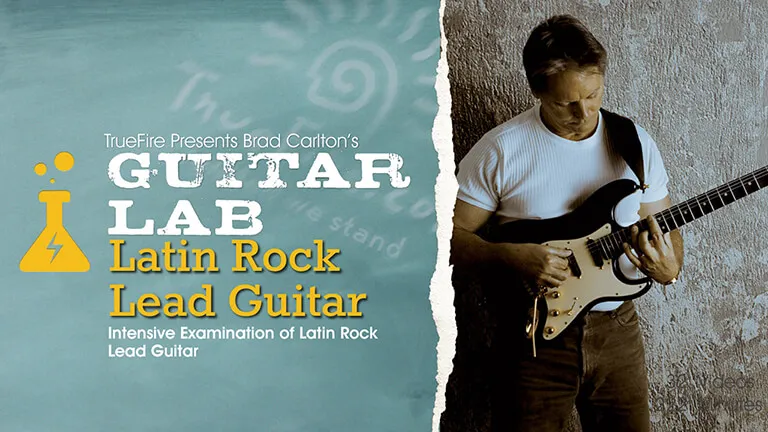
Guitar Lab: Latin Rock Lead

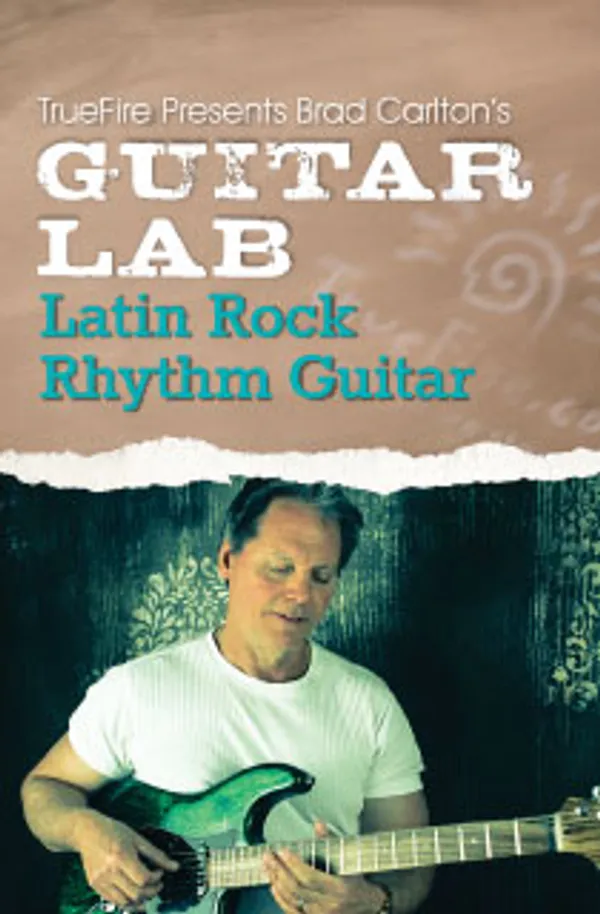
Learn how to play guitar with TrueFire's Guitar Lab: Latin Rock Rhythm guitar lessons by Brad Carlton.

Marty FriedmanTommy EmmanuelSteve VaiEric GalesEric Johnson

Get this course and 1,000+ more with All Access

Try 14 days free. Cancel any time.

Purchase Individual Course for $5.00
Guitar Lab: Latin Rock Lead

About this course

This course is designed to equip you with the tools necessary to solo over Latin style progressions. You will study scale/chord relationships which will allow you to create various colors as you play over the changes. Great emphasis will be placed upon understanding the rhythmic grid work in the music.

This will enable you to increase your phrasing options and will help you understand how to get more mileage out of any given riff. You will also receive melodic examples which will show you how to harmonize a melody in thirds. Latin style music is full of passion and fire and I think you'll enjoy playing over these tracks.

What you'll learn

  • Apply pentatonic scales in a quasi-vertical approach
  • Use chord voicings to create angular solo lines
  • Target chord tones to outline chord changes
  • Understand which chord extensions work with Dorian vs Phrygian
  • Awareness of prerequisite and companion learning materials
Release date: 05/29/2014 • 3h 42m runtime
Start Course
Sample lessons
Jam Track #1
Jam Track #1
Harmonic and Rhythmic Analysis
Chord / Scale Relationships
Hearing the Changes
Rhythmic Templates
Rhythmic Templates
Part 1
Rhythmic Templates
Rhythmic Templates
Part 2

What's included

32 lessons • 30 charts • 30 Jam Tracks

Latin Rock Guitar Lead
This course is designed to equip you with the tools necessary to solo over Latin style progressions. You will study scale/chord relationships which will allow you to create various colors as you play over the changes. Great emphasis will be placed upon understanding the rhythmic grid work in the music. This will enable you to increase your phrasing options and will help you understand how to get more mileage out of any given riff. You will also receive melodic examples which will show you how to harmonize a melody in thirds. Latin style music is full of passion and fire and I think you'll enjoy playing over these tracks.
Jam Track #1
We will be dealing with a four bar progression which can be seen in chart number one. Notice that measures one and three are full measure of the prevailing chord and measures two and four are what I term "two and two" which means you have two beats on each chord. Knowing the progression is critical in order to be able to anticipate the chord changes. There are two ways you can view this progression in terms of theoretical analysis. The theoretical key for this progression would be G major because the Em to B7 chord progression is a vi III7 in the key of G. This means that during the Em chord you would play the E Aeolian mode which is a G scale played from E to E. The B7 is non-diatonic which means that it's not in the key of G major. The note that changes is that the D# which is the third of the B7. This explains the III7 labeling because the three chord should be a minor to remain diatonic to the major scale. The scale you'll be using over this B7 is B Phrygian dominant which can be viewed as mode five of E harmonic minor. A quick easy way to get this scale would be to simply take the G major scale and change the D note to a D#. The street key analysis of this progression would be i to V7 in E minor.
Chord / Scale Relationships
Diagrams one and two show the arpeggios and scales for the two chords in this progression. This lesson demonstrates how to play these scales and hear how the notes change theoretically as the chords change. Remember that the numerical analysis of a note is based on the root of the prevailing chord. This means that if you're playing a B note over an Em chord, it is the 5. When you change chords to the B7, that same B note becomes the root (1). If you compare diagrams one and two, you'll see this principle in action throughout all seven notes of each scale. Notice that there are six common tones between the E Aeolian mode and the B Phrygian dominant scale. The only note that changes is the D in the E Aeolian ( the b7) which then changes to D# in the B Phrygian dominant scale (the 3). In the video you will learn how to play a note and listen to its function against the prevailing chord.
Rhythmic Templates
Chart number three is a rhythmic breakdown of one measure in 4/4 (common) time. As you view each of the four vertical columns, you will see how each beat can be subdivided thus yielding half notes, dotted half notes, quarter notes, eighth notes, 16th notes, and dotted 16th notes. In the video I will explain how to count these and play them on the guitar in terms of pure rhythm. Once you have these figures in your head and in your hands, you can then apply them as templates for your soloing ideas. Remember, "if you can count you can play it".
Rhythmic Templates
Chart number three is a rhythmic breakdown of one measure in 4/4 (common) time. As you view each of the four vertical columns, you will see how each beat can be subdivided thus yielding half notes, dotted half notes, quarter notes, eighth notes, 16th notes, and dotted 16th notes. In the video I will explain how to count these and play them on the guitar in terms of pure rhythm. Once you have these figures in your head and in your hands, you can then apply them as templates for your soloing ideas. Remember, "if you can count you can play it".
Rhythm Guitar Part
In this lesson I will demonstrate a rhythm guitar approach for jam track number one. Example 1 shows a general approach that involves eight notes and 16th notes as well as muted strings.
Riff #1
Example 2 is a thematic riff over this progression which involves two parts. In this video you will learn how to play the lower part and will have an opportunity play along with jam tracks. I've supplied jam tracks that have each part as well as a track that demonstrates both parts played together.

+ 25 more lessons

Start Course

Reviews

6 results

klaswestholm

Verified buyer

02/03/25

Really nice and inspiring

A good complimient to the latin accoustic guitar course. I really enjoy it.
Quark77

Verified buyer

08/17/23

Latin Rock or Jazz?

Carlton is a fantastic player and he clearly demonstrates his solid command of the concepts to approach Latin music: Rhythm/Grooves, Arpeggios, Scales, Modes. This course is for advanced students that already master scales in all the modes, else it would be difficult to follow Carlton's fast-paced explanations and applications. I deducted a start mainly for three reasons. First, many of the backing tracks are not in line with the course outline and it's obviously annoying if you want to practice something you're working on and the wrong backing track comes up. Second, the PDFs are all just concept charts and not play-along tabs, let alone synchronized, which would really be nice to learn the notes targeting. Third, the second half of the course, with all the progressions, becomes quite monotonous after a while. Anyhow, I highly recommend this course for advanced players who want to expand their latin guitar playing. Though, best to build a foundation with Carlton's Latin Rhythm course first.

Jeffrey K.

11/09/22

Simple, effective

Throughout this course, I kept thinking, this all sound like Santana's tune, Smooth, and who, for the love of god, doesn't love that song?! Brad gives you simple ways of combining the diminished with the minor to give you THAT sound. It sometimes seems that his endless twists and permutations are exhausting, but they are also inspiring, in so far as they suggest that, although we may never attend mastery, we can be worthy acolytes. I really enjoyed it and recommend it unreservedly!

loudeechris

Verified buyer

03/28/20

Latinize your guitar playing!

As usual Brad Carlton throws us in at the deep end with melodic/harmonic options, combined with theory in creating latin styled solo/rhythmic guitar parts you hear in guitar players like Carlos Santana. Don't get me wrong, this is not just one of those typical 'licks' based courses that you finish and then say to yourself, so what? Brad Carlton forces you to think about what you are playing in both harmonic and melodic terms and in doing so, makes you think like a real musician. I never regret buying any courses done by Brad Carlton, you always get more than your money's worth!

Timmez

Verified buyer

03/22/20

Super course

Buy this and the latin rock rhythm course and you get a real good grip on how to play latin music. Brad is a super player and an even vetter teacher. I like all his course and because of him i understand music theory.

Stop searching. Start improving with All Access.

Try 14 days free. Cancel any time.