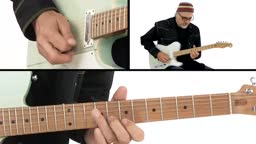
Okay, ladies and gentlemen, boys and girls seeking exotic and outside deviations for your blues nourishment. This particular tune we're going to work on next is a minor blues tune of mine, called—uh—a tune with a basic gist that just goes from A minor seven to D seven. It's like an A minor 11 to a D seven or a D seven over A. What I'm doing here is our first little foray into kind of taking things outside a little bit, or adding some exoticism or exotica. I don't know exactly what that means, but I get asked about this stuff all the time. People ask, "Hey, when it sounds like you're taking things out a little bit, what exactly are you doing?"
Well, there's a bunch of different things, and one of them is as simple as starting a half step below your tonal center, or a half step above, and then resolving to where we're at. So with this particular tune, I can think of a couple of different things, like just a straight A minor pentatonic or a blues, or even a Dorian.
Okay, so if I look at it pentatonic-wise and I'm playing over an A minor seven, I can start and literally do a blues lick a half step down. So there, I started a half step down below from A, so A flat, then back up to A, then to a half step above, back to A again. All right, so: A flat, A, B flat.
Okay. So in concert play, it's the idea of taking the listener on a little ride. You're grabbing them by the ear and they're going, "No, no." Then you resolve, and they go, "Ooh," kind of glad they went on that little trip. Same thing if we do like an A Dorian—if I start a half step down and do A flat Dorian back to a B flat, back to A.
It's an interesting way of breaking things up and adding a bit of ear candy. The theory behind it is not exactly rocket science. You're just literally moving your hand down a half step, going up to the tonic, and then going up a half step and then going back again. You can mix it up as much as you want, doing all that kind of fun stuff. So there you have it. That's the concept of this neighbor tone thing, if you will—half step down, half step above, resolving it to the tonic or the key that you're in, in this case, A minor, going down to A flat, going up to B flat, and going back to A.