
Guitar Zen: Modes

Unleash The Creative Power of Modes

Marty FriedmanTommy EmmanuelSteve VaiEric GalesEric Johnson

Get this course and 1,000+ more with All Access

Try 14 days free. Cancel any time.
Purchase Individual Course for $24.99
Guitar Zen: Modes

About this course

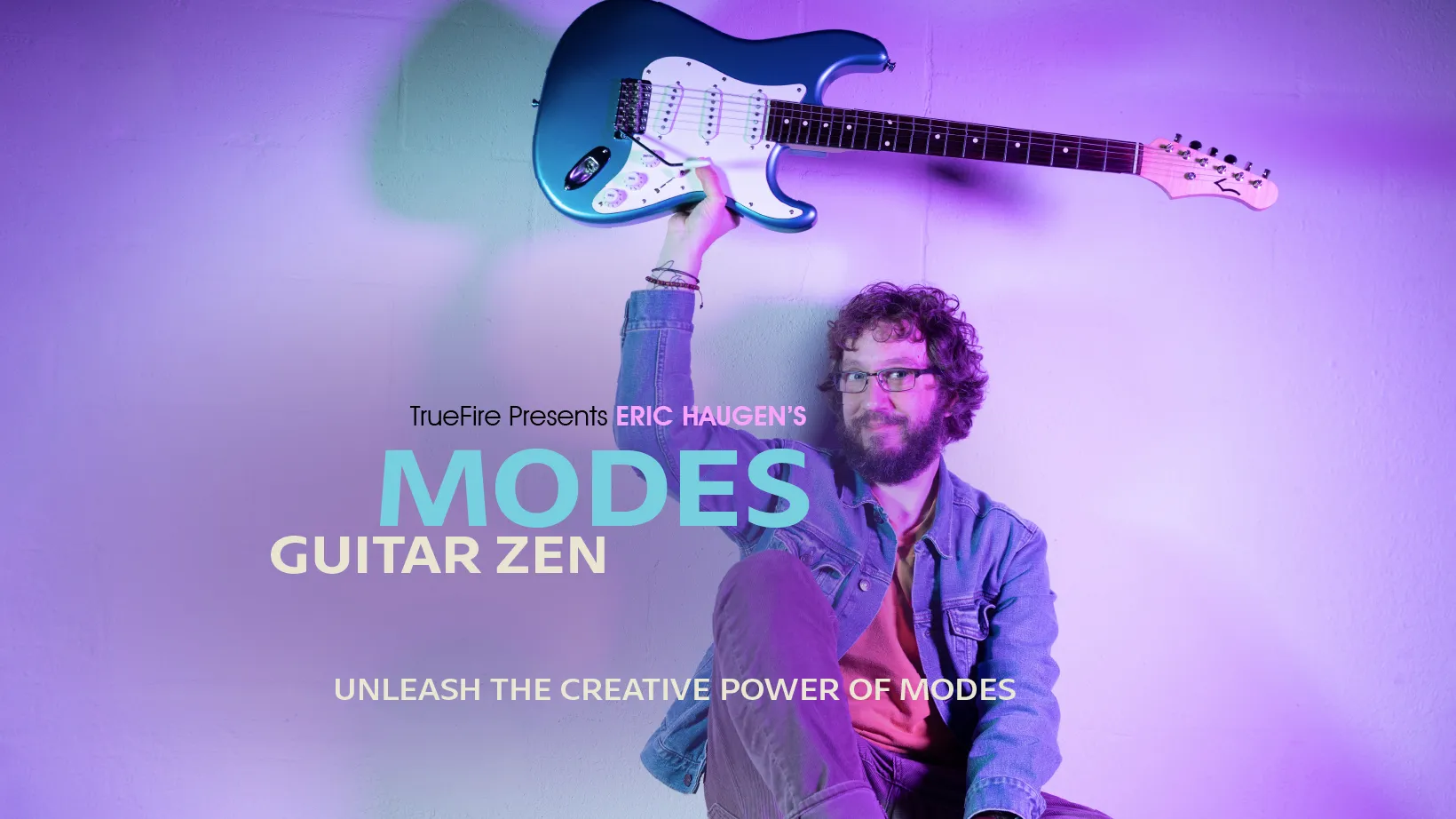
"Unleash The Creative Power of Modes" with Eric Haugen is an enlightening journey into modal guitar playing. Often perceived as complex, modes are easy to understand, learn, and apply in soloing, improvising, and even composing.

True to form, Eric demystifies modes through his extraordinarily popular Guitar Zen methodology to expand your musical knowledge and transform your rhythm and soloing virtually overnight.

” There are seven distinct modes, each with a unique flavor. They can be confusing, but they make sense with a bit of theory and patience. Whether you're using them for rhythm or soloing, the modes offer a treasure trove of sonic possibilities.

In this edition of Guitar Zen, I'll answer the modal questions—all across the neck—so you can play them and feel them.

We'll explore what makes each mode unique and work through interactive studies using backing tracks I crafted to help guide your discovery of simplified modal magic.”


You’ll have TrueFire’s interactive learning tools at your fingertips to customize your workspace and learn at your own pace.

The demonstrations and performances are tabbed, notated, and synced to the video lessons with controls for looping, slow motion, fretboard animation, and other tools designed to accelerate your progress.

You’ll also get the tab and standard notation files to print out, downloadable Guitar Pro files to edit if you desire, and backing tracks to practice and record with.

Grab your guitar, and let’s continue our Guitar Zen learning journey with sensei Eric Haugen!

What you'll learn

  • Navigate E minor scale across the fretboard
  • Play a complete solo study over Em7 to Bm7 changes
  • Create layered guitar parts with palm muting and choke notes
  • Apply 'repeat and add' improvisation technique
  • Visualize CAGED chord shapes while soloing in Lydian mode
Release date: 06/03/2024 • 3h 29m runtime
Start Course
Sample lessons
What Makes an A Dorian Progression?
Concept & Demo
Am7 to Bm7 Dorian Solo Study
Performance
Bm to C Phrygian Solo Study
Overview
Bm to C Phrygian Solo Study
Performance

What's included

49 lessons • 26 charts • 17 Jam Tracks

Guitar Zen: Modes
Hey, I'm Eric Haugen. Do you know what a mode is – sort of but not exactly?? I’m here to help.

There are seven distinct modes, each with a unique flavor. They can be confusing, but with a little bit of theory and patience, they actually make sense. Whether you're using them for rhythm or soloing, the modes offer a treasure trove of sonic possibilities.

In this edition of Guitar Zen, I'll answer the modal questions – all across the neck, so you can not only play them, but FEEL them.

We'll explore what makes each mode special, and work through a series of interactive studies, using backing tracks I crafted specifically for this purpose.

So join me and let’s discover the universe of modal magic, simplified.

Ready to drop in? Let's roll!
SECTION 1: Modes Primer
In this first section of the course, it is a bit of a review, so hopefully, you know some of the stuff, but if you don’t, that's okay. We're going to cover the G major scale and those intervals, the E minor scale and those intervals. Then also, the major key chords in the key of G and the chords in the key of E minor.

This is because these are the baseline layers of understanding major and minor keys. The modes will simply be variations on these themes. Therefore, it's essential to ensure we understand the standard concepts that we're modifying.
What is the New Method?
Here’s the thing. Modes are super cool scales, but they're also chord progressions. This course will cover not only the vibrant melodic aspects of modes, which are truly fascinating, but also, I think, the often overlooked elements—like chord progressions and their unique tonalities.

They have otherworldly implications that are really exciting. You’ll soon see why.
G Major Intervals (CAGED)
In this lesson, we’re going to dig deep into the roots of guitar playing by mastering the G major scale and its intervals. We’ll start with a review to make sure you're solid with the basics, like the G bar chord and the one-octave major scale. Remember, it’s all about associating scales with chords because that’s how I approach playing the guitar.

We’ll explore every note in the major scale, especially those tricky ones like the major 7th, which really wants to resolve back to G. Trust me, once you hear it, you can’t unhear it. We're not just learning scales here; we're learning how they form the backbone of all modes, which are just tweaks of these basic systems. To really get it, we'll practice by grooving through intervals—playing a few notes and resolving them, listening to how they interact, and building an intuitive feel for their relationships. This method isn't just about drilling notes; it's about understanding and feeling the music deeply, so you can play more expressively and creatively. Whether it’s practicing slowly to perfect your technique or exploring the CAGED system to see all chords in new ways, I’ll guide you through each step, making sure you’re not just playing notes but making music.
E Minor Intervals (CAGED)
I this lesson we're going to dive deep into the yin and yang of music, exploring the essential role of minor scales alongside their major counterparts. Understanding these is crucial for mastering modes and music theory in general. Many musicians focus primarily on major scales, but here, we'll embrace the haunting beauty of the minor scale, revealing how its distinct intervals and chord progressions set it apart and create those spine-chilling vibes we all love.

In this course, we'll break down the E minor scale—G major's moody cousin—and compare its intervals directly with the G major to really highlight the differences. For instance, where G major is bright and straightforward, E minor introduces more complex and somber tones with its flat thirds and sixths, perfect for those looking for a darker, more atmospheric sound. Through exercises that groove and resolve, we'll not only learn these scales but feel them, making the connections that turn notes into emotions. Join me as we explore these musical landscapes, connecting theory directly to your fingers and heart in a way that will transform how you play and understand music.
Major Key Chords & Progressions
Hey there! In this course, we're going to dive deep into the magic of the major scale, exploring not just the intervals but also the chords they generate. It's pretty awesome because unlike a monophonic instrument that plays one note at a time, we've got a polyphonic powerhouse here—you get to play chords too! We'll be sticking mainly to the key of G, and I'll show you how each note in this scale forms a chord, from the soothing G major to the intriguing F# diminished.

You'll find it fascinating how shifting around these modes, they might not sound like they're in the key of G at all, but that’s the beauty of music—it’s full of surprises! We’ll also tackle how these chords form the backbone of classic major key progressions. And hey, grab some scrap paper and a pencil—trust me, you’ll want to jot down these nuggets as we go along. Whether it's the straightforward G, D, C progression, or something more nuanced like a G, B minor, C, and back to G, mastering these will not only boost your playing skills but deepen your understanding of how music works. Let’s get those chords ringing and see where they take us!
Minor Key Chords & Progressions
Ready to dive into the world of minor keys with me? In this course, we're going to break down the minor scale and chord progressions like never before. Picture E minor as its own universe, with its own vibe and energy. We're talking about E minor being the one chord, F sharp minor seven flat five as the two, and G becoming the flat three. Trust me, it's a whole new musical landscape.

But hey, don't worry if those flat chords seem like a mystery at first. We'll unravel them together, step by step. And once you grasp them, you'll unlock the secrets of modes like Dorian and Mixolydian. And let's not forget those catchy progressions! From the classic 1-4-1-5 to the soulful 1-flat 6-flat 3-flat 7, we'll explore them all.

So grab your pen and paper, because we're about to embark on a musical journey that'll have you feeling the contemplative essence of minor keys in no time. And who knows, by the end of this course, you might just find yourself jamming out to some Neil Young-esque tunes with a newfound understanding of minor key magic. Ready to dive in? Let's do this!

+ 42 more lessons

Start Course

Reviews

8 results

DanielHolmes

Verified buyer

05/24/26

Guitar Zen: Modes

Eric has an incredible way of explaining the concepts!

Krillmonger

Verified buyer

02/11/26

Excellent course for understanding Modes

Well structured and made me rethink how I approach playing over chord progressions.

sindibad

08/20/24

MODES

With Eric Haugen it's zen, efficient and the modes are very clear. He manages to motivate everyone.

1Candido

Verified buyer

07/29/24

I thought they were called Mopes

Nice explanation with just enough detail to understand a new concept. I like Eric' teaching style. Thanks

swhitney

Verified buyer

07/24/24

Excellent

Anyone who can make Modes and modal changes relaxing and easier to understand is someone who I want to learn from.

Stop searching. Start improving with All Access.

Try 14 days free. Cancel any time.