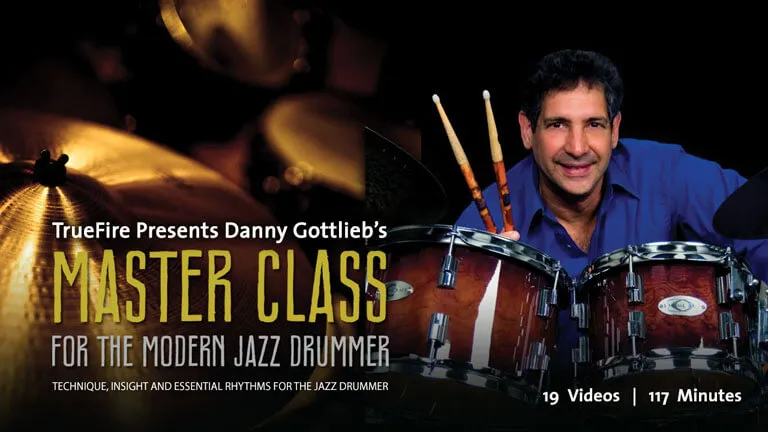
Master Class Drum Lessons

Technique, Insight and essential rhythms for the jazz drummer

Marty FriedmanTommy EmmanuelSteve VaiEric GalesEric Johnson

Get this course and 1,000+ more with All Access

Try 14 days free. Cancel any time.

Purchase Individual Course for $5.00
Master Class Drum Lessons

About this course

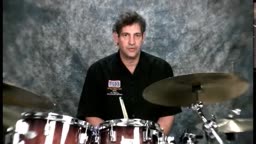
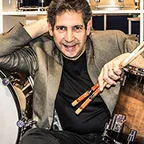
Danny Gottlieb is one of today's most popular drummers in jazz and contemporary music. While best known as the drummer in the original Pat Metheny Group, Danny, during the past 30 years, has performed and recorded with some of the world's greatest musicians: Bobby McFerrin, Sting, Chick Corea, Gil Evans, Gary Burton, John Mclaughlin, Stan Getz, Jeff Berlin, Pat Metheny, David Byrne, Herbie Hancock, Wayne Shorter, Gerry Mulligan, Clark Terry, Al DiMeola, The Blues Brothers Band, Booker T and the MG's, Lew Soloff, and many more. He is featured on more than 300 CDs to date, including four Grammy Award Winners.

"One of my most important mentors has been the legendary drummer and educator, Joe Morello. Most of the technical concepts in this instructional course are based in his teachings. Joe, in turn, studied with George Lawrence Stone, the author of the famed instructional text, Stick Control, and many of HIS teachings are based in Mr. Stone's concepts. I also refer to some of my other teachers; Mel Lewis, Bob Moses, Ed Soph, Airto Moreira, Jack De Johnnette. In reality, this course is a tribute to these great teachers, and my interpretation of their concepts."

Gottlieb's Master Class for the Modern Jazz Drummer covers a comprehensive range of tips, techniques and insight across its 117 minutes of video instruction. Intermediate to advanced drummers will be exposed to dozens of methods for holding the sticks, working with brushes, hi-hat and bass drum techniques, and best approaches for nailing jazz, rock, swing, Latin and Brazilian rhythms. Gottlieb has prepared dozens of exercises with practice audio tracks along with point-by-point study tips and a text guide.

"It is my goal, through this amazing medium, to provide you with some helpful ideas based in my 30-plus years of drumming, studying, and teaching. It's really an endless study, and as you will be able to tell from the examples I provide in this course, I have been unbelievably lucky to have become friends with and study with some of the greatest drummers in history. It thrills me to now be able to share this collective of knowledge with you."

What you'll learn

  • Apply appropriate bass drum technique for different musical styles
  • Use song melodies and bass lines as frameworks for soloing
  • Construct solos using call and response phrasing
  • Learn when to use heel-down vs heel-up technique
  • Develop authentic swing feel in drum solos
Release date: 02/08/2011 • 1h 57m runtime
Start Course
Sample lessons
Controlled Stroke
Controlled Stroke
Four Key Tips
Moeller Stroke
Moeller Stroke
Whipping the stick
The Hi Hat
The Hi Hat
Three Key Tips
The Bass Drum
The Bass Drum
Staccato and Feathering

What's included

19 lessons • 13 charts • 5 Jam Tracks

Introduction
In this segment, I talk about my background, history, and provide a basic introduction to the course. I have been playing drums for over 30 years, and one of my most important mentors has been the legendary drummer and educator, Joe Morello. Most of the technical concepts in this instructional course are based in his teachings. Joe, in turn, studied with George Lawrence Stone, the author of the famed instructional text, Stick Control, and many of HIS teachings are based in Mr. Stone's concepts. In reality, this course is a tribute to these two great teachers, and my interpretation of their concepts. For further information concerning the technical aspects of this course, please use as an additional reference, Joe Morello's texts, Master Studies Vol. 1 and 2.

In addition, I also refer to some of my other teachers; Mel Lewis, Bob Moses, Ed Soph, Airto Moreira, Jack De Johnnette. I encourage you to check out their many recordings, videos, and educational works. I also describe my background as a student at the University of Miami. I now use many of my college experiences as a guide for my own teaching at the University of North Florida, in Jacksonville. Please feel free to visit the school website, unf.edu, where you can find background on all instructors, and some of the teaching concepts that I use for private students (many of which are contained in this course).

Lastly, after learning about my background, you can see that I enjoy playing many different types of music, and I use the techniques and musical approaches described in this course constantly. It is my goal that the information contained in this course will provide you with some helpful tools, and useful information that will help you in your own musical adventures. All the best of luck, and, again, I hope you enjoy this course.

Special thanks to Brad, Ali and all at TrueFire; Joe Morello, Winnie and Robert at Drum Craft; Sarah, Joe, and John DeChristopher at Zildjian, Kevin and crew at Hot Sticks; Dave at Off World Percussion; Garrison, John, and Don at DW; Bruce and Michelle at Remo; John and Polly at Hammerax; Joe and Pam at Eames Drum Shells.
Holding The Sticks
One of the great things I learned in my studies with Joe Morello is a definitive concept on how to hold the sticks. As Joe explained years ago, most drummers, when asked how they hold the sticks, show a grip, but don't have a real explanation of why they are holding the sticks a particular way. "My teacher showed me", or "It feels good", or "I saw it in a picture in a book", or "I saw another drummer playing this way" are usual answers. All are valid to a point, but don't really explain specifically why you would hold a stick from an anatomical or logical standpoint. This segment deals with the analysis of the method I use, and the logic behind it. When I show it to my students, most are thrilled with the understanding of the concept, and are thrilled with the results. Others, though, appreciate the approach, but choose to do their own modifications. It's up to you, but when you find that you are having problems improving your technique, or are having pains or tension, this is a good reference for self analysis of your approach. It does work for me, and I am so happy that I have a method of holding the sticks that I can define.

Major points:
1. Very relaxed
2. Joe Morello's Natural Drumming approach
3. No tension with waving motion
4. Hold stick the way the hand moves without the stick
5. No squeezing or tension
6. Allow wrists to move freely
7. Space between thumb and first finger, no squeezing
8. Relaxed method, not a drum corps approach
9. Hold stick in crease of first finger
10. Keep fingers on the stick, so you can use the fingers
11. First finger over the stick as contact point
12. Bottom fingers used as buffer
13. Traditional of Matched? Your choice
14. Mel Lewis felt traditional grip was more loose, jazz oriented.
15. More power when wrists are flat (as opposed to French grip)
16. Most important: No squeezing, no tension!!!!!
Full Stroke
The Joe Morello/Stone approach uses a level system. Dynamics are played by starting at different heights, as opposed to hitting the drum harder, or squeezing. The grip at a low volume is basically the same as at a louder volume - it just starts at a higher position from the snare. But, many people do not use this approach. As I describe in this segment, when you analyze your own stroke by playing left and right very slowly, most drummers start low and raise the stick up before you make the stroke, or one goes down as the other goes up. With this method, you pick a distance from the drum, throw the stick down, and as Joe Morello describes, you ACCEPT the rebound by allowing the stick to bounce back to the starting position.

Joe divides his technical approach to the snare drum into wrist, arms and fingers. The FULL Stroke relates to the full range of motion using the wrist. You start in a ceiling position (straight up and down), and stick the drum and allow the stick to return back to the starting position.

Major Points:
1. The first stoke we study is the Full Stroke. Start with stick in ceiling position, throw stick down, accept rebound back to starting position
2. Don't bring stick back, allow stick to rebound. Think only down
3. Loudest wrist stroke. Full Range of motion
4. No squeezing
5. According to Joe Morello, Full Stroke does three things: Loosens the muscles; develops reflexes, develops consistent (loud) sound

Practice Exercises:

Use the following four exercises to develop the full stroke. Use Mr. Stone's Stick Control for further study. (and Joe Morello's Master Studies Vol 1 and 2 as mentioned)

Study Tips:
1. Start slowly, make sure sound is consistent
2. Watch movement in a mirror
3. Start at Ceiling position, allow stick to rebound back to starting position
4. Watch tips of sticks to make sure each full stroke starts at same spot
5. Important…..No windup before each stroke. Make sure each strokes goes down and back freely
6. No squeezing, no tension
7. Use metronome to increase tempo gradually. Make sure you have control of each stroke
Half Stroke
The Half Stroke is made by starting the stroke from a 6" or 9" level above the drum, and is used to maintain a consistent dynamic (from half of the distance of the full stroke) as well as develop your reflexes. As with the FULL Stroke, make sure that both hands are relaxed. The motion is made by starting at the "6 or 9" level, with no preparatory upstroke. You only think "down", and then accept the rebound, and allow the stick to come back to the starting level. As Joe Morello states, "It's like bouncing a ball". If the sticks are pitched the same, and you start at exactly the same distance from the drum, the dynamic sound from both hands should be very similar. Of course, if you play traditional grip, and hold one hand with a traditional grip, and the other with matched, there might be a slight sound difference that can be adjusted as you practice. By starting at the same level, the sound should be almost identical from one hand to the other.

Major Points:
1. Start 6" or 9" above the drum, half the distance between your full range of motion (Full Stroke)
2. No preparatory upstroke
3. Think "down" and allow the stick to rebound to the starting level

Practice Exercises:

The first four exercises are similar to those in the Full Stroke section, although these are played at half the dynamic level (and have no accents marked). The other exercises provide additional practice in the development of a consistent and even half stroke.

1. Exercises 1-8 should be practiced until mastered.
2. Exercises 9-12 are Joe's "Stone Killer". He suggests practicing each exercise 50 times.
3. Exercise 13 consists four combinations back to back to be used in developing even strokes and a consistent sound from each hand.

Study Tips
1. Watch your hand position in a mirror, making sure both hands start at the same level
2. Make sure you do not raise the stick before starting your downward motion
3. Practice slowly at first, make sure all strokes are even, and that the FORM is correct
4. Use a metronome, and keep a record of your practice time and tempos
5. Practice the exercises until they can be played with an even sound and control at all tempos
Controlled Stroke
This segment deals with a method of going from soft to loud and loud to soft dynamics with total control and relaxation. There are two main strokes used; a down stroke and an up stroke. Again, it comes from Joe Morello and George Lawrence Stone's natural approach. There is no tension, just positioning of the hands to control the dynamics. The down stroke allows you to throw the stick down and stop at a lower level position, allowing for a complete change in dynamics with control. The up stroke allows you to gently move the stick from a low position back up to a louder dynamic level with complete control, with no tension. It is different from making a preparatory stroke as an "up – down motion". This is a preparatory stroke, and if you were to stop the stick before making the loud sound, the stick would be back in a Full stroke position. For practice purposes, we are using these two dynamics-loud and soft, but in reality, you can use this level control system to play dynamics at any volume.

Major Points:
1. Down Stroke: start at Full stroke position: throw stick down and instead of accepting the rebound, stop at the new, lower position
2. Up stroke: Make a stroke from the lower position (without a wind up, or preparatory stroke - no lifting!), and then gently follow the stick back and bring it up to the full stroke position
3. There should be no tension when you bring the stick back to the full stroke position
4. There should be no tension when you stop the sick at the lower level by not accepting the rebound

Practice Exercises:
1. These five exercises illustrate both the down stroke and the up stroke
2. Exercise one contains four loud strokes, followed by four soft strokes
3. Exercise two is a paradiddle with the accent on the first beat
4. Exercise three is the bossa nova rhythm in single strokes
5. Exercise four is the Brazilian Bossa Nova rhythm in double strokes
6. Exercise five is the Brazilian Bossa Nova rhythm in a paradiddle sticking

Study tips:
1. You will note that in addition to the right and left hand stick markings listed under each exercise, hand position markings are also included.
2. F=Full stroke
3. T=tap, or half stroke
4. D=Down stroke
5. U= Upstroke
6. Use a mirror to watch hand positions. Make sure each stroke is accurate and controlled
7. Practice slowly at first, using a metronome for accuracy and to gauge progress
8. Recite the stroke names aloud as you make each stroke ("Right, Down, tap", etc)
9. You can play exercises 3-4-5 back to back without stopping
10. Use George Lawrence Stone's "Accents and Rebounds", or Joe's Master Studies Vol. 1 and 2 for further study
Moeller Stroke
Many students think the Morello/Stone method is the Moeller method, but in reality the Moeller Stroke is a completely different stoke. As Joe Morello explains in his teachings, the Stone method is basically "the shortest distance between two points is a straight line". It is made but starting at a specific distance from the drum. The Moeller stroke, however, uses a whipping motion. The stroke starts down near the drum surface and involves whipping the stick with the forearm and elbow, which after getting a single accent creates multiple rebounds. The Moeller is great for single accents, but cannot be used for multiple accents. It is mainly played in three or four note groupings, but can be used in two, five, six or seven note groupings as well.

Major Points:
1. Use Whipping Motion to create one accent and multiple rebounds
2. Can be used in groups of two, three, four, five and six notes
3. Elbow hits body early during motion, like a flam
4. Different than Stone Method, as you can NOT play multiple accents
5. Works well with single stroke rolls
6. Works well with vamps from hand to hand

Practice Exercises:
1.These exercises show a variety of ways to use the Moeller Stroke

Study Tips
1. Watch video clips, and then watch yourself in a mirror. Try to imitate left and right hand motions
2. Arm motion is not so dramatic at lower volumes. Again, watch motion in a mirror
3. Use Joe Morello's Master studies for further study and exercises
Brush Technique
There are many ways to play brushes, and this clip illustrates my approach. I play with traditional grip, and I move "out - in" with left hand. The left hand makes kind of an egg shell movement, and the right hand plays time, just like a ride cymbal. The right hand crosses over the left when playing time, mainly on two and four. The hi hat is mainly played on two and four, but can also be changed for comping, and depends on the music you are playing. The bass drum, as illustrated, is feathered lightly on all four beats when playing time.

Major Points:
1. Left hand - out and in
2. Right Hand - time and main accents
3. Hi Hat - two and four, with variations
4. Bass Drum feathered on all four beats softly and used for accents

Exercises
These two simple time exercises should be practiced and mastered at all tempos

Study Tips
1. Watch the video and emulate movement
2. Listen for consistent brush sound and time feel
3. Listen to master brush players: Tony Williams, Jack De Johnette, Jeff Hamilton, Jimmy Cobb, Joe Morello, Buddy Rich, Clayton Cameron, Paul Motian, etc.
4. Use Morello method for brush dynamics and developing of the reflexes
5. Watch your hand movements in a mirror

+ 12 more lessons

Start Course

Reviews

10 results

Mathew w.

08/06/22

most excellent

wonderful course, clear simple explanations, very useful. hopefully more to follow

surfsup

Verified buyer

07/01/20

Great Information and technical demonstration by Danny Surfsup

Stephen B.

04/10/20

Good drum course - also good for guitar players

Am primarily a classical guitar player, but played the drums back in grade school. Checked out this course in the name of nostalgia and because I recently acquired an electronic drum kit (so the neighbors don't shoot me) and needed some material to help me get back into it. This course fit the bill to a tee, and I am starting to get back some (grade-school level) chops on the drums. It's been a lot of fun working through the ideas in this course using matched grip as well as the traditional grip I learned with back in the day. Danny Gottlieb is a clear communicator with a wealth of knowledge and as a result this is a good course on a number of aspects of technique and it contains a lot of useful tips and reference points for intermediate or returning drummers, particularly in the jazz idiom. I expected that. Less expected was the effect this is having on my guitar playing - I feel like it is improving my timing in a subtle but noticeable way, and I find that more creative applications, trying to turn an ensemble rhythm from the drum kit into something that you can execute on the guitar, is very educational. Likewise, I feel that the focus drumming practice puts on making the non-dominant hand an equal partner is making a bit of an improvement at my efforts at piano playing, where my left hand has always been less solid and less independent than I would like. It would be great to see more drumming courses on Truefire - I would particularly love to see a course that covers the rudiments, stick control, and syncopation and accents, as well as a course that explores how different musical genres have their rhythmic characteristics implemented. A course on rhythmic solfege (e.g. takadimi or the Carnatic tradition) would also be most useful to drummers and guitarists alike, I suspect. In the meantime, back to work on the material in Danny Gottlieb's excellent course in jazz drumming.

PSchwander

Verified buyer

11/15/19

Great course

I am not a drummer, but I very much enjoy Danny's course. Highly recommended!

58smitty

Verified buyer

01/07/19

A Great Course!

I'm a new drummer and there is a lot of great stuff in here. C'mon Truefire, more drums please.

Stop searching. Start improving with All Access.

Try 14 days free. Cancel any time.