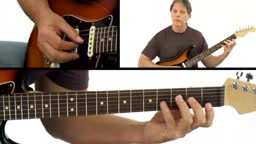
In this first volume of i to V7 vamps, you'll explore a powerful approach to voice leading, learning to use each string as a melody note when connecting your chords. The voicings and fingerings in these 15 studies can be used in almost any musical setting from rock and pop to funk and jazz, but you'll also explore exotic flamenco sounding palettes in this pack as well.
About the Chord Studies Series
If Forest Gump’s shrimp-loving Bubba played guitar, his take on chords might go something like this, ”You can strum ‘em, fingerpick ‘em, arpeggiate ‘em, mute ‘em, alternate tune ‘em, voice lead ‘em. Dey’s uh, barre chords, altered chords, extended chords, moveable chords, cluster chords, slash chords, inversions, triads, diads. There’s jazz chords, power chords, blues chords, cowboy chords, block chords, open chords…”
Bubba would be right — there’s a wide and wonderful world of chords for we guitarists to explore. But what’s the best way to do that? Chord dictionaries might be handy references but there’s no context (and really, when’s the last time you looked at one of those?).
Theory and harmony instructionals are filled with chord construction strategies and applications and we highly recommend digging as deep into the science of chords as your left brain will allow you.
However, learning new chords, progressions, applications and right-hand techniques in a musical context (songs, etudes, jamming with other players, etc.) is the most popular approach and that is the educational premise behind Brad’s Carlton’s Chord Studies course seres.
Each edition of Chord Studies features 15 play-along and jammable chord studies, which are focused on a particular chord type, chord progression or chord application. While Brad does touch on rhythmic qualities, this is not a rhythm guitar course — these studies are specifically designed to significantly expand your chord know-how and vocabulary.
Brad covers a range of styles, levels , chord types and progressions across 10 editions: CAGED Chords, Jazz Blues Progressions, Open String Chords, Rock and Pop Progressions, Slow Blues Progressions, Evolving Blues, Evolving Triads, Slash Chords, Power Chords and Beginner Chords.
Each of the 15 Studies within an edition includes an overview from Brad followed by a performance and play-along of the chord study over a rhythm track. Chord grid charts and a chord lead sheet accompanies each study. Plus, you’ll get all of the practice rhythm tracks to work with on your own.
Reference the chord charts to become familiar with the voicings and their fingerings, and then use the lead sheet to play-along with Brad’s video performance. Try different rhythmic patterns over the supplied rhythm tracks and then take it all to your own playlist of songs and jam tracks.
What you'll learn
Play extended chord voicings in 10th position
Apply voice leading principles to chord progressions
Control which strings ring out in complex chord voicings
Understand the intervallic relationship between chord tones (minor ninth)
Understand how minimal finger movement creates smooth transitions
In this first volume of i to V7 vamps, you'll explore a powerful approach to voice leading, learning to use each string as a melody note when connecting your chords. The voicings and fingerings in these 15 studies can be used in almost any musical setting from rock and pop to funk and jazz, but you'll also explore exotic flamenco sounding palettes in this pack as well.
In this first volume of i to V7 vamps, you'll explore a powerful approach to voice leading, learning to use each string as a melody note when connecting your chords. The voicings and fingerings in these 15 studies can be used in almost any musical setting from rock and pop to funk and jazz, but you'll also explore exotic flamenco sounding palettes in this pack as well.
This progression is in the key of A minor. We're starting on Am our I chord and then moving to the V chord which is E7. Notice how on the second time through we re-voice the E7 chord. This brightens the chord up because we've got the ♭7, the D note on the second string.
This progression is in the key of A minor. We're starting on Am our I chord and then moving to the V chord which is E7. Notice how on the second time through we re-voice the E7 chord. This brightens the chord up because we've got the ♭7, the D note on the second string.
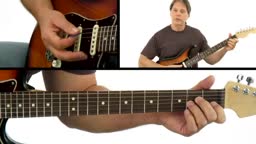
Our progression here is still Am to E7, but we're creating some variety here. Going from Am9 to Am notice we've got the melody of B moving down A on the third string. We're doing the same thing going from E7♭9 to E7, creating an almost dialogue-like melody.
Our progression here is still Am to E7, but we're creating some variety here. Going from Am9 to Am notice we've got the melody of B moving down A on the third string. We're doing the same thing going from E7♭9 to E7, creating an almost dialogue-like melody.
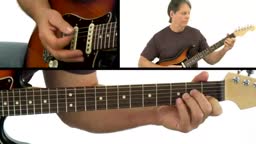
Here we have our Am to E7 move again and we're gonna keep our little melodic motive we developed in the last lesson present. It may be a bit of a challenge on the E7♯9 to grab the first string without moving other fingers and getting unwanted muting. Collapse the joint in your pinky to facilitate grabbing the G note while keeping your hand in one place.