Chord Studies: CAGED Chords Vol. 1

Theory and harmony instructionals filled with chord construction strategies and applications

Marty FriedmanTommy EmmanuelSteve VaiEric GalesEric Johnson

Get this course and 1,000+ more with All Access

Try 14 days free. Cancel any time.

Purchase Individual Course for $9.99
Chord Studies: CAGED Chords Vol. 1

About this course

In the same way that you barre the open E and open A chord shapes to craft major chords up and down the neck, the CAGED chord system also provides for open C, G and D chord shapes. Mastering the system delivers economy of motion, new voicing and a much wider range of chord colors and textures.

About the Chord Studies Series

If Forest Gump’s shrimp-loving Bubba played guitar, his take on chords might go something like this, ”You can strum ‘em, fingerpick ‘em, arpeggiate ‘em, mute ‘em, alternate tune ‘em, voice lead ‘em. Dey’s uh, barre chords, altered chords, extended chords, moveable chords, cluster chords, slash chords, inversions, triads, diads. There’s jazz chords, power chords, blues chords, cowboy chords, block chords, open chords…”

Bubba would be right — there’s a wide and wonderful world of chords for we guitarists to explore. But what’s the best way to do that? Chord dictionaries might be handy references but there’s no context (and really, when’s the last time you looked at one of those?).

Theory and harmony instructionals are filled with chord construction strategies and applications and we highly recommend digging as deep into the science of chords as your left brain will allow you.

However, learning new chords, progressions, applications and right-hand techniques in a musical context (songs, etudes, jamming with other players, etc.) is the most popular approach and that is the educational premise behind Brad’s Carlton’s Chord Studies course seres.

Each edition of Chord Studies features 15 play-along and jammable chord studies, which are focused on a particular chord type, chord progression or chord application. While Brad does touch on rhythmic qualities, this is not a rhythm guitar course — these studies are specifically designed to significantly expand your chord know-how and vocabulary.

Brad covers a range of styles, levels , chord types and progressions across 10 editions: CAGED Chords, Jazz Blues Progressions, Open String Chords, Rock and Pop Progressions, Slow Blues Progressions, Evolving Blues, Evolving Triads, Slash Chords, Power Chords and Beginner Chords.

Each of the 15 Studies within an edition includes an overview from Brad followed by a performance and play-along of the chord study over a rhythm track. Chord grid charts and a chord lead sheet accompanies each study. Plus, you’ll get all of the practice rhythm tracks to work with on your own.

Reference the chord charts to become familiar with the voicings and their fingerings, and then use the lead sheet to play-along with Brad’s video performance. Try different rhythmic patterns over the supplied rhythm tracks and then take it all to your own playlist of songs and jam tracks.

What you'll learn

  • Play chord progressions without large position shifts
  • Apply CAGED/EDCAG system to find multiple chord voicings
  • Navigate a 6-5-4 progression using system-based thinking
  • Identify which chord forms work in specific fretboard positions
  • Develop proper finger angles for complex chord voicings
Release date: 09/05/2014 • 1h 08m runtime
Start Course
Sample lessons
CAGED Chords Vol. 1
CAGED Chords Vol. 1
Overview
C Form For All
C Form For All
Overview
C Form For All
C Form For All
Playalong
C Minor For All
C Minor For All
Overview

What's included

32 lessons • 15 charts • 15 Jam Tracks

Chord Studies: CAGED Chords Vol. 1
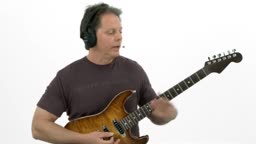
Hi this is Brad Carlton. Welcome to this Guitar Lab edition focused on CAGED chord applications. Each individual edition in this guitar lab series features 15 studies focused on a particular application of chords. I designed this series to provide you with unlimited, creative options for crafting interesting and compelling rhythm guitar parts. Across the series we'll explore essential and exotic chord voicings, all-purpose substitutions, creative approaches, and performance techniques. In this group of lessons, we're going to be applying the CAGED system and the EDCAG system of chord voicings to accomodate three different progressions. Our first progression will be A to G. Our second progression will be A minor to B minor. Our third progression will be B minor, A, and G. I'll break down and demonstrate the chord studies over rhythm tracks in a variety of styles. Using chord progressions commonly encountered in that style. You'll also get chord diagrams that'll clearly give you the left-hand fingerings, and you'll get the jam tracks for you to work with on your own. So get your guitar and let's make some music.
CAGED Chords Vol. 1
In this group of lessons we're going to be applying the CAGED system and the EDCAG system of chord voicings to accommodate three different progressions. Our first progression will be A to G. Our second progression will be A minor to B minor. And then we're going to mix it up and include both qualities. Our third progression will be B minor, A, and G. Now the CAGED system is simply derived from your five folk forms. C, A, G, E, and D. You know these chords if you play a C chord. An A chord. A G chord. An E chord. And a D chord. So what we do is that you utilize your index finger to function as a capo, which allows you to take those forms, or fingerings, and move anywhere you need to find the chord that you need. The EDCAG system does the same thing with minor forms. So the beauty of this is is you're going to learn how to play and keep your hand in one place, as opposed to always shifting around with just a bar chord, which doesn't allow you to get good voice leading. Now I'm also going to talk briefly about some technical tips as you go through these exercises and these progressions. The first thing is to stay relaxed, unless you're actually sounding a chord. Amazingly, most people have a hard time doing this. So practice deadening the strings when you're forming the chord. Don't squeeze right away. Just get your fingers in place. And that's your default hand position, unless your actually sounding the chord. You then squeeze, and then practice releasing so that the strings lift themselves up off the frets. We do change positions. If you have to use the same form don't change anything with your thumb or your forearm and your wrist. Just move and don't let things start changing in terms of angle. And finally, two very important fingering principles in playing the guitar. A pivot finger, which is defined as the same finger, same string, same fret. It can shift within the fret, within the space between the frets, but you don't pick it up. So what does that do? It stabilizes your hand. And finally guide fingers. Now guide rhymes with slide. So a guide finger would be, fore example, if I play an A minor chord with these three fingers and then I'm going to move up a whole step, why would I pick up my second, third, and fourth fingers? I relax them and then they just glide on the strings. And you see the benefits. You have a point of reference. You're not picking your fingers up off the strings, and it also does this. It keeps things quiet. It mutes the strings in between your chord changes. Keep your ears open. Watch for your intonation. You want clarity. And also dampen, so you don't get those open strings ringing in between your chord changes.
C Form For All
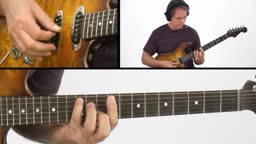
In this example we will be applying the open C chord form out of the CAGED system to play both an A chord in the ninth fret and a G chord in the seventh fret. Each chord will be played for four beats. Because both chords in this sheet use the same form, the important thing to remember is that all four fingers work as guide fingers, sliding between positions with a light enough pressure to avoid squeaks, but enough to maintain contact with the strings.
C Form For All
In this example we will be applying the open C chord form out of the CAGED system to play both an A chord in the ninth fret and a G chord in the seventh fret. Each chord will be played for four beats. Because both chords in this sheet use the same form, the important thing to remember is that all four fingers work as guide fingers, sliding between positions with a light enough pressure to avoid squeaks, but enough to maintain contact with the strings.
A Form For All
This example applies the A chord form out of the CAGED system to play both an A and a G chord. Each chord is played for four beats, so start out simple enough to make the changes clean and then start to introduce more rhythmic variation. Note that the A chord in the 12th fret is the octave of the standard open position A chord.
A Form For All
This example applies the A chord form out of the CAGED system to play both an A and a G chord. Each chord is played for four beats, so start out simple enough to make the changes clean and then start to introduce more rhythmic variation. Note that the A chord in the 12th fret is the octave of the standard open position A chord.
G Form For All
This example applies the G form out of the CAGED system to play both an A and G chord. When you play the A chord with the G form, it is suggested you go ahead and bar all six strings, just as if your first finger is functioning as a capo. That will bring your second, third, and fourth fingers into a more upright posture and make fretting the right notes easier for your fretting hand.

+ 25 more lessons

Start Course

Reviews

7 results

TheEdge92

03/13/22

CAGED in bite size

Great nuggets of CAGED

bouncerec

Verified buyer

03/12/21

Great intro to this world

wholmer

12/27/20

Best class I have taken for the Caged System

I give this class 5 stars because I have had trouble in the past trying to learn chords and strumming progressions all over the neck. The structure is well planned and progress is from easy to not so easy but you are ready for it if you follow along and practice!

hooty29340

Verified buyer

10/11/20

Fantastic Barre Chord study for Major and Minor chords

Brad shows us the barre chords up and down the fretboard with many common questions answered and methods shown. I have been playing for over 40 years and have learned a lot from this. The more you know and can play the more you will be desired by others to play with them. Knowing barre chords enable you to jump from what others are playing (cowboy/folk chords) without the fuss of grabbing a capo. Very good course to learn from on using common chords in barre forms. A+

rdanielhogan

06/25/20

Not all Useful

Good basic primer on CAGED and EDCAG (the minor version of CAGED) chords. However, a lot of the shapes used are not particularly useful, and most people would not fret a whole G shape, or the D minor shape. But, you can just use abridged versions of the chords.

Stop searching. Start improving with All Access.

Try 14 days free. Cancel any time.