




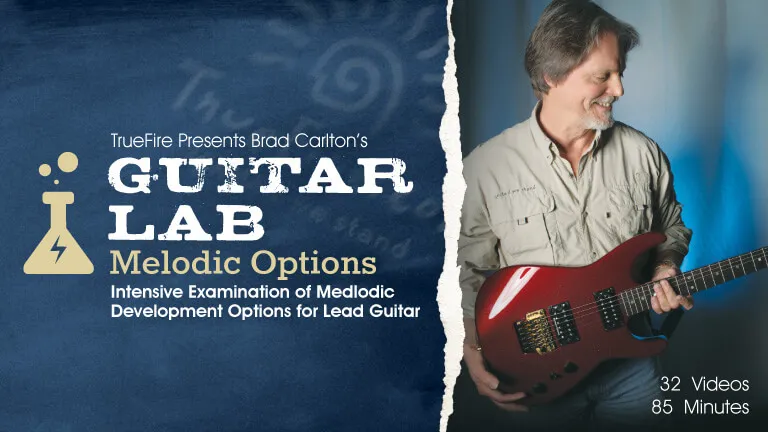





Guitar Lab: Melodic Options

Intensive Examination of Melodic Development Options for Lead Guitar

Marty FriedmanTommy EmmanuelSteve VaiEric GalesEric Johnson

Get this course and 1,000+ more with All Access

Try 14 days free. Cancel any time.

Purchase Individual Course for $5.00
Guitar Lab: Melodic Options

About this course

This course is designed to increase your awareness of the various ways a melodic line can be played on the guitar. You'll be presented with 15 variations of an ascending melody and six variations of a descending melody in the key of E over a I - V - IV progression. These examples will utilize thirds, sixths, octaves, pedal tones, legato and staccato phrasing, hammer-ons, pull-offs, harp style effects, octave displacement, bends, prebends, releases, and contrapuntal lines as a means of creating different variations.

You'll then be given five motifs to develop variations of your own using the tools presented in this course. All theory relevant to this progression will be explained and charted out on fingerboard diagrams, and you'll receive a jam track which will support all the examples in this course, as well as the ones that you'll be creating.

What you'll learn

  • Create singable, musical melodic lines
  • Apply staccato articulation to melodic motifs
  • Learn to strengthen melodic lines by moving toward chord tones using scalar approaches
  • Develop ability to improvise without repeating yourself
  • Develop motifs through articulation changes
Release date: 10/01/2015 • 1h 25m runtime
Start Course
Sample lessons
Melodic Motif #2
Melodic Motif #2
Demonstration and Breakdown
Melodic Motif #8
Melodic Motif #8
Demonstration and Breakdown
Melodic Motif #13
Melodic Motif #13
Demonstration and Breakdown
Eadd9 Arppeggio
Eadd9 Arppeggio
Demonstration and Breakdown

What's included

32 lessons • 31 charts • 1 Jam Tracks

Guitar Lab: Melodic Options

This course is designed to increase your awareness of the various ways a melodic line can be played on the guitar. You'll be presented with 15 variations of an ascending melody and six variations of a descending melody in the key of E over a I - V - IV progression. These examples will utilize thirds, sixths, octaves, pedal tones, legato and staccato phrasing, hammer-ons, pull-offs, harp style effects, octave displacement, bends, prebends, releases, and contrapuntal lines as a means of creating different variations.

You'll then be given five motifs to develop variations of your own using the tools presented in this course. All theory relevant to this progression will be explained and charted out on fingerboard diagrams, and you'll receive a jam track which will support all the examples in this course, as well as the ones that you'll be creating.

Jam Track Analysis pt. 1
The jam track that we'll be using is based on a 2 bar chord progression in the key of E major with a I - V - IV progression. In the accompanying video for this particular lesson, I'll explain the theory of how these diatonic chords are built and also the potential for extending any chord while still remaining in the key.
Jam Track Analysis pt. 2

The progression that you'll be playing over for this entire course is I - V - IV in the key of E major. Examples 1a and 1c present the chord voicings, which include power chords, sus2 structures, add9, and add4 voicings. Examples 1b and 1d depict the rhythm that you will play when playing the chord voicings along with the jam track. I'll explain the strum pattern in example 1d in depth in the accompanying video.

Melodic Motif #1

Example 2 is the motif that we'll be using for the next few lessons. It's simply an E major scale starting on the root, ascending up to the 6, and then returning back to the 4. In the video I'll explain the rhythm of this particular melodic line.

Melodic Motif #2

Example 3 applies staccato phrasing to the same line that you used in the previous lesson. Articulation is a powerful tool for creating variety in your melodic lines.

Melodic Motif #3

Example 4 applies legato phrasing to the same melodic line by using hammer-ons and pull-offs.

Melodic Motif #4

Example 5 applies an auxiliary descending melodic line, which through the use of the "let ring" technique creates double stops in three locations of this melody.

+ 25 more lessons

Start Course

Reviews

1 result

Jeffochka

10/27/18

Master Melodies

I would recommend this course in tandem with Brad Carlton’s Melodic Patters, which is equally awesome. You get a wealth of material in both courses. The focus in this course is learning to play ascending and descending melodies over a I – V – IV progression. It’s in the key of E, which should be familiar territory for any rock and/or blues player. He covers a lot here: thirds, sixths, octaves hammer-ons, pull-offs, bends, and my personal favorites: legato and staccato phrasing. You get soundtracks and then Brad ends off with 5 melodic examples. Very well done!

Stop searching. Start improving with All Access.

Try 14 days free. Cancel any time.