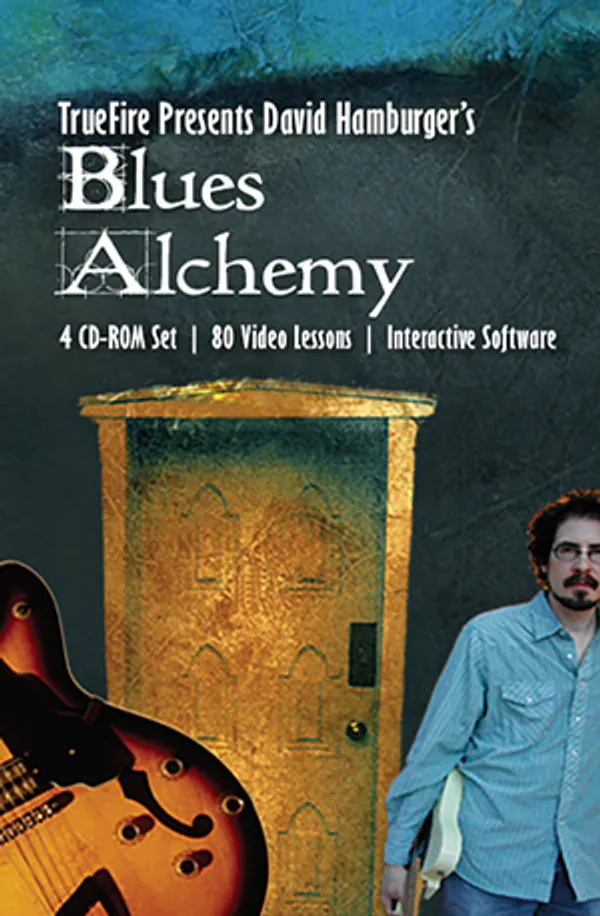
As American roots music became electrified in the years after World War II, blues musicians in thriving urban centers like Chicago and Los Angeles began transforming earlier, prewar blues sounds into a variety of vibrant, groove-oriented styles. The innovative sounds and vocabularies first waxed by icons like T-Bone Walker, Muddy Waters, Lightnin' Hopkins and Ray Charles in the 1950s still form the foundation of every modern blues musicians' sensibilities.
In David Hamburger's Post War edition of Blues Alchemy you'll play your way through eight essential ‘Post War' grooves, while learning how to combine the fundamental pentatonic blues vocabulary with more sophisticated approaches for soloing and playing the changes.
”In my Post War edition of Blues Alchemy, you'll learn how to use eight classic 1950's blues grooves as jumping-off points for your own improvising. Whether the chord progression is a one-chord Howlin' Wolf vamp or a sophisticated Ray Charles-style blues ballad, you'll learn how to transform your basic pentatonic moves with a combination of double stops, open position licks, swing phrasing, and jazz chromaticism so you can play through the changes while staying true to the feeling of the blues.”
For each of the eight Performance Studies, David not only presents a solo for you to learn, he'll also give you alternative licks, approaches and techniques to incorporate into your improvisations. David demonstrates all of the Performance Studies over rhythm tracks and then breaks them down by stepping you through the key concepts and techniques employed in the solo.
Your first Performance Study is called Chesterpiece, a Howlin' Wolf-style one-chord vamp in the key of G. Next up, you'll explore a T-Bone Walker-inspired jump blues called Texlahoma. In Rushmore, you'll learn how to play over a Chicago-style slow blues with a 12/8 feel. Little Sixteen is a sixteen bar shuffle in F inspired by the music of harmonica legend Little Walter. With Sam I Am, you'll dig into a more sophisticated, up-the-neck approach to a Lightnin' Hopkins-esque eight-bar progression.
Buck Buck is a 12 bar shuffle in C inspired by the organ combo sound of B-3 wizard Jimmy Smith. In The Genius, you'll learn how to mix funky minor pentatonic blues licks with the kind of sophisticated changes found in a Ray Charles blues ballad. And finally, Morganfield examines how to combine chromatic licks, hybrid-grip picking and blues licks on a Muddy Waters-style two-beat groove.
All of the Performance Studies are tabbed and notated for your practice, reference and study purposes. You'll also get Guitar Pro files so that you can loop and/or slow any section down as you work through the lessons. Plus, David generously includes all of the rhythm tracks for you to work with on your own.
Grab your guitar and let's play the changes with David Hamburger!
What you'll learn
Create chord-specific blues licks
Create variations on existing blues licks
Develop improvisation skills in open position
Learn to apply licks across different blues progressions
Hi, I'm David Hamburger and welcome to the Post-War edition of Blues Alchemy! In this course, you'll learn how to use eight classic 1950's blues grooves as jumping-off points for your own improvising. Whether the chord progression is a one-chord Howlin’ Wolf vamp or a sophisticated Ray Charles-style blues ballad, you'll learn how to transform your basic pentatonic moves with a combination of double stops, open position licks, swing phrasing, and jazz chromaticism so you can play through the changes while staying true to the feeling of the blues.
For each performance study, I'll not only show you a solo to learn, but I'll also give you alternative licks, approaches, and techniques to try and specific ideas of how to incorporate them into the solo. You'll also get standard notation, tablature and jam tracks to work with on your own. So grab your guitar and let's get started!
Chester Burnett, better known as Howlin' Wolf, stands as one of the towering figures of the 1950's Chicago blues scene. As a member of the Chess Records stable, Wolf worked closely with songwriter, producer and bassist Willie Dixon, and was responsible for some of the most iconic recordings in the blues repertoire, including Dixon’s "Spoonful” and "Back Door Man” and the singer’s own “Smokestack Lightning.”
My friend Paul Rishell worked with Wolf in the early 1970's as part of a pickup band for Wolf’s Boston-area gigs, and said that by that time, the blues legend would only bring one harmonica to the gig. Wolf would sit at the front of the stage with the band behind him, and according Paul, “after every tune, he’d turn around and say, ‘It’s too fast! And it’s too loud!’ [Pause] ‘The next song’s in G!’”
In the studio and onstage, Wolf’s music featured the chops and imagination of guitarist Hubert Sumlin so generously that it’s easy to forget that Wolf was no slouch himself in the six-string department. Do a search on Youtube for live footage of “Meet Me In The Bottom” to catch Wolf tearing it up with a bottleneck on a Firebird, or check out the rock-solid acoustic rhythms he lays down on “Shake For Me” from the 1964 American Folk Blues Festival (and catch some killer Sumlin in the bargain!).
My other favorite Howlin’ Wolf story also comes from Paul Rishell, and it involves a Wolf session that included a young African-American guitarist who had turned up to the early-1970's session in then-regulation afro and dashiki. At the end of the session, this guitarist asked Wolf if there was any advice he could give to a young musician. “Yeah,” Wolf allegedly barked, “throw them pedals in the river on your way to the barber shop!”
You can trace just about any major electric blues guitarist from the 1960's on back to B.B. King, and since T-Bone Walker was one of the biggest influences on B.B. King, that makes Walker the big granddaddy of countless musicians that you know and love. Young B.B. was equally enamoured of Lonnie Johnson, who played both blues and jazz with aplomb, and Django Reinhardt, as well as the country bluesmen. Check out any of T-Bone’s many recordings and then give B.B.’s 1950's hits a spin and you'll hear the connection immediately.
With his horn section, swinging eight-to-the-bar grooves, and relaxed, jivey vocal style, T-Bone Walker had more in common with R&B stars like Louis Jordan and Wynonie Harris than south side Chicago blues shouters like Muddy Waters. While Muddy had a direct influence on the British Invasion bands, and therefore on the sound and attitude of rock ‘n roll generally, T-Bone’s music has been carried on as more of a cultivated taste, first by revivalists like Roomful of Blues and later by a cadre of fleet-fingered west coast guitarists like Hollywood Fats and Rick Holmstrom.
It's a great course, David is an excellent teacher. I've already taken his two fingerpicking courses and they're excellent too. Every exercise or lick he suggests is great; you really enjoy practicing and learning. David, more courses please!
P
poebodyknows
Verified buyer
12/23/25
Blues Alchemy is a comprehensive study of rhythm and lead blues guitar
This course and the one that precedes it (Blues Alchemy) are two of the best courses on Truefire. I'm a huge fan of David's finger style lessons and I'm actually a paid subscriber to his Fingerstyle Five website for full disclosure.
David does a great job of breaking up blues songs into rhythm and lead with multiple variations for each song to add layers of complexity as you develop familiarity with the material. These two courses will give you a lot to work with as you develop from an intermediate to advanced blues guitarist. The transcriptions are all accurate which is not something I can say for every course on true fire and there are play alongs with tab for each song.
G
GeoffB1
Verified buyer
01/11/25
A first class course, unfortunately due to a hand injure I am only able to watch course , but this in its self is very rewarding. this makes me take in more of the information about the solo or cord progression and scales being used and David's delivery is informative, laidback and spot on as always,
fantastic value from True fire again.
O
Osokin
Verified buyer
10/17/21
Authentic Blues With Added Colours!
Another great course from David Hamburger and TrueFire. David is such an excellent player and teacher and his lessons always deliver great value.
Here his approach is to take eight classic 1950's blues grooves as jumping-off points for your own improvising, and demonstrate and explain how you can add some different concepts and colours to make your solos more interesting while still retaining an authentic blues sound. Great stuff!
K
krvavi
07/12/21
You must have this one
For me as big fan of Swing, Jive, Jazz and blues it is must to go through this course. And it is great one! David is fantastic teacher, he bring the player to then next level. Thank you so much!