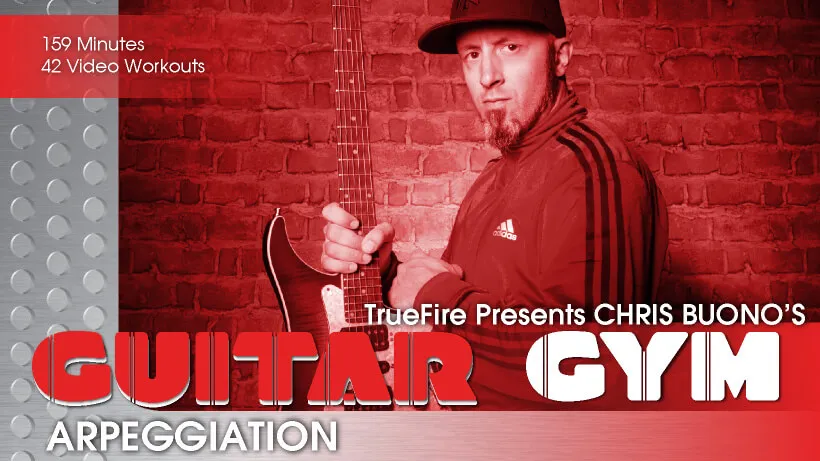
Guitar Gym: Arpeggiation

Arpeggiation exercises to take your playing to the next level

Marty FriedmanTommy EmmanuelSteve VaiEric GalesEric Johnson

Get this course and 1,000+ more with All Access

Try 14 days free. Cancel any time.

Purchase Individual Course for $9.99
Guitar Gym: Arpeggiation

About this course

In this edition of Guitar Gym, it’s all about mastering Arpeggiation. Split into four leveled sections, these workouts guide you through a comprehensive, rigorous practice regimen designed to get these essential playing elements solidified and ready to build on. Buono will guide you through 48 Workouts across the 4 levels. The workouts are organized into tempo sets (from slow to fast) each with an accompanying overview video where Buono explains the ins and outs for practicing the workouts. Each Workout is also clearly laid out for you in Guitar Pro, which can further be adjusted to any tempo. Buono will perform each workout on video (in various views) for the prescribed amount of time and so you’ll always have your coach there to play along and sweat it out with in the Guitar Gym.

Each Guitar Gym course focuses on a specific guitar technique by guiding the student through a deliberately prescribed series of optimized workouts, organized across a series of levels with increasing intensity. Buono demonstrates each of the workouts by explaining how the workout is engineered and then showing you how to play the workout correctly.

The workouts are ALL interactive video playalongs -- Buono performs each workout with you, for the correct amount of time, at all of the prescribed tempos. You will not be alone in the shed!

All of the workouts also include text guides, PDF charts, Guitar Pro files and all of the practice metronome tracks, at all of the prescribed tempos. Everything you need to develop monster chops by practicing correctly is included.

Practice does NOT make perfect -- "perfect" practice does. We've heard this time and again from our instructors and we get it; practice the wrong thing, or practice the wrong way, and you'll learn how to play it perfectly wrong. Makes "perfect" sense but what exactly do we practice, and how specifically do we practice it? TrueFire's resident Professor of the Deep, Chris Buono has invested the last couple of decades coming up with the answer.

Developing solid guitar techniques is particularly subject to the quality and intensity of your practice regimens -- you'll only get so far relying on repetition and frequency alone. Chris Buono's Guitar Gym workouts will take you the rest of the way with 12 collections of tried, tested and proven intensive workouts for Triad Arpeggios, Tapping, Hybrid Picking, Alternate Picking, Hammers & Pull-Offs, Power Chords, Scales, Speed Picking,Triads, Harmonic Minor Triad Chord Scales, Major Triad Chord Scales and Melodic Minor Triad Chord Scales

Guitar Gym -- your path to "perfect" chops!

What you'll learn

  • Play complex chord progressions with descending bass lines in 3/4 time
  • Perform bar chord arpeggiation with internal chord movements
  • Master upstroke-initiated arpeggiation patterns
  • Understand the importance of consistent daily practice over sporadic long sessions
  • Develop awareness of building practice stamina gradually
Release date: 01/08/2016 • 2h 29m runtime
Start Course
Sample lessons
Working Out In the Gym
Schedules and Rules
Arpeggiation
Arpeggiation
Level 1: Overview
Arpeggiation: Level 1
Workout #1: Overview
Arpeggiation: Level 1
Workout #1: 40 BPM

What's included

42 lessons • 36 charts • 18 Jam Tracks

Guitar Gym: Arpeggiation
Chops: Our heroes have 'em and we all want 'em. In order to get 'em you gotta do what any other person training to better themselves in some way would do - get to the gym! Well, that's exactly what you're going to do - welcome to the Guitar Gym series. No matter what level you're at or if you have various strong and weak points in your technique, Guitar Gym has you covered. Each course is comprised of a collection of leveled Workouts waiting for you to dig into.

Here in Guitar Gym: Arpeggiation, you have but one task and one only: Pick notes within chords on-by-one and let them ring throughout. Not to be confused with the term arpeggio, which is a sequence of notes contained in a chord (called chord tones) played one at a time that DO NOT ring together. Think of it this way: Arpeggiation is a harmonic concept, whereas an arpeggio is a melodic concept.

Split into three leveled sections, Guitar Gym: Arpeggiation guides you through a comprehensive, rigorous game plan for you to get this essential playing element solidified and ready to build on. Each level is split up into three workouts made up of 13 video segments, starting with the overview where I'll give you a quick synopsis of what's in store. The following 12 videos further split the three workouts into three tempos (slow, medium, fast) that all have an accompanying introduction video where I'll explain the ins and outs on how to play the workout. Each workout is clearly laid out for you in Guitar Pro and will be readily available for you to download right from the TrueFire player.

In the three actual workout videos, I'll play through the workout for the amount of time I prescribe in the overview and introduction videos so you'll always have me right there with you (in various views) as you sweat it all out here in Guitar Gym.

At the heart of any drilling regimen, including this one, is precise timing. It not only keeps things orderly in all aspects of music, but also serves as a guide and indicator as to how you're progressing. What's more, anyone who has been in the chops shed knows that one of the most important practices is to increase the tempo incrementally one-by-one. While the three parts of each workout will be presented in a slow-medium-fast fashion in regards to tempo, it's up to you to take the workout into your own shed and incrementally up the tempo while you practice, preparing you for the next tempo mark.

Dig?

Ready!?

Let's do it do it!!
Working Out In the Gym
Developing great chops is not about just mindlessly drilling an exercise over and over. There has to be a method to the madness...

First and foremost, you need to create what I call in my Guitar Gym Online Classroom a Workout Schedule. My Workout Schedules carve out a set amount of time on set days of the week that slot out precisely what it is you're going to play. This helps big time and the results are inspiring to say the least! And it doesn't take as much time as you might expect - if you're working on just one skill such as the one here in this course, you need but 15-30 minutes a day depending on how many workouts you want to drill down. That said, you could set it up so you do a morning and evening session. The key is focused, disciplined practice time with a metronome. Just stick to your "WS" and let your fingers do the rest!

Speaking of focus and discipline, when starting to put together your own WS keep this mantra in mind: You absolutely must start out playing the workouts slow and gradually climb up the tempo ladder to the top tempo tier. No if's, and's, or lazy butts about it. Even if you think you can play the workout at the medium tempo, trust me, knock it down to the lowest tier and build. You may be masking playing anomalies you don't even know are there by jumping into passages at a medium to high tempo. Slowing down what you're playing will reveal what you may need to work on. Do it!

Not only does starting out at the lowest tempo tier ensure you'll get the most out of your practice time, but it will also help to prevent any injuries. Playing in reasonable blocks of time is a much safer way to build your muscle memory as well as help you attain the ultimate skill in playing proficiently on the guitar: The art of relaxation. If you're relaxed and keeping your practice time calculated and spaced out, you'll be safe and successful!
Arpeggiation
Arpeggiation is picking notes within the chord one-by-one and letting them ring throughout. Not to be confused with the term arpeggio, which is a sequence of notes contained in a chord (called chord tones) played one at a time that DO NOT ring together. Think of it this way: Arpeggiation is a harmonic concept whereas an arpeggio is a melodic concept. Our Level 1 Arpeggiation Workouts introduce this concept, emphasizing the essential components: surrounding the changes, arching, and clean chord changes.

These Arpeggiation Workouts are centered on two open position chords: E and A. Throughout the three workouts, you'll play various arpeggiation patterns in adjacent and nonadjacent string patterns for two minutes each. All the while you must pay close attention to your fret hand fingering to ensure none of your fingers are leaning, thus cutting off a note's ringing potential. The name of the game is maximum ring!
Arpeggiation: Level 1
In Workout #1, you'll play open position E and A chords. In the first two bars you'll pick the open E from the bottom to top (6th string to 1st string) with all downstrokes as you ascend the pattern until you get to the top note (open first string) where you'll play an upstroke. This is the beginning of the "surround technique." From there you'll arpeggiate the chord in a reverse fashion - descending the pattern starting with a succession of upstrokes that ends with a lone downstroke on the lowest note once again surrounding the borders.

When playing the A chord in bar 3, you'll once again pick from the bottom to top (this time 5th string to 1st string), but at the end after the surrounding upstroke on the 1st string, you'll play a downstroke for the 2nd fret C#. In the fourth and final bar, you'll start the pattern with that same C# with a downstroke and then descend the chord with all upstrokes until the final downstroke for the open A.

Regarding the A chord in bars 3 and 4: If there's one chord that seems to have a few ways for it to be fingered, it's this one. To be able to play this workout and the remaining Level 1 Workouts, be sure you're fingering the open A just like I do: a 2-3-4 fingering on the 2nd fret of the 4-3-2 strings respectively. This will enable you to make a smooth change from E to A and let you concentrate on the task at hand - picking the chord tones while letting them ring into each other.
Arpeggiation: Level 1
In Workout #1, you'll play open position E and A chords. In the first two bars you'll pick the open E from the bottom to top (6th string to 1st string) with all downstrokes as you ascend the pattern until you get to the top note (open first string) where you'll play an upstroke. This is the beginning of the "surround technique." From there you'll arpeggiate the chord in a reverse fashion - descending the pattern starting with a succession of upstrokes that ends with a lone downstroke on the lowest note once again surrounding the borders.

When playing the A chord in bar 3, you'll once again pick from the bottom to top (this time 5th string to 1st string), but at the end after the surrounding upstroke on the 1st string, you'll play a downstroke for the 2nd fret C#. In the fourth and final bar, you'll start the pattern with that same C# with a downstroke and then descend the chord with all upstrokes until the final downstroke for the open A.

Regarding the A chord in bars 3 and 4: If there's one chord that seems to have a few ways for it to be fingered, it's this one. To be able to play this workout and the remaining Level 1 Workouts, be sure you're fingering the open A just like I do: a 2-3-4 fingering on the 2nd fret of the 4-3-2 strings respectively. This will enable you to make a smooth change from E to A and let you concentrate on the task at hand - picking the chord tones while letting them ring into each other.
Arpeggiation: Level 1
In Workout #1, you'll play open position E and A chords. In the first two bars you'll pick the open E from the bottom to top (6th string to 1st string) with all downstrokes as you ascend the pattern until you get to the top note (open first string) where you'll play an upstroke. This is the beginning of the "surround technique." From there you'll arpeggiate the chord in a reverse fashion - descending the pattern starting with a succession of upstrokes that ends with a lone downstroke on the lowest note once again surrounding the borders.

When playing the A chord in bar 3, you'll once again pick from the bottom to top (this time 5th string to 1st string), but at the end after the surrounding upstroke on the 1st string, you'll play a downstroke for the 2nd fret C#. In the fourth and final bar, you'll start the pattern with that same C# with a downstroke and then descend the chord with all upstrokes until the final downstroke for the open A.

Regarding the A chord in bars 3 and 4: If there's one chord that seems to have a few ways for it to be fingered, it's this one. To be able to play this workout and the remaining Level 1 Workouts, be sure you're fingering the open A just like I do: a 2-3-4 fingering on the 2nd fret of the 4-3-2 strings respectively. This will enable you to make a smooth change from E to A and let you concentrate on the task at hand - picking the chord tones while letting them ring into each other.
Arpeggiation: Level 1
In Workout #1, you'll play open position E and A chords. In the first two bars you'll pick the open E from the bottom to top (6th string to 1st string) with all downstrokes as you ascend the pattern until you get to the top note (open first string) where you'll play an upstroke. This is the beginning of the "surround technique." From there you'll arpeggiate the chord in a reverse fashion - descending the pattern starting with a succession of upstrokes that ends with a lone downstroke on the lowest note once again surrounding the borders.

When playing the A chord in bar 3, you'll once again pick from the bottom to top (this time 5th string to 1st string), but at the end after the surrounding upstroke on the 1st string, you'll play a downstroke for the 2nd fret C#. In the fourth and final bar, you'll start the pattern with that same C# with a downstroke and then descend the chord with all upstrokes until the final downstroke for the open A.

Regarding the A chord in bars 3 and 4: If there's one chord that seems to have a few ways for it to be fingered, it's this one. To be able to play this workout and the remaining Level 1 Workouts, be sure you're fingering the open A just like I do: a 2-3-4 fingering on the 2nd fret of the 4-3-2 strings respectively. This will enable you to make a smooth change from E to A and let you concentrate on the task at hand - picking the chord tones while letting them ring into each other.

+ 35 more lessons

Start Course

Reviews

8 results

Milion

05/16/24

Useful for beginners/late beginners

Great exercises if you want to start this technique, but some exercises are really hard on the left hand, and you can't really focus on the right hand technique, too bad. Except that, I recommend


jTunes

Verified buyer

02/09/22

I know of no better personal trainer for guitar chops than Chris Buono—simply put, Buono > Muy Bueno

ArtemIV

Verified buyer

05/04/21

Arpeggio and discipline,)

If you think you can play arpeggios, then you are wrong!) This course teaches you how to play and develops a layout for playing arpeggios.

Sindibad

11/15/20

Chris Buono's Guitar Gym: Arpeggiation

It is an important exercise that must be worked on regularly. As usual the pedagogy is excellent.

captainxc

Verified buyer

10/24/20

Excellent well organised course!

I wanted to improve my arpeggio playing with a pick to add some variety to my acoustic covers. This course fit the bill exactly, it's well organised in small, easy to achieve, incremental steps and in a couple of weeks my arpeggio playing has improved drastically.

Stop searching. Start improving with All Access.

Try 14 days free. Cancel any time.