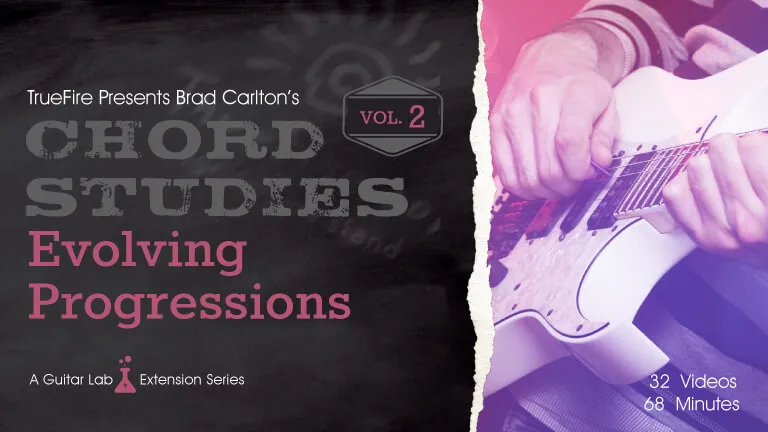
In this second volume of Chord Studies: Evolving Progressions, you'll explore creative harmonic options for playing a ii - V progression in the key of C. By focusing on the top four strings in this edition, you'll also continue building efficient and interesting voice leading options through the use of extensions, common tones, and slash chords.
About the Chord Studies Series
If Forest Gump’s shrimp-loving Bubba played guitar, his take on chords might go something like this, ”You can strum ‘em, fingerpick ‘em, arpeggiate ‘em, mute ‘em, alternate tune ‘em, voice lead ‘em. Dey’s uh, barre chords, altered chords, extended chords, moveable chords, cluster chords, slash chords, inversions, triads, diads. There’s jazz chords, power chords, blues chords, cowboy chords, block chords, open chords…”
Bubba would be right — there’s a wide and wonderful world of chords for we guitarists to explore. But what’s the best way to do that? Chord dictionaries might be handy references but there’s no context (and really, when’s the last time you looked at one of those?).
Theory and harmony instructionals are filled with chord construction strategies and applications and we highly recommend digging as deep into the science of chords as your left brain will allow you.
However, learning new chords, progressions, applications and right-hand techniques in a musical context (songs, etudes, jamming with other players, etc.) is the most popular approach and that is the educational premise behind Brad’s Carlton’s Chord Studies course seres.
Each edition of Chord Studies features 15 play-along and jammable chord studies, which are focused on a particular chord type, chord progression or chord application. While Brad does touch on rhythmic qualities, this is not a rhythm guitar course — these studies are specifically designed to significantly expand your chord know-how and vocabulary.
Brad covers a range of styles, levels , chord types and progressions across 10 editions: CAGED Chords, Jazz Blues Progressions, Open String Chords, Rock and Pop Progressions, Slow Blues Progressions, Evolving Blues, Evolving Triads, Slash Chords, Power Chords and Beginner Chords.
Each of the 15 Studies within an edition includes an overview from Brad followed by a performance and play-along of the chord study over a rhythm track. Chord grid charts and a chord lead sheet accompanies each study. Plus, you’ll get all of the practice rhythm tracks to work with on your own.
Reference the chord charts to become familiar with the voicings and their fingerings, and then use the lead sheet to play-along with Brad’s video performance. Try different rhythmic patterns over the supplied rhythm tracks and then take it all to your own playlist of songs and jam tracks.
What you'll learn
Navigate physical challenges of extended voicings in upper frets
Play D minor 11 to G7-6 progression with proper voicings
Make informed decisions about including or omitting chord tones
Understand proper hand positioning to avoid intonation issues
Recognize when voicings are practical in different neck positions
In this second volume of Chord Studies: Evolving Progressions, you'll explore creative harmonic options for playing a ii - V progression in the key of C. By focusing on the top four strings in this edition, you'll also continue building efficient and interesting voice leading options through the use of extensions, common tones, and slash chords.
In this second volume of Chord Studies: Evolving Progressions, you'll explore creative harmonic options for playing a ii - V progression in the key of C. By focusing on the top four strings in this edition, you'll also continue building efficient and interesting voice leading options through the use of extensions, common tones, and slash chords.
This progression is a ii - V in the key of C. The first chord is a Dm7/11, and all we have to do is move the second and third voices down diatonically in the key of C (all natural notes) to get to our G7. This is a great progression to try transposing into different keys.
This progression is a ii - V in the key of C. The first chord is a Dm7/11, and all we have to do is move the second and third voices down diatonically in the key of C (all natural notes) to get to our G7. This is a great progression to try transposing into different keys.
This is a ii - V progression in the key of C. The first chord may look like an F chord, but with a D bass under it you get the Dm7. All you have to do to get the G13 chord is to drop the first two voicings. This progression is an example of where the bass notes aren't played in order to make room for what the bass player would be doing in the low register of a typical ii - V.
This is a ii - V progression in the key of C. The first chord may look like an F chord, but with a D bass under it you get the Dm7. All you have to do to get the G13 chord is to drop the first two voicings. This progression is an example of where the bass notes aren't played in order to make room for what the bass player would be doing in the low register of a typical ii - V.
Here we're looking at a ii - V progression in the key of C. We've got a great example of voice leading here going on with the second string. In our first chord, the Dm7/11, we've got the C note on the second string. When we move to the Gadd9, we take that finger away and that gives us some chromatic voice leading with that note going down to the open B. A very simple progression, but a great example of getting some great voice leading out of something so simple.