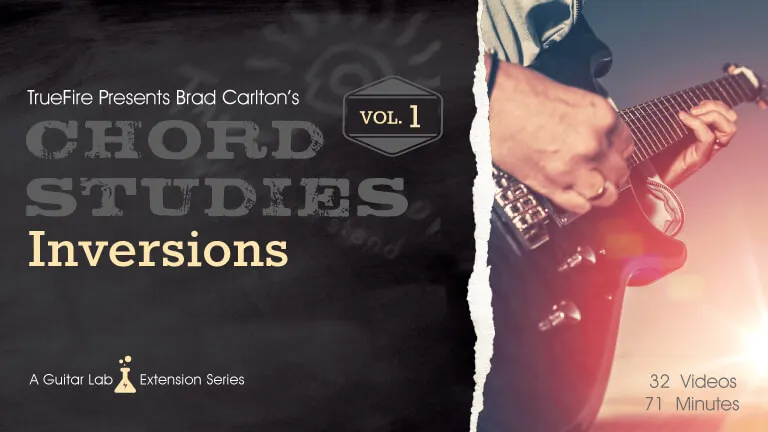
Chord Studies: Inversions Vol. 1

Theory and harmony instructionals filled with chord construction strategies and applications

Marty FriedmanTommy EmmanuelSteve VaiEric GalesEric Johnson

Get this course and 1,000+ more with All Access

Try 14 days free. Cancel any time.

Purchase Individual Course for $5.00
Chord Studies: Inversions Vol. 1

About this course

Considering that guitarists play rhythm most of the time, chord inversions may very well be the most powerful tool in a guitarist’s toolkit. Knowing how to construct and play chord inversions exponentially increases your chord options. These 15 studies will get you going in a hurry.

About the Chord Studies Series

If Forest Gump’s shrimp-loving Bubba played guitar, his take on chords might go something like this, ”You can strum ‘em, fingerpick ‘em, arpeggiate ‘em, mute ‘em, alternate tune ‘em, voice lead ‘em. Dey’s uh, barre chords, altered chords, extended chords, moveable chords, cluster chords, slash chords, inversions, triads, diads. There’s jazz chords, power chords, blues chords, cowboy chords, block chords, open chords…”

Bubba would be right — there’s a wide and wonderful world of chords for we guitarists to explore. But what’s the best way to do that? Chord dictionaries might be handy references but there’s no context (and really, when’s the last time you looked at one of those?).

Theory and harmony instructionals are filled with chord construction strategies and applications and we highly recommend digging as deep into the science of chords as your left brain will allow you.

However, learning new chords, progressions, applications and right-hand techniques in a musical context (songs, etudes, jamming with other players, etc.) is the most popular approach and that is the educational premise behind Brad’s Carlton’s Chord Studies course seres.

Each edition of Chord Studies features 15 play-along and jammable chord studies, which are focused on a particular chord type, chord progression or chord application. While Brad does touch on rhythmic qualities, this is not a rhythm guitar course — these studies are specifically designed to significantly expand your chord know-how and vocabulary.

Brad covers a range of styles, levels , chord types and progressions across 10 editions: CAGED Chords, Jazz Blues Progressions, Open String Chords, Rock and Pop Progressions, Slow Blues Progressions, Evolving Blues, Evolving Triads, Slash Chords, Power Chords and Beginner Chords.

Each of the 15 Studies within an edition includes an overview from Brad followed by a performance and play-along of the chord study over a rhythm track. Chord grid charts and a chord lead sheet accompanies each study. Plus, you’ll get all of the practice rhythm tracks to work with on your own.

Reference the chord charts to become familiar with the voicings and their fingerings, and then use the lead sheet to play-along with Brad’s video performance. Try different rhythmic patterns over the supplied rhythm tracks and then take it all to your own playlist of songs and jam tracks.

What you'll learn

  • Execute smooth transitions between chord inversions using finger economy
  • Execute partial barre technique with proper finger positioning
  • Create melodic movement through voice leading on top strings
  • Understand the difference between root position (chord theory) and fret position (guitar)
  • Recognize CAGED form relationships in triad voicings
Release date: 05/01/2015 • 1h 11m runtime
Start Course
Sample lessons
Inversions Vol. 1
Inversions Vol. 1
Overview
Triple C Major Play
Triple C Major Play
Overview
Triple C Major Play
Triple C Major Play
Playalong
Pole Position
Pole Position
Overview

What's included

32 lessons • 15 charts • 15 Jam Tracks

Chord Studies: Inversions Vol. 1
Considering that guitarists play rhythm most of the time, chord inversions may very well be the most powerful tool in a guitarist’s toolkit. Knowing how to construct and play chord inversions exponentially increases your chord options. These 15 studies will get you going in a hurry.
Inversions Vol. 1
Considering that guitarists play rhythm most of the time, chord inversions may very well be the most powerful tool in a guitarist’s toolkit. Knowing how to construct and play chord inversions exponentially increases your chord options. These 15 studies will get you going in a hurry.
Triple C Major Play
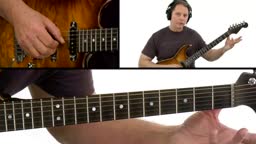
In this example, we're looking at the three inversions of a C Major triad on the first second and third strings.  Each chord should be played for four beats each.  We'll begin with the second inversion voicing down in the open position, then move to the third fret, to the eighth, and then up to the octave in the twelfth fret.  Be sure to only play the first three strings on each chord.
Triple C Major Play
In this example, we're looking at the three inversions of a C Major triad on the first second and third strings.  Each chord should be played for four beats each.  We'll begin with the second inversion voicing down in the open position, then move to the third fret, to the eighth, and then up to the octave in the twelfth fret.  Be sure to only play the first three strings on each chord.
Pole Position
This example will demonstrate playing the inversions of a C Major triad on the second, third, and fourth strings.  We'll begin here with the first inversion down in open position, then the second inversion in the fifth fret, the root position in the eighth fret, and finally the first inversion again this time in the twelfth fret.  Watch your chord diagrams for the muted first string in the second and third chord.
Pole Position
This example will demonstrate playing the inversions of a C Major triad on the second, third, and fourth strings.  We'll begin here with the first inversion down in open position, then the second inversion in the fifth fret, the root position in the eighth fret, and finally the first inversion again this time in the twelfth fret.  Watch your chord diagrams for the muted first string in the second and third chord.
Extra Mile One
Now we move on to the inversions of a C Major triad on the third, fourth, and fifth strings.  We begin with the root position down in open position, then move to the fifth, then the ninth, and finally the twelfth fret for the octave.  Here's a little fingering tip: maintain your third finger's contact with the fifth string through all three inversions.  Another tip: the group of fingerings you see for this example also applies to the triad inversions on the fourth, fifth, and sixth strings.

+ 25 more lessons

Start Course

Reviews

6 results

Ohio5665

Verified buyer

09/17/23

Lots of information and great advice from Brad Carlton!
rafahc

Verified buyer

11/07/22

Si quieres controlar los acordes y sus inversiones a lo largo del mástil

El curso es muy completo y además Brad carltón lo lleva progresivamente,es necesario conocer las inversiones de los acordes básicos para tocar las inversiones en diferentes partes del mástil e ir conociendo las notas que forman los acordes, también recomiendo que para estudiar este curso antes conozcas las formas básicas de acordes abiertos y de cejilla,una cosa que hecho en falta es el intervalo de cada nota que forma la inversión o el acorde,por ejemplo al ser inversión de 1a que funcion e intervalo hace cada nota si es de 3 M en el bajo etc,,,,una revisión le vendría bien al curso y una actualización también para completarlo,lo recomiendo,pero si no conoces los acordes básicos y la función que hacen cada nota e intervalos compraría antes un curso de acordes para principiantes con sistema caged y luego después este otro de inversiones,muy bueno

Peter M.

12/27/18

Good for learning to play up the neck

This course will teach you how to play chords in any position on the neck. The triad chord shapes are all given in the keys of C and D minor, but they are movable to any position and any key. Memorizing these shapes and incorporating them into your playing will open up the neck for you. The play-alongs are simple and are focused on getting the shapes into your muscle memory. Once you have done this, they are yours forever, for whatever purpose you wish to use them.

guitarpicker8383

10/01/18

I love it!

Brad Carlton is the best!

Zach W.

10/01/18

Solid course

I like it.

Stop searching. Start improving with All Access.

Try 14 days free. Cancel any time.