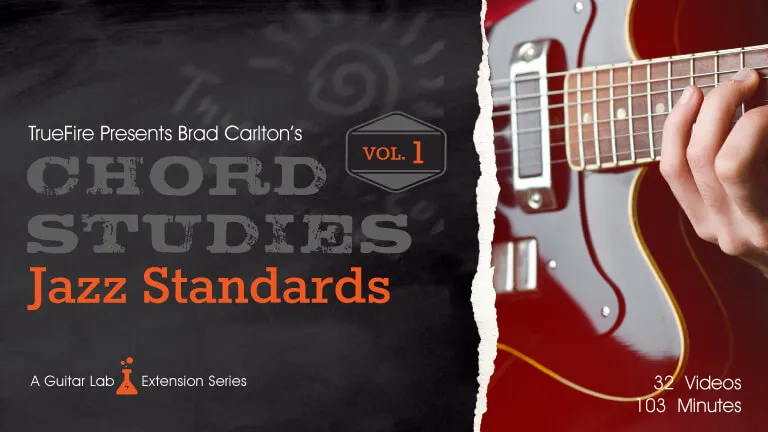
The entire jazz standard songbook is built primarily on major and minor ii-V-I, major blues, minor blues and modal progressions. Learn how to comp over these types of progressions starting with these arrangements patterned after classic standards.
About the Chord Studies Series
If Forest Gump’s shrimp-loving Bubba played guitar, his take on chords might go something like this, ”You can strum ‘em, fingerpick ‘em, arpeggiate ‘em, mute ‘em, alternate tune ‘em, voice lead ‘em. Dey’s uh, barre chords, altered chords, extended chords, moveable chords, cluster chords, slash chords, inversions, triads, diads. There’s jazz chords, power chords, blues chords, cowboy chords, block chords, open chords…”
Bubba would be right — there’s a wide and wonderful world of chords for we guitarists to explore. But what’s the best way to do that? Chord dictionaries might be handy references but there’s no context (and really, when’s the last time you looked at one of those?).
Theory and harmony instructionals are filled with chord construction strategies and applications and we highly recommend digging as deep into the science of chords as your left brain will allow you.
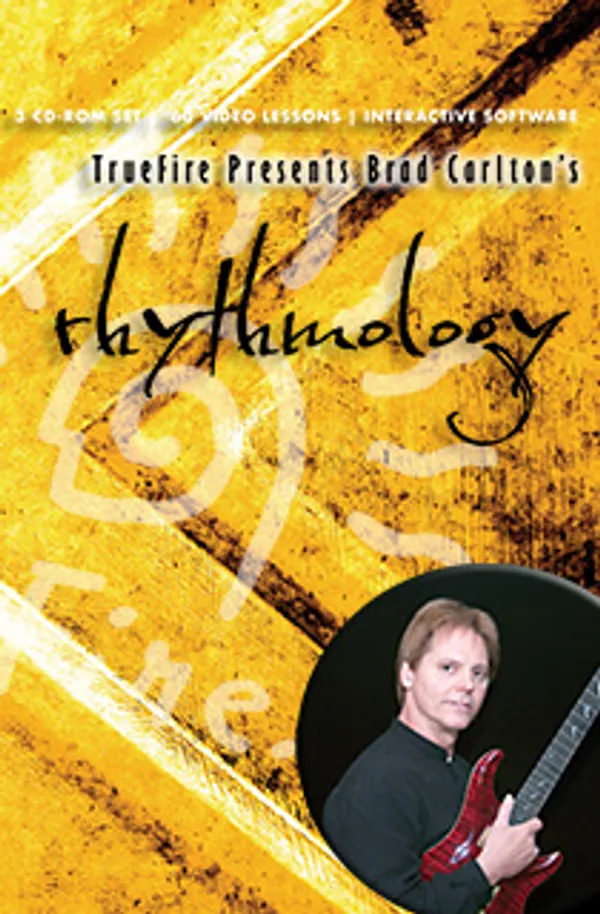
However, learning new chords, progressions, applications and right-hand techniques in a musical context (songs, etudes, jamming with other players, etc.) is the most popular approach and that is the educational premise behind Brad’s Carlton’s Chord Studies course seres.
Each edition of Chord Studies features 15 play-along and jammable chord studies, which are focused on a particular chord type, chord progression or chord application. While Brad does touch on rhythmic qualities, this is not a rhythm guitar course — these studies are specifically designed to significantly expand your chord know-how and vocabulary.
Brad covers a range of styles, levels , chord types and progressions across 10 editions: CAGED Chords, Jazz Blues Progressions, Open String Chords, Rock and Pop Progressions, Slow Blues Progressions, Evolving Blues, Evolving Triads, Slash Chords, Power Chords and Beginner Chords.
Each of the 15 Studies within an edition includes an overview from Brad followed by a performance and play-along of the chord study over a rhythm track. Chord grid charts and a chord lead sheet accompanies each study. Plus, you’ll get all of the practice rhythm tracks to work with on your own.
Reference the chord charts to become familiar with the voicings and their fingerings, and then use the lead sheet to play-along with Brad’s video performance. Try different rhythmic patterns over the supplied rhythm tracks and then take it all to your own playlist of songs and jam tracks.
What you'll learn
Play through a complete jazz standard chord progression with proper voice leading
Execute smooth chord transitions using pivot and guide finger techniques
The entire jazz standard songbook is built primarily on major and minor ii-V-I, major blues, minor blues and modal progressions. Learn how to comp over these types of progressions starting with these arrangements patterned after classic standards.
The entire jazz standard songbook is built primarily on major and minor ii-V-I, major blues, minor blues and modal progressions. Learn how to comp over these types of progressions starting with these arrangements patterned after classic standards.
This jazz standard progression is in the style of Blue Bossa. There are 16 bars and a lot of chord changes, so take your time and look through the progression to start with. Familiarize yourself with the chords that you see multiple times in there. That is always a good place to start - by just getting down the chords that appear more that once. This progression is in the "street key" of C minor.
This jazz standard progression is in the style of Blue Bossa. There are 16 bars and a lot of chord changes, so take your time and look through the progression to start with. Familiarize yourself with the chords that you see multiple times in there. That is always a good place to start - by just getting down the chords that appear more that once. This progression is in the "street key" of C minor.
Here we have a great Bossa Nova feel in the style of Girl from Ipanema. The FMaj7 is prevalent throughout and the F to G vibe is what drives this tune. Instead of using a pick and just strumming, try playing this one with your right hand fingers to really get that Bossa Nova feel as you are comping.
Here we have a great Bossa Nova feel in the style of Girl from Ipanema. The FMaj7 is prevalent throughout and the F to G vibe is what drives this tune. Instead of using a pick and just strumming, try playing this one with your right hand fingers to really get that Bossa Nova feel as you are comping.
We take on this standard jazz progression in the key of G. There are two sections, the first being 8 bars. In bars 11 and 12 we have some nice barre chords that use the barre as our pivot point, so we keep that static as we move the other fingers to get to the chord. This is in the style of Autumn Leaves.
Ages ago in college I took a jazz guitar class that covered jazz chord progressions and a few standard tunes. Brad's course is a welcome refresher for me, and goes beyond the progressions I'd already learned (and with which I was rust). Well done!
R
RockyRoll
Verified buyer
06/10/22
I love the course!
I've wanted to learn some jazz for a while now, and this course is fantastic. Brady teaches in a really nice clear way. I really recommend it if your looking for some new chord grips.
Z
zoso77
10/05/21
Jazz Standards Vol. 1 - Straight forward, concise, understandable, and informative.
Excellent cours. So clear, to the point and enlightening. Great instruction and playing also. Grateful for your work, Mr. Carlton!
T
Tonyde
07/02/21
More than a resident tutor
I was reliably told that the rhythm and comping is the foundation of good guitar technique as opposed to centre stage soloing. Switching to Jazz with that in mind is not for the faint hearted but Truefire and Brad take a solid range of 15 Jazz standards to make that switch possible. Every song chosen are classics in one way or the other that is delivered with a steady build in complexity (hence the Late Intermediate tag, I suppose). Styles covered include Nat King Cole, Antonio Carlos Jobim, John Coltrane, Miles Davis, Stan Getz, Ella Fitzgerald, and Frank Sinatra to name a few. A absolute gem of a compilation.
The course starts with a flattering delve into Blues Bossa and 2 pages of chords with a couple of gentle finger stretching minor 9s. The journey continues with many songs covering 6 pages and chords over 5 frets (Em add9). If that sounds daunting, Brad faces it head on and shows the easy way - "easy when you know how" as they say. At times it feels like live lessons with each chord change and shape explained. What more can we ask for!
The course provides hours of practice that will give tons of confidence for rhythm and comping.
A must for any budding Jazz guitarist!
D
dwaggitt
Verified buyer
05/10/21
Jazz Practice
Great course to learn some jazz progression and move forward to learn neat chord voicings