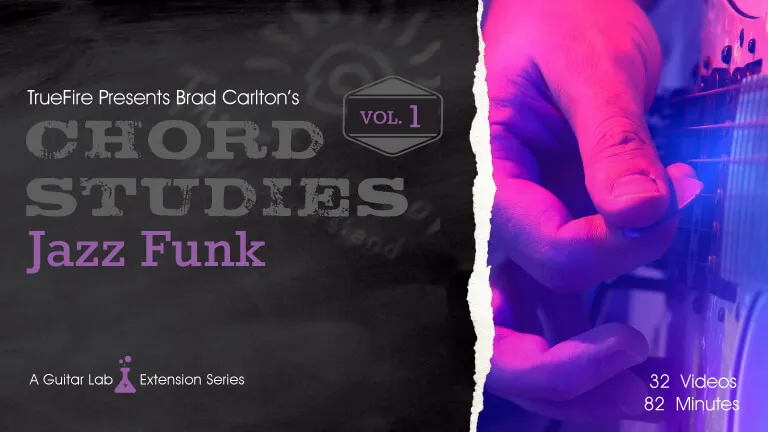
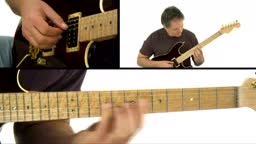
Hi there, and welcome to Jazz Funk Chord Studies: Volume 01. I crafted this series to provide you with unlimited creative options for crafting interesting and compelling rhythm guitar parts. Across the series we'll explore interesting and exotic chord voicings, all-purpose substitutions, creative approaches and performance techniques. So grab your guitar and let's make some music!
About the Chord Studies Series
If Forest Gump’s shrimp-loving Bubba played guitar, his take on chords might go something like this, ”You can strum ‘em, fingerpick ‘em, arpeggiate ‘em, mute ‘em, alternate tune ‘em, voice lead ‘em. Dey’s uh, barre chords, altered chords, extended chords, moveable chords, cluster chords, slash chords, inversions, triads, diads. There’s jazz chords, power chords, blues chords, cowboy chords, block chords, open chords…”
Bubba would be right — there’s a wide and wonderful world of chords for we guitarists to explore. But what’s the best way to do that? Chord dictionaries might be handy references but there’s no context (and really, when’s the last time you looked at one of those?).
Theory and harmony instructionals are filled with chord construction strategies and applications and we highly recommend digging as deep into the science of chords as your left brain will allow you.
However, learning new chords, progressions, applications and right-hand techniques in a musical context (songs, etudes, jamming with other players, etc.) is the most popular approach and that is the educational premise behind Brad’s Carlton’s Chord Studies course seres.
Each edition of Chord Studies features 15 play-along and jammable chord studies, which are focused on a particular chord type, chord progression or chord application. While Brad does touch on rhythmic qualities, this is not a rhythm guitar course — these studies are specifically designed to significantly expand your chord know-how and vocabulary.
Brad covers a range of styles, levels , chord types and progressions across 10 editions: CAGED Chords, Jazz Blues Progressions, Open String Chords, Rock and Pop Progressions, Slow Blues Progressions, Evolving Blues, Evolving Triads, Slash Chords, Power Chords and Beginner Chords.
Each of the 15 Studies within an edition includes an overview from Brad followed by a performance and play-along of the chord study over a rhythm track. Chord grid charts and a chord lead sheet accompanies each study. Plus, you’ll get all of the practice rhythm tracks to work with on your own.
Reference the chord charts to become familiar with the voicings and their fingerings, and then use the lead sheet to play-along with Brad’s video performance. Try different rhythmic patterns over the supplied rhythm tracks and then take it all to your own playlist of songs and jam tracks.
What you'll learn
Navigate the entire diminished scale using chord voicings
Master advanced 7sharp9 voicings on both 4th and 5th string roots
Apply chord-scale theory to move structures through adjacent scale tones
Apply chord voicings over different bass notes for variation
Understand how to construct chords from the half-whole diminished scale
Hi there, and welcome to Jazz Funk Chord Studies: Volume 01. I crafted this series to provide you with unlimited creative options for crafting interesting and compelling rhythm guitar parts. Across the series we'll explore interesting and exotic chord voicings, all-purpose substitutions, creative approaches and performance techniques. So grab your guitar and let's make some music!
This chord study focuses on chords you'll be using in a jazz funk scenario, so that means 7#9s, 13#9s, minor 7/6s, and you'll also learn some great ideas about chord scales and inversions. Even though you may already know some of these chords, I'll be giving you some fingerings that will make you scratch your ear.
In this example you will be using "7add4" voicings. That's a dominant 7 (1-3-5-b7) but we are adding in the 4. You'll notice the root notes are omitted from this study and that is because the bass notes are being covered by the bass player on the track provided. When moving from the first to the second chord, keep in mind that your second finger will act as a guide finger. Using guide fingers will help you facilitate those quick chord changes in an economic fashion.
In this example you will be using "7add4" voicings. That's a dominant 7 (1-3-5-b7) but we are adding in the 4. You'll notice the root notes are omitted from this study and that is because the bass notes are being covered by the bass player on the track provided. When moving from the first to the second chord, keep in mind that your second finger will act as a guide finger. Using guide fingers will help you facilitate those quick chord changes in an economic fashion.
In the previous example I showed you "7add4" voicings with the root omitted from the chord. In this example we will be omitting the 5th of the chord but keeping the root in each of these voicings. Maintain the 2/3 barre as you move from the first to the second voicing. Moving to the third voicing your first and third finger will act as guide fingers.
In the previous example I showed you "7add4" voicings with the root omitted from the chord. In this example we will be omitting the 5th of the chord but keeping the root in each of these voicings. Maintain the 2/3 barre as you move from the first to the second voicing. Moving to the third voicing your first and third finger will act as guide fingers.
This study uses a great funk chord: the 13#9 chord. What we're playing here is a G13#9 but without a 5th and without a root because again, the bass player is going to have those notes covered. The F (b7) and the B (3) are your guide tones here, and you'll notice that the hand formation stays consistent as you switch voicings. This is because the interval between the voicings is an augmented 4th or diminished 5th. This is a great groove to practice some funky rhythms on.
This is one in a series of chord study courses that Brad Carlton has produced with TrueFire.
Like the other courses, this one follows the blueprint of presenting 15 chord progressions using different voicings (chords appropriate for use in a jazz funk context, in this instance) that the student can watch and play along with.
This is a really good and enjoyable way of embedding some new chord voicings into your playing (as well as seriously strengthening your rhythm playing) and Brad also provides some useful insights about each example.
T
timw86
Verified buyer
09/09/22
Jazz funk
Very Jazz/funk
C
chimaeraobscura
Verified buyer
07/31/21
Yeah!
I've been getting more into jazz-funk lately, and this chord study is just what the doctor ordered.
J
jonmarcus
02/09/20
more please
we need more soul jazz funk r&B groove stuff!! Thanks TrueFire!!