The name originated in 1928 when the Dopyera brothers, John and Emil, formed the Dobro Manufacturing Company. "Dobro" is both a contraction of "Dopyera brothers" and a word meaning "goodness" or goodwill in their native Slovak. An early company motto was "Dobro means good in any language.”
Good is an understatement, especially when you hear the Dobro being played in a blues setting. The expressive and vocal-like qualities of the instrument are particularly impactful once you’ve got a grip on the authentic vocabulary of blues licks and phrases originated by the likes of Stevie Ray, Freddie King, Robert Johnson, Muddy Waters, Buddy Guy, Eric Clapton and Cab Calloway.
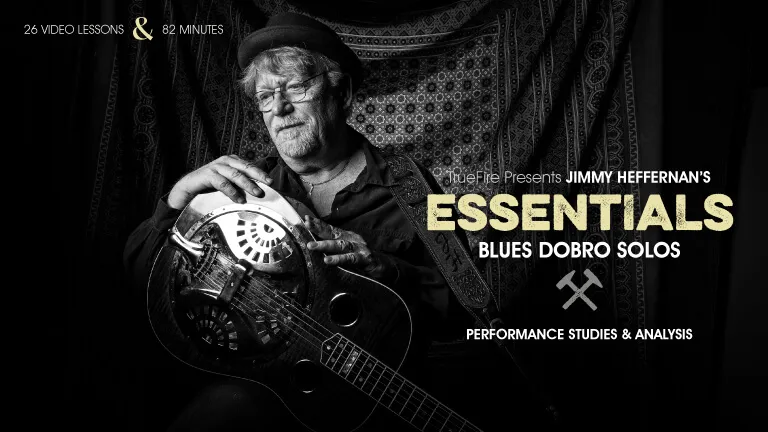
In this Blues Dobro Solos edition of Essentials from master bluesman Jimmy Heffernan, you’ll learn that classic Dobro vocabulary by playing your way through eight Dobro blues solos across an eclectic range of blues styles, in a variety of keys.
“I'll not only show you where the notes are located, but how to play them in well-known phrases used by all the top blues artists. With the blues, the phrasing is the most important thing. If you just run up and down blues scales it sounds like exactly that—running up and down blues scales. When you get through this course, you'll know the most often played blues phrases and where to find them in playable pockets of notes. So grab your Dobro and let's get started!”
Jimmy demonstrates the solos over rhythm tracks and then breaks them down by stepping you through the key concepts, techniques and creative approaches he used to improvise the solo in the performance study.
Here’s Jimmy’s descriptions of the eight Dobro blues solos that you’ll be learning…
One Lick Blues- “Playing blues is all about phrasing and feel, not how many notes you can play. Some of the most haunting sounds I've ever heard are repeated lines that sound almost like field chants. In this example, we'll begin to look at how to get that feeling from the dobro.”
One Lick Blues Too- “In this lesson, we'll continue focusing on how to phrase in the blues using small, simple note choices. Here we are in A again, demonstrating the same principle with a different lick over a different groove. The E or V chord lick I'm using here is a solid, well used blues lick that should be in your arsenal.”
Eternal Blues - “Now let's look at how to solo in a minor key with a tune called "Eternal Blues." We'll be using elements of the relative major, which is the major scale up a minor third from the root. Knowing a slow minor blues tune is a must for any blues player. This one is in the key of B, inspired by the feel of Stevie Ray's "Tin Pan Alley," although it's not in 3/4 time.”
Florida Blues - “Here we are in A again, demonstrating the same principle with a different lick over a different groove. The E or V chord lick I'm using here is a solid, well used blues lick that should be in your arsenal. Notice in the first half of the V chord lick I’m playing in E, and in the second half I'm playing "ahead of the band" with an A chord lick to pull your ear to the I or A chord. This is to clue the listener into what's coming ahead, and is done often in the blues (so it’s a good thing to learn).”
Rocky Road - “This is a tune that might be cool for you and your band or jam buddies to learn. Easy and groovy. The funky head part in this solo is followed by some new licks that use some "chicken pickin'" muted notes. The thing to focus on here is how the solo fits right in with the head or melody, not starting in left field when I start the solo, letting it flow and carry the feel of the head part.”
Red D Blues - “This is one that you'll definitely want to learn and absorb for when you're playing blues in D, something I do a lot when playing bluegrass. All of our techniques fit in here, its just a different type of groove to have under your belt. You can even use these licks playing rock, try them while playing "Sweet Home Alabama" for example.”
8th Son- “In this one we'll start to learn the early elements of swing and rockabilly, both with a healthy dose of blues in them. Country blues, boogie, rockabilly, and swing all melt together here with a dash of Cab Calloway meets Bill Monroe. Check out Bill Monroe's "Rocky Road Blues" and see if you don't hear early rock and roll.”
Swamp Blues- “Here we'll be using a new tuning that many of the early country blues players used for playing slide. The D tuning we're using here is great for slide blues playing, and sounds great on any guitar. Make special note of the wide vibrato effect that's used on "Swamp Blues." In this tuning, there's a lot of cool notes to play around with at the third fret that you can add to your blues repertoire.” All of the key demonstrations, performances and examples are tabbed and notated for your practice, reference and study purposes. You’ll also get Guitar Pro files so that you can loop and/or slow any section down as you work through the lessons. Plus, Jimmy generously includes all of the rhythm tracks for you to work with on your own.
Grab your Dobro and let’s get busy and bluesy with Jimmy Heffernan!
Don’t have a Dobro? No worries! Today you can buy a "nut converter" and a "slide bar" for less than $35, and then convert any old steel string to a killer dobro without any permanent damage. Too good to be true? Watch this video (https://truefire.com/techniques-guitar-lessons/dobro-handbook/watch/v13462). If you already play guitar, you can get up and running on Dobro very quickly thanks to Jimmy Heffernan's other TrueFire course, The Dobro Handbook - A Guitarist's Guide for Playing Dobro (https://truefire.com/techniques-guitar-lessons/dobro-handbook/watch/v13462).
What you'll learn
Execute the classic flatted third blues sound on slide guitar
Play ahead of chord changes for more sophisticated phrasing
Use chicken picking technique for rhythmic variation
Create conversational phrasing by clipping notes and leaving space
Hi, I'm Jimmy Heffernan and I'm going to show you how to play the blues on the dobro or any other slide instrument. I'll not only show you where the notes are located, but how to play them in well-known phrases used by all the top blues artists. With the blues, the phrasing is the most important thing. If you just run up and down blues scales it sounds like exactly that—running up and down blues scales. When you get through this course, you'll know the most often played blues phrases and where to find them in playable pockets of notes. So grab your dobro and let's get started!
Playing blues is all about phrasing and feel, not how many notes you can play. Some of the most haunting sounds I've ever heard are repeated lines that sound almost like field chants. In this example, we'll begin to look at how to get that feeling from the dobro.
This is a slow shuffle in A to get you going. Notice how the notes I play remain the same, but sound different over the basic blues chord changes.
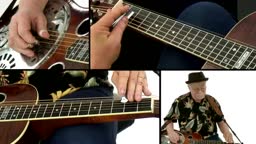
Watch closely how I use the bar on the neck, lifting it up and bringing it down to get different effects, giving me the control to let the notes ring or not.
In this lesson, we'll continue focusing on how to phrase in the blues using small, simple note choices.
Here we are in A again, demonstrating the same principle with a different lick over a different groove. The E or V chord lick I'm using here is a solid, well used blues lick that should be in your arsenal. Notice in the first half of the V chord lick I’m playing in E, and in the second half I'm playing "ahead of the band" with an A chord lick to pull your ear to the I or A chord. This is to clue the listener into what's coming ahead, and is done often in the blues (so it’s a good thing to learn).
In this video, I'm using the same ideas that we went over previously, showing you some pockets of licks that can be used in other keys.
Jimmy is a great teacher. video was clear and esy to under stand. . Breakdown was really helpful.
S
Sody1
Verified buyer
12/12/25
Jimmy explains things very well. I like his approach.
M
moman
Verified buyer
12/06/25
Gets you off the ground.
This is an excellent place to get started with getting around on the Dobro wether you are starting from scratch or coming to it from guitar - I encourage you all to check out his playing in general.
T
tedevans
Verified buyer
06/06/23
Must Course for Blues on the Dobro
Even if you know where all the notes are Jimmy will teach you how to put it all together and a sound good; like you really know what you are doing. He will you over the blues "noodling" hurdle. Jimmy is a great instructor. Highly recommended.