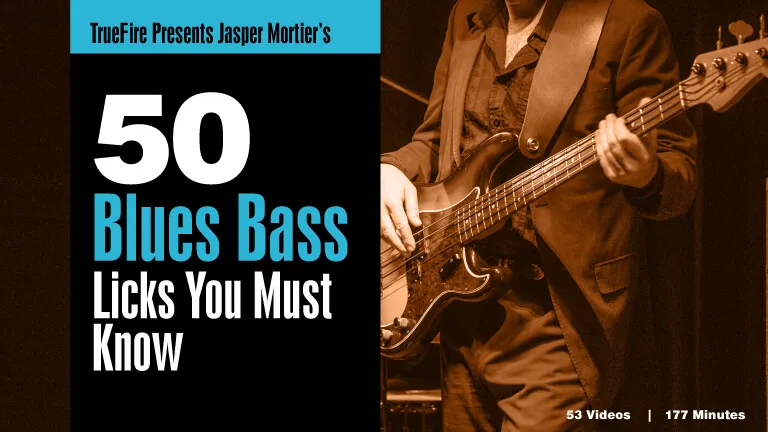
50 Blues Bass Licks You Must Know

A hand-picked collection of licks and grooves covers virtually every style of blues

Marty FriedmanTommy EmmanuelSteve VaiEric GalesEric Johnson

Get this course and 1,000+ more with All Access

Try 14 days free. Cancel any time.

Purchase Individual Course for $14.99
50 Blues Bass Licks You Must Know

About this course

The audience may be focused on the singer or guitar players who are hamming it up stage front, but it’s the rhythm section that makes the magic happen in any great blues band or blues jam. While they’re usually standing out of the spotlight, it’s bass players who have the most challenging job — locking up with the drummer rhythmically while feeding critical harmonic framework to the other band members.

Despite the relatively simple chord progressions encountered in blues music, there are countless harmonic variations, rhythmic feels and expressive qualities. Bass players MUST have a deep bag of grooves that they can call on anytime, in any key, to be successful on the bandstand. If you aspire to master blues bass, then Jasper Mortier’s 50 Blues Bass Licks You MUST Know is your roadmap to success.

Jasper’s hand-picked collection of licks and grooves covers virtually every style of blues you might encounter on the bandstand: Boogaloo, New Orleans Style, Swamp Groove, Upright Swing Blues , Jazzy Swing Blues, Albert Collins' Style, Slow Blues Bass, Stormy Blues, Funky Blues, Sixties Rocker, Rhumba Blues, Single Note Swing, Green Onions Groove, Two-Step Shuffle, Hideaway Groove, Laid Back Double Shuffle, Blues Rock Boogie, Classic Boogie, Descending Swing, Blues Rock Riff, Rock & Roll Swing, New Orleans Shuffle, Magic Sam Style, Upright Muting , Left Hand Muting, Power Double Shuffle and so many more key feels and styles.

Jasper demonstrates all of the licks over drum tracks and then breaks them down measure-by-measure, technique-by-technique. All of the licks are tabbed and notated for your practice, reference and study purposes.

You’ll also get Guitar Pro files so that you can loop and/or slow any section down as you work through the lessons. Plus, Jasper generously includes all of the drum tracks for you to work with on your own.

Grab your bass and make some magic happen!

What you'll learn

  • Execute a typical blues turnaround from the V chord
  • Play the authentic Peter Gunn lick as used in Hideaway
  • Execute the transition from straight 8ths to shuffle feel
  • Add connecting notes between chord changes in a blues shuffle
  • Recognize the difference between superficially similar licks and the authentic version
Release date: 04/08/2015 • 2h 57m runtime
Start Course
Sample lessons
New Orleans Style
New Orleans Style
Lick 6
Swamp Groove
Swamp Groove
Lick 9
Rhumba Blues
Rhumba Blues
Lick 14
Albert Collins' Style
Lick 19

What's included

53 lessons • 51 charts • 50 Jam Tracks

50 Blues Bass Licks
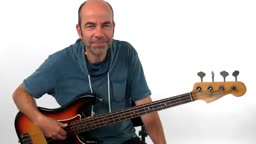
Hi, I'm Jasper Mortier. Welcome To 50 Blues Bass Licks you MUST know. As a self taught musician, I've been making a living as a blues bass player for more than twenty years. I've found that expression and feel is what a bass player needs to bring to the gig and to the jam. Aside from - of course - an extensive knowledge of blues standards and grooves. In this selection you will find all the bass licks you'll ever need for a blues jam. But because feel and expression are so important, we'll also look at different playing and muting techniques. These will shape your playing and define your place in the band as the connecting force between drums and the other musicians. Blues bass licks like 'Help Me' and what I call a 'Lumpty Dumpty' are standard issue material for jam sessions. We'll take a look at different bass grooves, like a rumba, a boogaloo, a New Orleans style bass line, a funk shuffle and a stroll. Keeping your cool is extremely important as a bass player in a blues setting. Playing Powerful but relaxed grooves like a flattire will tie things together. Muting is a very important part of playing the bass. We'll play licks that look at different types of right and left hand muting. A special kind of muting combination will make your electric bass sound like an Upright bass. We will provide tabs, backing tracks and extra information with all these 50 bass licks. I wish you lots of fun in studying these grooves and licks. There is a load of good material in here to help you in all kinds of jam and playing situations. Let's get busy!
Mustang Jelly
Chuck Berry had a simple theory to create a hit: just stick to every day issues for your songs like cars and girls for example. In Mustang Sally those two topics are simply combined and proved Chuck Berry's theory completely right! But the song would have never reached such a legendary status without the smooth yet powerful rhythm track created by one of my all time favorite rhythm sections: Al Jackson on drums and Donald 'Duck' Dunn on bass and of course the great rhythm guitar by Steve Cropper. In their version of the song the bassline is doubled by the guitar giving it an even more driving feel.
Start And Finish
Bass players in the 60-ies and 70-ies often constantly muted their strings with foam. But with this overall way of muting you just make all of the notes die out faster - which can already sound funky enough though! - but it the note doesn't stop at a specific moment. To be more aware of the length of the note try to think of 'organ' for instance since that's got an everlasting sustain as long as you keep on pressing the key. This way of playing also helps to be more aware of all of the 16th notes in your part and not only of the actual notes picked. You'll also become more aware of the silence in between your notes. Those are at least as powerful as the noise you're making!
Cool Vultures
John Mayer is clearly influenced by blues guys like Stevie Ray Vaughan for example, but he took it to another level with the John Mayer trio. What I really like and admire about those sessions is the seemingly simplicity of the performances. The live recordings like Try! have nothing added as far as I can hear. No extra guitars, vocals or keyboards. Just three fantastic musicians playing a bunch of strong songs live. So it gives us a huge opportunity to study what you can achieve with as few resources as possible: it gives the rhythm section an enormous responsibility. It's only doable with super sound, super timing and refined parts. This is of course in good hands of Steve Jordan on the drums and Pino Palladino on the bass.
Straight Thrill
Jerry Jemmott - the bassplayer on the Thrill is gone - is one of the main influences of Jaco Pastorius so you know he's got some chops! He could have easily outperformed about anybody on this planet on this song, but still he choose to play this groove as simple as possible. The guy who they all got it from is James Jamerson of course. Listen for instance to 'I heard it through the Grapevine' by Gladys night and Pips to get an idea of this 'wobling' over the changes.
Boogaloo
The perfect example of a boogaloo would be Tramp. If you listen closely to the original version by Lowell Fulson you'll hear the guitarplayer being tricked when going to the V too late and later the bassplayer by going to the V too soon. Once again: everything is recorded live in those days. No overdubs to correct those kind of mistakes! And apparently a frontguy who likes to fool around with his band even during recording. Otis Redding did a killer and very funny version too with Carla Thomas. Of course here we have Donald 'Duck' Dunn on the bass. He plays the lick with a VIIb and the I is not as muted as the Lowell Fulson bassplayer's version.
New Orleans Style
This feel is also called 'playing it in a swingstyle'. So they write regular 1/16 notes, but you should play them in the triplet or 'swing' manner. Another very clear example of this triplet feel is of course 'Superstion' by Stevie Wonder (listen to that hihat part played by Stevie himself!) and also you may want to listen to the mega-funky 'Come Dancing' by Jeff Beck with it's killer bassline and ditto drums. Let's try to explain the difference between a shuffle and this triplet feel: First let's stick to a regular 4/4 with 4 quarter notes in a bar. In a shuffle the quarter notes are divided into three pieces (triplets) instead of two like with regular eighth notes (sometimes called straight 8). Therefore resulting in 12 8th notes in a bar (4x3) instead of a 'regular' 8 8th notes (4x2). In the so called triplet feel the quarter notes are regularly divided in eighth notes but those itself are divided into three instead of two sixteenth notes. Resulting in 24 1/16th notes (4x2x3) in a bar instead of a 'regular' 16 16th notes (4x2x2). So if you're still with me: you could consider the tripletfeel a halftime played fast shuffle!

+ 46 more lessons

Start Course

Reviews

11 results

Dima1234

Verified buyer

06/07/25

Good course

micktur

Verified buyer

07/14/21

Very happy with this addition to my bass journey. Love it.

jotka53

Verified buyer

06/29/21

50 Blues Bass Licks You Must Know

It makes fun to play that licks

zoopit

Verified buyer

03/23/21

Great Course!

I'm just getting started in playing bass guitar and this course suits me perfectly. I am an intermediate guitar play with emphasis on the blues. I couldn't be more pleased with the content. Very clear and concise lessons and had me playing great bass licks in no time! Very encouraging.

Gary P.

01/10/21

My Favorite Truefire Course!

HIghly recommended! There's some easier stuff in this course, some really hard stuff, and just about everything in between, but the licks are FUN and Jasper is just terrific....I could listen to him all day. Wish he had more courses! Best course I ever bought.

Stop searching. Start improving with All Access.

Try 14 days free. Cancel any time.