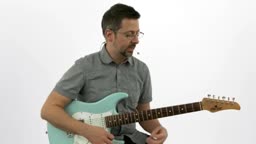
Focus On: Fusion

Requisite skills, techniques and harmonic knowledge for fusion guitar

Marty FriedmanTommy EmmanuelSteve VaiEric GalesEric Johnson

Get this course and 1,000+ more with All Access

Try 14 days free. Cancel any time.

Purchase Individual Course for $9.99
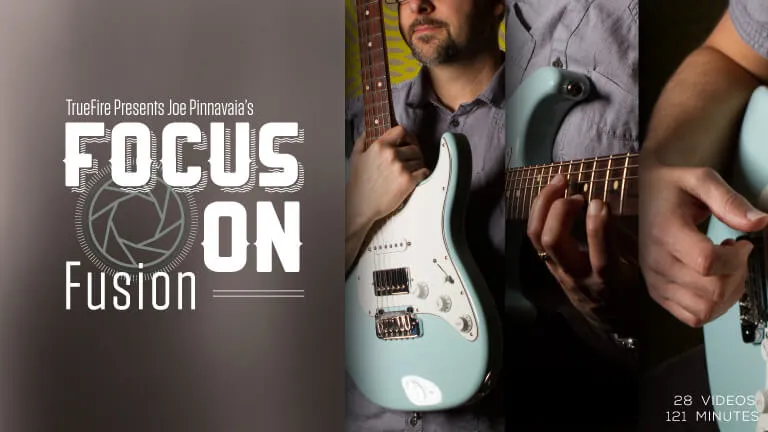
Focus On: Fusion

About this course

Fusing jazz, rock, funk and R&B and forged back in the 60’s and pioneered by artists such as Miles Davis, Larry Coryell, Pat Metheny, Gary Burton and John Mclaughlin, the genre known as Fusion continued to evolve and is very much alive and well today. There are many contemporary derivatives of fusion, and all of them are exciting to listen to and a blast to play, especially for guitarists.

While the genre’s waters run wide and deep, Joe Pinnavaia’s Focus On Fusion curriculum will introduce you to the style and help you form a foundation of the requisite skills, techniques and harmonic knowledge that you will build on to become an accomplished Fusion player.

Joe organized the course into four sections. In Section 1, Joe presents a brief background and historical overview of the genre and its key players, along with tips on tone and gear.

In Section 2, Joe presents five key Soloing Concepts: Extending Your Pentatonics, Using A Linear Approach, Using Triads For An Intervallic Sound, Tension and Release, and How To Fusionize Your Phrasing.

In Section 3, Joe presents five key Chordal Concepts: Fusion Chord Voicings, Chord Substitutions, and Harmonizing With Pentatonics

In Section 4, Joe guides you through four Performance Studies, which apply all of the techniques and key concepts presented in the previous sections.

  1. Static Vamp: Two-chord vamp in the key of A Minor that highlights the Dorian sound and demonstrates the use of chord forms, pentatonics, triads and chromatics to spice up static vamps.
  2. Two Chords Two Keys: A simple progression (D Min7 to D Maj7) with a focus on using chord tones to alternate between major and minor keys using triads and chord shapes to stay "inside" the keys resolve the changes.
  3. Minor 3rd Ascension: Focus on developing melodic ideas over a four- chord progression (CMin7, A Min7, F# Min7 and Eb Min7) designed to develop visualization skills for playing over changes.
  4. B Minor Jam: Emphasizes the harmonic minor scale and modal playing for hitting the change on the V chord to help develop statements with the tension and resolution characteristics of fusion improvisations.
Joe demonstrates all of the Performance Studies over rhythm tracks and then breaks them down measure-by-measure, technique-by-technique. All of the key examples and performance studies are tabbed and notated for your practice, reference and study purposes.

You’ll also get Guitar Pro files so that you can loop and/or slow any section down as you work through the lessons. Plus, Joe generously includes all of the rhythm tracks for you to work with on your own.

Grab your guitar and let’s fuse on!

What you'll learn

  • Apply chord extensions to add color and dimension to progressions
  • Create melodic movement through voice leading
  • Understand how to substitute chords while maintaining harmonic function
  • Understand the history and key players of fusion guitar
  • Develop fusion-style comping vocabulary
Release date: 04/08/2015 • 2h 02m runtime
Start Course
Sample lessons
Extending Your Pentatonics
Soloing Concept 1
Using A Linear Approach
Soloing Concept 2
Harmonizing With Pentatonics
Chordal Concept 3
Minor 3rd Ascension
Minor 3rd Ascension
Overview

What's included

28 lessons • 12 charts • 9 Jam Tracks

Focus On: Fusion
Welcome and thank you for joining this course!
I hope that you will get as much out of this as possible and will add fuel to your desire to play fusion for years to come.
Fusion is a genre that crosses paths with many others such as rock, jazz, blues, R&B, funk and some world and ethnic music.
If you listen to many different types of music chances are you will infuse that into your playing. Congrats! For most that is no easy task. If you like even a few different genres it leaves you open to inspiration from other places and keeps your perspective fresh.
This course is broken down into four sections and discusses topics such as the history and players, gear, soloing concepts, chordal concepts, plus 4 different performances that I break down for you. Not bad! Plus there is plenty of TABs and references for you to call up when you need them.
Again, I thank you and look forward to helping you reach your goal of becoming a better musician!

Joe
SECTION 1: Background
Rock and jazz were nearly separate until about 1967 when the use of electronic instruments were combined with such traditional jazz instruments. Since then the fusion genre exploded with a bevy of players and groups that made the genre what it is today.
What we will do next is discuss some of these key players and gear considerations to help shape your fusion sound.
History and Players
Listening to great players of the genre that you would like to master is one of the most important parts of learning.
You can pick up phrasing ideas and note choices that will inspire you to become that fusion player that you want to be.
Here are a few greats to listen to:
Allan Holdsworth
Brett Garsed
Greg Howe
Scott Henderson
Pat Methany
John McLaughlin
Larry Coryell
Larry Carlton
Wayne Krantz
Also check out these new players:
Martin Miller
Tom Quayle
Rick Graham

Do not listen to just guitar players and as Michael Brecker said - "Copy me and you become an imitator - listen to who influenced me and become my peer."

Check out sax players - how they phrase and how they solo is way different than how a guitarist may approach it. You will learn great things from other players who play instruments that are not your primary instrument. Keep your "Big Ears On!"
Tones and Gear
Gear is always an open forum and a great topic of often heated discussions. Keep one thing in mind - you should look at what your favorite players use and start there. Maybe not the $300 distortion pedal but something similar that will get you the results you desire - experiment, experiment, experiment!

Amp Modelers to look at are - Avid Eleven Rack, AxeFx, Kemper profiling amp. Also nice clean tube amps can be used with pedals to get both a great clean and great distortion sound. Fenders are such amps as well as Port City.

Guitars can be anything from Gibson and Fender guitars to custom guitars such Suhr Anderson and Lull guitars. I have also seen Ibanez guitars as well - again it depends on the sound you are going for.
SECTION 2: Essential Soloing Concepts
Use of improvisation in a rock setting and playing through changes. We will work on extended pentatonics, modal/linear approaches, intervallic ideas by using triads and fusionizing your phrasing by way of legato.
Extending Your Pentatonics
Pentatonics are easily accesible to most players but have a huge impact with varied uses. Here are some ways to combine two box shapes to make three note per string forms that fusion players are using. These ideas can generate some interesting intervallic lines with wide stretches and arpeggios that will have you outside of the typical pentatonic patterns.
Using A Linear Approach
Modes are essential for any style of music and improvisation. Here we will discuss the modes and ways of putting them together so that we may start using all of the fretboard as well as seeing beyond one position. One way of seeing beyond the fretboard is by using the octave as a way of landmarking the fretboard.

+ 21 more lessons

Start Course

Reviews

5 results

Baccetti

Verified buyer

12/08/25

OK.
markusr

Verified buyer

07/06/25

Could use an update

Course is good. Lots of great info, but the pdfs could use an update. Only a few parts of the performances are transcribed and even the lessons the transcriptions don't include alot of playing. Great teacher and helpful course otherwise

Russell100

Verified buyer

02/11/25

Expanding into fusion

I'm looking to expand my blues and rock style and add some fusion elements into it. I've only just started this course, but in scanning it, it looks like it will be perfect for me. As are all the truefire courses I get. I like there's so many focused courses. I can work on exactly what I need as I progress in my learning.

salkatzos

Verified buyer

01/21/25

Fusion Fun

This is a great lesson. It is also very comprehensive and in depth. There is so much here that demystifies playing fusion and it’s all served up in a way that is understandable and easy to apply. I look forward to getting through this and achieving a higher level of playing.

Acrooster

Verified buyer

03/05/19

Really good

A great overview of some great approaches to a very deep technique--Fusion. I like the topics that allow you to sound like that genre. I really like the examples showing the style of some of the big names in that field. If you are looking for a good kick start to this style of music, then this is a good course for you.

Stop searching. Start improving with All Access.

Try 14 days free. Cancel any time.