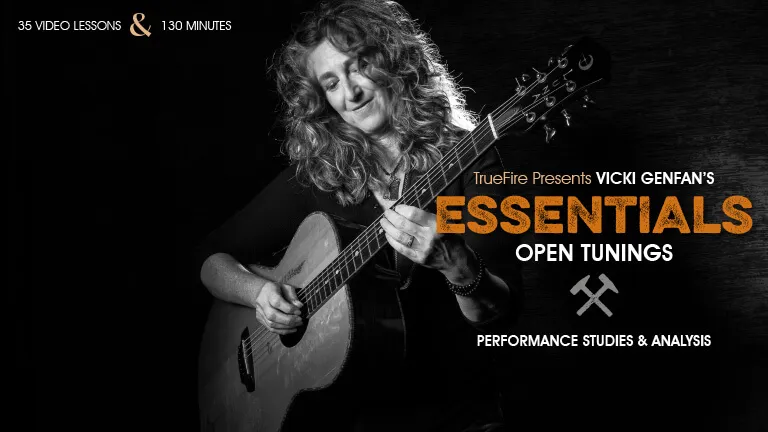
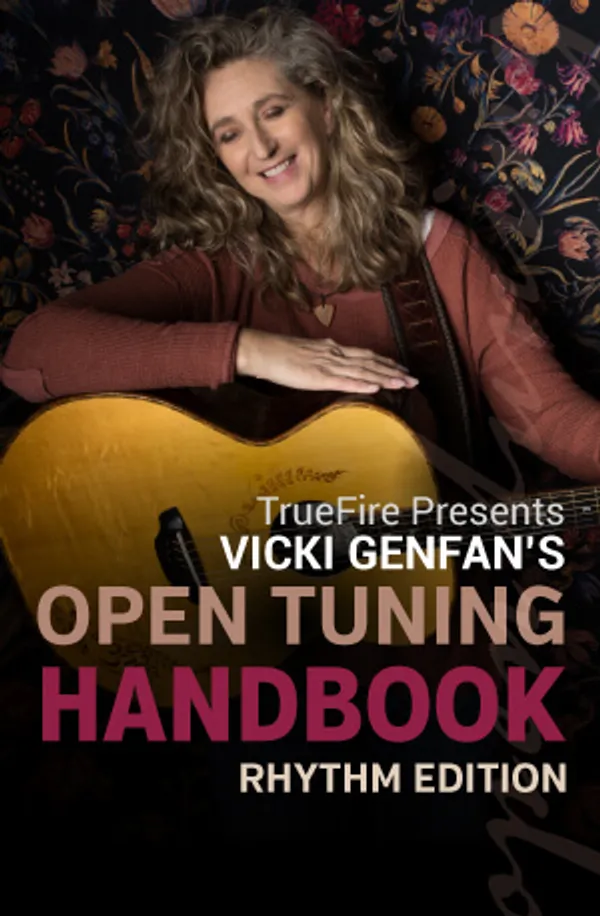
Vicki Genfan guides you on an engaging exploration of 11 colorful and versatile open tunings that you can use for original compositions, arrangements, vamps, jams and creative development.
One of the most harmonically exciting and singular qualities of the guitar is the player’s ability to easily tune their instrument to a virtually countless variety of ‘open’ tunings (also referred to as ‘alternative’ or ‘alternate’ tunings).
Popularized by rock, pop and folk artists in the 60’ and 70s, open tunings gave the likes of Nick Drake, Jimmy Page, Richie Havens, David Crosby, Keith Richards and Joni Mitchell their distinctive if not signature distinctive sound palettes.
The use of open tunings continued to flourish across a variety of styles up to present day by guitar masters including Michael Hedges, Pierre Bensusan, Preston Reed, Don Ross, Al Petteway, Don Alder, Justin King, Kaki King, Petteri Sariola and Andy McKee.
Recording artist, touring performer and Guitar Player Magazine Guitar Superstar, Vick Genfan uses open tunings almost exclusively and is widely respected as a true innovator and master of the style. Vicki is also a prodigious educator with several platinum-selling courses to her credit.
“Open tunings spark instant creativity by putting fresh palettes of sonic colors under your fingertips. Because the fretboard patterns, fingerings and muscle memories of standard tuning are no longer relevant, you’re forced to let your ears guide your music. And it’s that fretboard freedom and the ultra-rich harmonies that are possible with open tunings that foster such creativity and inventiveness.”
Each of the 11 Performance Studies in this edition of ESSENTIALS features a different open tuning: D sus 2 Tuning, D sus 4 Tuning, D min 7 Tuning, Open D Tuning, D7 sus 4 Tuning, Open G Tuning, E m11 Tuning, C sus 2 Tuning, C m11 Tuning, C 6 add 9 Tuning and C 11 add 9 Tuning.
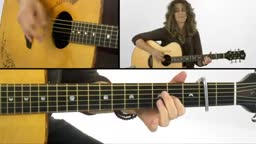
For each Performance Study, Vicki introduces you to the tuning, describes its harmonic characteristics and then performs the study. In the breakdown section of each study, Vicki teaches you the study’s chord voicings, techniques and rhythm patterns as she steps you through the study measure-by-measure.
Everything is tabbed and notated, PLUS Vicki also includes an Open Tuning Exploration Guide which contains four essential resources for your Open Tuning education: (1) An expanded chord chart for each of the 11 tunings giving you more colors for you palette, (2) A step-by-step guide for Exploring Open Tunings, (3) A step-by-step guide for Creating Your Own Open Tunings and (4) The perfect creativity warm-up, The Rut Buster Exercise.
Grab your guitar and click now to open up your playing…
About the Series
Designed for intermediate and advanced students, TrueFire’s Essentials courses consist of Performance Studies focused on the "essential" harmonic and technical characteristics of a particular style of playing. Educators first perform the study for demonstration purposes and then break it down for the student. Performance Studies include tab, notation and practice rhythm tracks.
What you'll learn
Navigate chord voicings in unfamiliar tuning landscapes
Explore how different tunings inspire different musical ideas
Understand the purpose and benefits of open tunings
Learn to create your own custom open tunings
Develop a systematic approach to exploring new tunings
This course is an in-depth introduction to 11 open tunings that have been specially chosen for the guitarist who is hungry for new sounds, new sonic and rhythmic possibilities, and is downright curious about all this 'open tuning' stuff! While open tunings have been used by guitarists of all musical genres, acoustic and electric players alike, they are just now becoming of greater interest to the mainstream guitar world. Artists such as Nick Drake, Jimmy Page, Richie Havens, David Crosby, Keith Richards, and Joni Mitchell have been using open tunings in popular folk and rock music of the 60's and forward, while many know Michael Hedges for his extended techniques and pioneering contributions to the world of solo fingerstyle guitar in the 70's and 80's. In the singer songwriter world, Jonatha Brooke and Shawn Colvin are just 2 artists whose open tuning guitar playing often goes under-appreciated in favor of their great lyrical content and amazing vocals. Other artists you may have heard such as Pierre Bensusan, Preston Reed, Don Ross, Al Petteway, Don Alder and in the younger generation, Justin King, Kaki King (no relation), Petteri Sariola and Andy McKee are all using open tunings to go beyond the traditional techniques of guitar playing. The music being composed and arranged by these and countless other artists is simply fantastic and deserves our attention and great appreciation. I hope to demystify open tunings for you and open the door into this exciting playground!
Note: Hawaiian musicians refer to open tunings as 'Slack Key' because when tuning the strings lower (you can also tune them higher), the strings become a bit loose or slack. You will also hear people talk about alternate or alternative tunings and they are basically referring to the same thing. Some will say the difference is that an open tuning sounds like a chord when strumming all the open strings together, while an alternate or alternative tuning doesn't particularly sound like a harmonious chord. For our purposes I will refer to open tunings throughout this course meaning any variation from standard guitar tuning (E A D G B E).
I’ve written 11 new teaching compositions, or etudes, which serve as introductions to each of the tunings. Each one has something special to offer. Close your eyes, and open your heart and ears when you listen to me play them. Some will move you more than others. There’s no need to go in order - start where you are most excited and work your way through them all. You’ll soon realize that it’s not that difficult to re-tune your guitar, and Wow - what a small price to pay for the payoff of creative juice that will flow as a result!
I hope you’ll also spend time exploring each tuning on your own. Refer to the PDF, "Exploring New Tunings" for a bunch of ideas about how to do this. And don’t be afraid to try your hand at creating your very own tunings. Again, I’ve provided a PDF called "Creating a New Tuning" to give you some guidelines. With 6 strings and a range of at least 6 notes that we can tune each string to, there are 46,656 possibilities! Get busy people!
My approach to this course overall is very much from a creative angle. This is how I've always worked. I'll talk about the tunings in terms of special features and cool things I've discovered you can do with them, not from a highly technical or theoretical standpoint. Those of you who think that way may come up with your own deductions and theories as you go along - and I encourage you to do so, but not at the expense of your creative self who just wants to make awesome music and get lost in the jingle jangle droney modal world that awaits! ** Note about naming these tunings: I wanted to name the tunings after the chords the open strings played. In the world of music theory, there are varying opinions about the correct names of some of the more complex chords. For this reason, I've made a special *Note in some of the following text when I think it's important that you see alternative naming possibilities!
(*Naming: This chord is probably more likely to be named a Dadd2. There is not actually a suspension with the addition of the 2nd chord tone. This refers more commonly to a suspended 4th which suspends the resolution of the 3rd.) This tuning has a neutral sound, because it has no 3rd in it. The chord quality, (major or minor) is undetermined. This also makes it sound a bit unresolved. Note: There’s a whole step between the 4th and 3rd strings (in standard tuning there’s the much larger interval of a perfect 4th), so when you play single note lines, patterns and scales that you’d play in standard tuning you’re going to get some interesting surprises when going between those two strings!
Songs I’ve used in this tuning are Norwegian Wood, Let it Rain (both on my ‘Up Close & Personal’ CD), Why Don’t Love Sit Still, Outside the Box (‘Outside the Box’ CD) and a song to be released on an upcoming CD, ‘I Didn’t Cry for You’.
Don’t forget to try using the capo on all the tunings. This one in particular has a great ringing quality capoed in the higher frets - if you let the high strings (1, 2 & 3) ring open. Explore!
If you feel more comfortable using a pick, feel free to use it. In the finger picking or plucking section it will be good practice for your flatpicking technique. Take note of how I use my left hand thumb to help mute the 6th string while I'm playing the chords that have the 5th string as the bass.
Make sure to move your left hand fingers as little as possible when changing chords - notice which fingers can remain on the strings as you move from one chord to the next. While my strumming pattern involves down-up strokes, you may find it easier to strum with only down strokes. That's fine too, as long as you're playing the correct rhythmic pattern.
Probably the most well recognized and used of all the open tunings, DADGAD seems to have permeated Celtic, American roots, blues, and fingerstyle genres, just to name a few. Many trace the tuning back to Davey Graham, one of the most influential guitarists in the British folk music scene of the 60’s. Graham had a great influence on guitarists as diverse as Bert Jansch, Wizz Jones, John Renbourn, John Martyn, Paul Simon and Jimmy Page, who in turn influenced players such as the French-Algerian guitarist, Pierre Bensusan who uses DADGAD exclusively in his music which is most often characterized as Celtic, folk, World music, New Age, or chamber jazz. I found a wonderful quote from a website called Session.org that sums up the ‘Zeitgeist’ of this period of time and musical innovation in the 60’s; “There were bazillions of guitar playing eclectic folk fanatics tuning into exotic ethnic musics and experimenting and improvising with the main instrument at hand - the guitar”. There are ties to Morocco, to the modal tunings used by the slaves of African descent on their banjos, to the middle eastern Oud. And the list goes on. The etude I've composed for this tuning reflects two sides of this uber versatile tuning; a modal, roots feel showing its blues influence as well as a more new age or folk feel which highlights the lush, rich chord voicings that are so easily found here.
Take note of the basso ostinato in the first section where we allow the low 6th string (E) to ring throughout the first three chord changes.
In the first section, when playing the single note descending scale phrase, see what works for you - you can pick each note or you may want to do some pull-offs. Notice the middle finger of my left hand subtly muting the 6th string on the C#m11 chord in the second section. Can you do that? It's a great skill to have. After a while it becomes second nature!
An exceptional and very good teacher. Her teaching method is very effective. Her classes are very pleasant to follow. Simply. . . good and friendly.
A
arpeggio5
Verified buyer
08/29/24
You of her courses and all her courses are very understandable. She explains things very clearly and she makes her point on each lesson. She’s a very excellent teacher with rhythms cord tones, and open to meetings.
R
rbroeg
Verified buyer
12/23/20
Big variety of tunings
This course has more tunings than I knew existed and chord charts for each oner.
2
2canoe
Verified buyer
09/27/20
Great Introduction to Open Tunings
Vicki Genfan explores open tunings including the more common D and G as well as a number of unique ideas. Chord shapes are presented for all the tuning combinations plus examples of how they can be used. Great new voicing ideas. Thanks Vicki and Truefire