Open Tuning Handbook: Rhythm

Creative Approaches & Applications for Open Tunings

Marty FriedmanTommy EmmanuelSteve VaiEric GalesEric Johnson

Get this course and 1,000+ more with All Access

Try 14 days free. Cancel any time.

Purchase Individual Course for $9.99
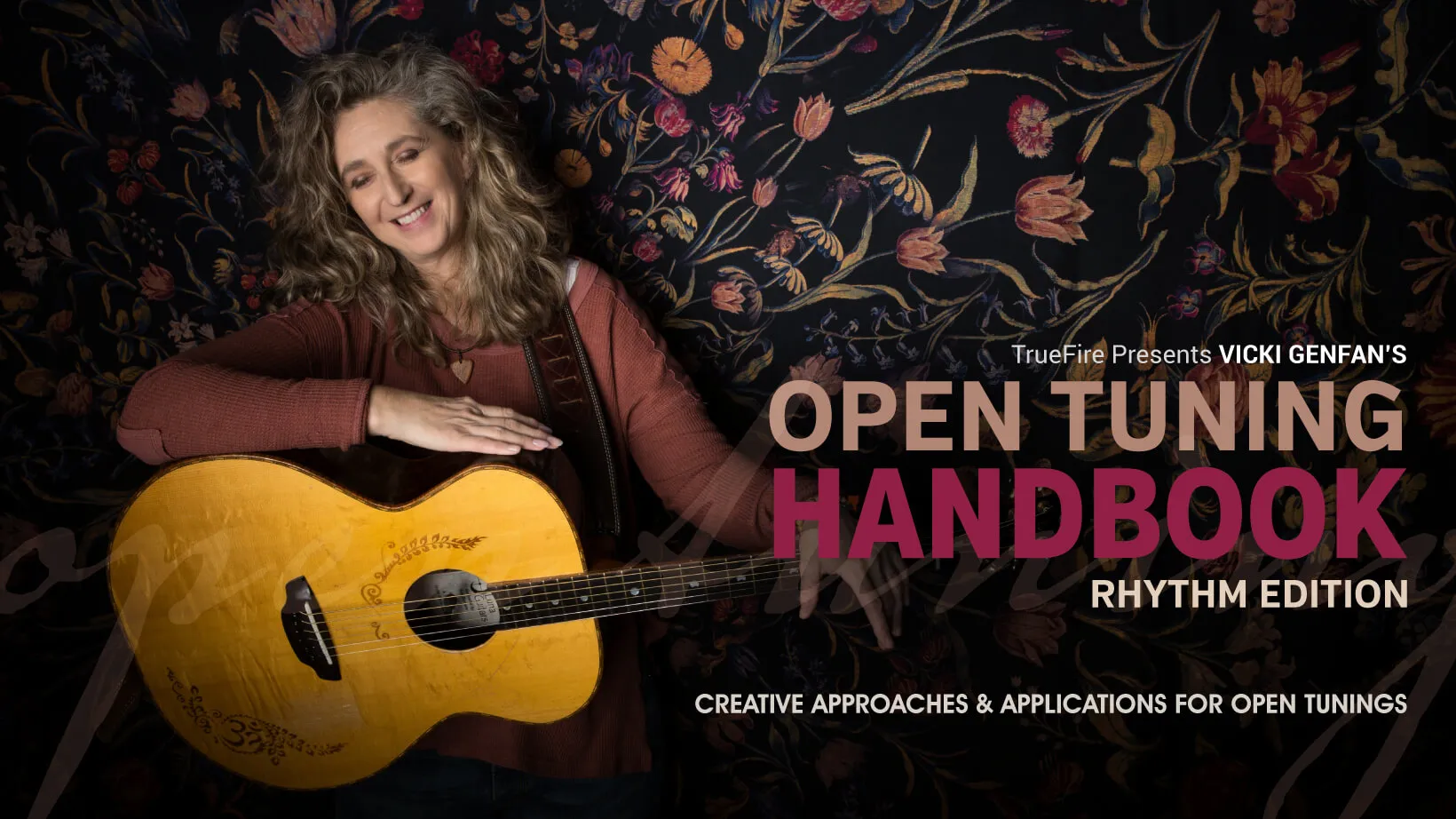
Open Tuning Handbook: Rhythm

About this course

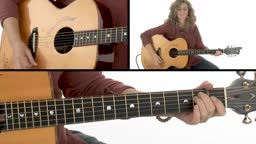
Andy McKee, Jon Gomm, Petteri Sariola, Christie Lenee, Kaki King, and Vicki Genfan are all part of the new generation of acoustic, percussive players who favor open tunings. However, rock veterans like Rolling Stones guitarist, Keith Richards, and Led Zeppelin’s Jimmy Page, as well artists like Nick Drake, Richie Havens, Joni Mitchell, David Crosby, and Michael Hedges have all been taking advantage of the sounds and sonic possibilities that these tunings offer long before today.

Open tunings are not only beautiful sounding and very easy to play -- they’ll spark your creativity whether you’re covering songs or composing your own. In this Rhythm Edition of Vicki Genfan’s Open Tuning Handbook, you’ll learn five of her favorite open tunings, the chord shapes you need to know, and 3 etudes for each tuning.

”I’m thrilled to introduce you to the magical world of open tunings while at the same time, demystifying them. We’ll work with 5 of my favorite tunings and we’ll learn common chords in each tuning, chords that will enable you to play tons of songs. My wish for you in this course is that you will find open tunings to be yet another ‘tool’ in your musical toolbox, one that you can use to add new sounds, new ideas and new inspiration to the songs you’re playing, arranging and or composing.”

For each of the 5 tunings, Vicki created a set of lessons including an overview of the tuning, tuning guide, general demonstration of the tuning, and then 3 Performance Studies (etudes) at 3 different playing levels, starting with ‘late beginner’ and then progressing to late intermediate

Vicki wraps the course up with a Rut Busting lesson to help spark your creativity and originality.

Vicki will explain and demonstrate all of the key concepts and approaches along the way.  You’ll get standard notation and tabs for all of the performance studies and will be able to loop or slow down any of the videos so that you can work with the lessons at your own pace.

Grab your guitar and let’s dial in an open tuning with Vicki Genfan!

What you'll learn

  • Create a distinct groove using rhythmic breaks
  • Apply palm muting as a rhythmic device
  • Learn the relationship between Em and the key of D
  • Understand how this tuning simplifies complex voicings
  • Build tempo gradually while maintaining the pattern
Release date: 05/21/2018 • 1h 58m runtime
Start Course
Sample lessons
Course Primer
Course Primer
How to Work the Course
Csus2 (CGDGCD)
Csus2 (CGDGCD)
Overview & Tuning
Diatonic Chords & Let It Be
Csus2: Demonstration
I vi ii V Etude Level 1
Csus2: Performance

What's included

51 lessons • 30 charts

Open Tuning Handbook: Rhythm
Open tunings (aka alternate tunings) have become a "buzz phrase" within a sub-culture of the guitar world and you may have heard it used when talking about artists such as Andy McKee, Jon Gomm, Petteri Sariola, Christie Lenee, or Kaki King, who are part of the younger generation of acoustic, percussive players. However, rock veterans like Rolling Stones guitarist Keith Richards, and Led Zeppelin's Jimmy Page have been taking advantage of the sounds and sonic possibilities that these tunings offer long before today. In the 60's & 70's, artists like Nick Drake, Richie Havens, Joni Mitchell, and David Crosby continued the tradition, making music influenced by open tunings, and in the 80's, Michael Hedges came on the scene, completely reinventing the acoustic guitar with his innovative and kinetic style, compositions, and spirit. I encourage you to listen to (and watch) any and all of the artists I've mentioned, as there is such a broad range of music and technique they each display. This genre of guitar music has blossomed and truly found it's time and place and can be referred to in varying ways; acoustic fingerstyle, percussive, two handed, free style...and many more.

In this course, I'm thrilled to introduce you to the magical world of open tunings while at the same time demystifying it. At the time of this writing, I have "discovered" over 36 tunings myself, and from those tunings I have created many, many songs and some really fun techniques: thumb slapping, body percussion, harmonic tapping, and variations on these. I fell into this purely by accident, after hearing the wonderful sounds from the guitar and dulcimer of singer/songstress Joni Mitchell in the late 70's. I dove into this "uncharted territory" using only my ear and my heart. I fell in love with the wide "open" sounds, simple chord shapes, and later on, the shimmering harmonics. I explored, experimented, and found my hands using the guitar and guitar body in percussive ways I never knew were possible. What evolved over many years was a kind of one-woman band where bass, rhythm, and melody were all coming out of the guitar. I call it "slap-tap". This is FUN!!

I'd like to open this world to you in a way that is fun and easy. OK – learning any new skill takes time and practice, but I want to present open tunings to you without overwhelming you. And by the way, don't worry about breaking strings – just prepare by buying some single E, B & G strings (1st, 2nd & 3rd). You can get them at any music store or online (I use D'Addario strings).

We'll work with 5 of my favorite tunings and we'll learn common chords in each tuning, chords that will enable you to play tons of songs. My wish for you in this course is that you'll find open tunings to be yet another "tool" in your musical toolbox, one that you can use to add new sounds, new ideas, and new inspiration to the songs you're playing, arranging, and/or composing – and you can apply all of this on acoustic or electric guitar. (Note: Electric guitar strings are typically much lighter gauges and this will make tuning lower a little more challenging, but not impossible!)

If you're interested in going further with open tunings and the percussive techniques I use, you'll probably love my 3D Acoustic Guitar and Essentials: Open Tunings courses, both of which take you further down the road with this work.

How Will YOU Use Open Tunings in Your Playing or Writing?
Many of my colleagues who use Open Tunings use only one or possibly two. This allows them to dig deeper into the tuning, learn scales, arpeggios, multiple chord voicings, etc so they are able to easily compose, jam, play along with others or figure out cover songs, etc. My path has been different. I chose to use the tunings more as writing tools, and I have continually come up with new tunings for over 35 years...I can figure out anything if I spend the time, since I do understand theory and I have a good ear. This helps me write out charts and tell other musicians what I'm playing. (Using the 'Nashville' numbering system is very helpful in this way, and I'll explain that to you in the course!)

So, let the tunings speak to you and discover how you want to include them in your playing. There are no rules – except to follow your JOY!

This course is the Rhythm edition of the Open Tuning Handbook. It will be followed by a course called Open Tuning Handbook: Scales and Patterns which will take us on a journey through scales, patterns, melody lines and soloing in the 5 open tunings!

Course Primer
In summary, this is how I've laid out the course:
  1. Naming the strings in each tuning
  2. Playing diatonic chords in the "key" of the tuning (I, II, III, etc.)
  3. Playing "Let It Be" in each tuning
  4. Playing and breaking down the etudes – 3 levels for each tuning
I've created etudes for each tuning in 3 different levels, starting with "late beginner" and reaching into the early and late intermediate levels. However, I encourage you to customize these exercises if you need to. The progressions are simple. Most of the chord shapes are pretty simple (occasional stretch required!). You can always make an exercise more challenging by increasing the speed, or perhaps playing it in a different time signature (if it's in 4/4, try 3/4 or evern 5/4!). You can use a strumming or fingerpicking pattern that's more difficult. Similarly, if you need to make something simpler, try it ultra-slowly, use a more basic strumming or picking pattern. The most important thing is to begin to hear the new sounds, chords and possibilities the tunings bring forth!

Important things:
  1. I'll often refer to chords with numbers, which refer to scale tones (diatonic). In each tuning, there's a central "key" around which we can most easily build these chords.
  2. To indicate which fingers to use with your picking hand on picking etudes, I've used the Italian system of fingering called p-i-m-a. p=thumb, i=index, m=middle, a=ring.
  3. Don't be surprised if you have to "coax" your strings into staying in tune. They are not used to all this changing around! Use your tuner, and after a while, try just using your ear. The more you use it, the better it will get! (good skill for a musician.)
Diatonic Chords
For those who are interested, let me go just a little deeper into the theory. Go to this website for a great explanation. Diatonic chords are built upon the notes in a major scale. Since we have 7 notes (plus the octave) in a scale, there are 7 diatonic chords for each key. 3 are major, 2 are minor, and one is diminished. Millions of songs in hundreds of genres use combinations of these 7 chords to create their structure. It follows then, that if you're familiar with these chords you can play or compose and endless amount of music!
DADGAD
Also called Dsus4, this tuning has a very rich history. You will find it often used in Celtic, American roots, blues, and fingerstyle music, and I've used it in my own blend of pop-folk-funk. We can trace some of its roots back to the music of Morocco, in the unique tunings used by the slaves of African descent on their banjos, as well as in the music of the Middle Eastern stringed instrument, oud. According to some, Davey Graham, a very well known and influential guitarist in the British folk music scene of the 60's brought this tuning into the mainstream, and he in turn influenced players as diverse as Bert Jansch, Wizz Jones, John Renbourn, John Martyn, Paul Simon, Jimmy Page, and the French-Algerian guitarist, Pierre Bensusan, who uses DADGAD as his only tuning. It's got a very "open" and suspended sound due to the fact there is no 3rd in the chord. Due to the popularity of this tuning, some guitarists are using the partial capo (called "DADGAD" capo by D'Addario and "Short Cut" capo by Kyser) which allows you to press down only 3 strings (5, 4 & 3) on the 2nd fret of a Standard tuned guitar, and you'll get this same chord, but with the root on E instead of D (EBEABE).

In the Level 1 exercise for this tuning, we'll play a very simple and beautiful finger picking pattern over our ii-V-I-vi progression. In Level 2, we'll use the guitar body to give us some percussion patterns, and in Level 3, we'll add a simple melody using octaves on the 4th & 1st strings.
Diatonic Chords & Let It Be
We'll be in the key of D. (Wow, I love these chords!) You may need to work up to the stretch in that vi chord...but it's worth the effort. Can you find some chords from songs you know using different combinations of these diatonic chords? Don't forget to check out the "additional" chords on your chart.
ii V I vi Etude Level 1
Make sure to let the strings ring out in this etude. That requires that your right hand doesn't lean on any of the strings in between your chord changes.
ii V I vi Etude Level 1
Check to make sure you're using the correct RH fingerings: thumb (p) on strings 6, 5 & 4. It may take a while to get used to these fingerings, but in time you'll experience more ease of playing and a smoother RH movement over all. Also be sure you're playing the correct bass notes: The ii chord (Em) root is on the 6th string, the V chord (Asus) root is on the 5th string, the I chord (D) root is on 6th string, and the vi chord root is on the 5th string.
ii V I vi Etude Level 2
Again, be sure to let the strings ring out in between chord changes. When strumming, it's a little harder to control which strings you're hitting. Can you mute the 6th string when you need to?

+ 44 more lessons

Start Course

Reviews

4 results

macgurrl

Verified buyer

04/13/25

Great Chord Companion

Great companion to open tunings. I prefer open tunings but, have had trouble learning chord voicing. This program is helping me tremendously. I would highly recommend it to anyone struggling with chords.

arnsin

Verified buyer

07/24/22

lærte mye raskt

garnet

Verified buyer

10/06/18

I have not had time to get into the course.

mattstutts2

10/02/18

Open Tuning Guidance

Vicki is so great in alternate and open tunings and I really recommend this for anyone wanting to get more comfortable in non-standard tunings. I believe she uses 4 or 5 different tunings and then works step by step through etudes in these tunings. There's lots of useful guidance and ideas here and you'll walk away sounding convincing with those ringing open strings. Good stuff here.

Stop searching. Start improving with All Access.

Try 14 days free. Cancel any time.