Fingerstyle Survival Guide

Essential Techniques For Fingerstyle Guitar

Marty FriedmanTommy EmmanuelSteve VaiEric GalesEric Johnson

Get this course and 1,000+ more with All Access

Try 14 days free. Cancel any time.

Purchase Individual Course for $24.99
Fingerstyle Survival Guide

About this course

Every new generation of musicians pays homage to the great artists of past generations. The young artist studies the music of their heroes and mentors, often times learning their recorded performances note-for-note. After years of diligent practice and focus, the young artist starts to develop their own musicality and creative prowess. While still influenced by the masters they studied, the young artist brings fresh perspective, creative innovation and even advanced technical skills to the genre. Such is the evolution of art.

We first met Brooks Robertson at the Chet Atkins Convention when he was just fourteen. Even then it was clear he had the focus, drive and opportunity to become a master of fingerstyle guitar. He also had the heart and initiative to earn the respect of the great Buster B Jones who took him under his wing as a student (here’s what we witnessed in 2007).

“I was so fortunate to have Buster B Jones take me under his wing at a young age and guide my studies with fingerstyle guitar. Buster was a master of so many different styles of fingerstyle and he encouraged me to learn as many different approaches, techniques and styles as possible ….to watch, listen and study as many of the masters as possible... and then take it all and craft my own sound and style.”

What Buster and we didn't know is how skilled and passionate Brooks would become as a teacher. We’re proud to welcome Brooks to the TrueFire family with his Fingerstyle Survival Guide.

“This Fingerstyle Survival Guide is a road map of sorts to discovering your own sound and style. I’m very excited to have this opportunity to pass along all of the essential techniques and concepts that I’ve learned from my own mentors, throughout my own studies. These key learnings have been instrumental in helping me become a more creative, better fingerstyle guitarist and I’m hopeful they will help guide your studies as well.”

In the first section of the Fingerstyle Survival Guide, Brooks presents and demonstrates 16 key concepts and techniques: Movable Chords: 6th & 5th String Root, Movable Chords: Top Four Strings, String Transference, Left Hand Dynamics & Decoration, 1/2 Step Slide Embellishments, Boom Chick: Alternating Thumb, Boom Chick: Patterns, Syncopated Picking Patterns, Banjo Rolls, Waltz Patterns, Skipping Patterns, Fingernail Click Patterns, Right Hand Dynamics & Tone Concept, Cascading Harp Harmonics and Cascading Harp Harmonics.

In the second section, Brooks shows you how apply all of the key concepts and techniques across 7 performance studies:

Keep It Movin’: Traditional country boom-chick sound in the key of E
Into The Trees: Jazzy, funky feel with fingernail clicks and banjo rolls
Waltz For One: Beautiful fingerstyle waltz in the key of C
Jessica Sue: Ballad with string skipping patterns and left hand inversions
Carol: More boom-chick with a tune in the key of A minor.
Jonesin’: Buster B. techniques with a flair of Jerry Reed in E minor.
Waking Up To Dream: Fingernail clicks, rolls and cascading harp harmonics

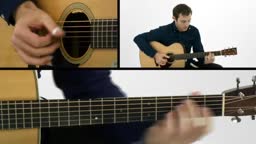
Showing an educator’s maturity way beyond his years, Brooks composed the performance studies to be extremely accessible for the intermediate player and still ear-pleasingly sophisticated enough to holds its own in anybody repertoire. Brooks first performs the studies and then breaks them down move-by-move with impeccable clarity and patience. You will also get tab and notation for all of the key examples and performance studies.

If you’re passionate about fingerstyle guitar, you will find Brook’s Fingerstyle Survival Guide to be an indispensable companion on your learning journey.


What you'll learn

  • Perform finger slides as melodic embellishments
  • Integrate melody notes within chord voicings
  • Apply skipping patterns throughout an entire composition
  • Experience a complete musical performance of 'Live at Five'
  • Observe professional phrasing and musical expression in context
Release date: 03/04/2015 • 4h 00m runtime
Start Course
Sample lessons
Boom Chick: Patterns
Concept 7
Skipping Patterns
Skipping Patterns
Concept 12
Keep It Movin'
Keep It Movin'
Performance
Into The Trees
Into The Trees
Overview

What's included

42 lessons • 22 charts

Fingerstyle Survival Guide
Fingerstyle guitar playing is such a magical way to play the guitar. It is a form of playing in which you can be a six stringed, ten fingered, one person band. Technically it demands being able to control bass, chords, melody and harmony simultaneously in order to achieve a general sense of musicality and fluidity. The more complete and strong your fundamentals, foundations and techniques, the broader range of styles and genres you can approach.

I remember the first time seeing Thom Bresh and Buster B. Jones play live, I was astonished and inspired by how much music could come from one guitar. The method in which I learned from Buster in subsequent years was to initially study key fundamentals and techniques and then slowly apply the concepts to a wide variety of fingerstyle tunes. It is common to see or hear a seasoned musician and be amazed at how simple they make it look to execute. While certain elements of musicianship come naturally for some, most players (myself included) have had to work very hard at developing the necessary skills to be able to play complex fingerstyle pieces.

Having the right study plan as well as a progressive curriculum is very important and I’ve taken that into consideration while designing this course. As you work through the various concepts and techniques be patient, take your time and give each concept many attempts. Feel free to experiment, embellish or enhance the concepts and songs given into something you feel good about and enjoy the sound of. I truly hope this Fingerstyle Survival Guide gives you the essential tools and techniques necessary for improving your playing no matter what level you are currently at or whatever level you aspire to reach.
SECTION 1: Essential Concepts
Think of all your different skills on the guitar like the foundation and framework of a building. Imagine how important the framework and foundation are to the building's structural integrity. If it’s going to be strong, dynamic, resilient and have the capability of being built upon it really depends on these essentials. My hope is to give you the materials to strengthen and expand your existing fingerstyle techniques or maybe even to help you start a new design from scratch.

Section One is here to provide you with fifteen essential fingerstyle concepts that from my point of view are essential and since I first started playing fingerstyle have been some of my favorites. These will include; left hand techniques like movable chord forms, inversions, dynamics, decoration, as well as right hand picking techniques including thumb and finger independence, basic boom chick patterns, syncopated double stop patterns, waltz patterns, skipping patterns, patterns using your palm and fingernails to click on the strings, banjo rolls, cascading harp harmonics, dynamics, tone and more. This part of the course is really about developing the skills and techniques to begin arranging, composing and playing all sorts of fingerstyle pieces.
Movable Chords: 6th & 5th String Root
The movable chord forms here will serve a number of different purposes. They will be great to supplement your existing knowledge and vocabulary of Maj 6, Maj 7, min 6, min 7, Dom 7, and min7b5 chord voicing, they will also be used to introduce you to exploring chord inversions. What's also particularly importantly in the context of this course - they will give you a vocabulary and colors on your palette to pair with your right hand techniques.

I encourage you to try taking a song or two that you already know and try incorporating some of these forms shown in the video/chart. Note the progression you're using in the song and then try replacing any basic minor or major chords with these sightly more colorful chords. For example if you started with G, Em, Am, D one possible alternative would be G6, Em7, Am6, D7. Try a few different combinations and listen to what changes and what sounds you like or dislike.
Movable Chords: Top Four Strings
Here is another example of different, movable chord inversions and forms of the Maj 6, Maj 7, min 6, min 7, Dom7, and min7b5 chord qualities. This time the root will be on one of the top 4 strings of the guitar. Why is it helpful to know where the root is? Well, if you can identify where the root is within these different types of chords and forms then you can play them in any key. All of the examples shown are a great representation of the way chord inversions work. These chord forms sound great with picking patterns, banjo rolls or harp harmonics. I’ve found they also can provide the basis of interesting chord melody ideas when you move between them. Remember this is only a small fraction of chord qualities, inversions and ways to play them on the guitar. Be sure to check out the tab and charts while you get introduced to these new forms. Try all sorts of progressions, combinations and styles to really experiment with how you can use these movable chord forms on the top four strings.
String Transference
From Ted Greene’s book "Modern Chord Progressions" this is a great technique that allows you to play the same chord voicing either on the next higher or lower group of strings. Not only is this helpful for memorizing multiple ways to play the same chord voicing, it also allows you to move across the fretboard and avoid running out of room when looking for a specific chord voicing at a particular pitch. This technique is also helpful when searching for how to play the same voicing and octave higher or lower. Try using this concept with a few different qualities of chords from the movable forms we looked at.

In Ted Greene’s book Modern Chord Progressions here is how the concept of string transference is explained,

“1. To find the same chord voicing on the next higher group of strings, move all the notes in the chord over to the next higher group of strings; retain the same visual shape unless any note has landed on the 2nd string, in which case you move the note up one fret; now move the whole chord down five frets (or up seven if you want to hear the same chord an octave higher).

2. To find the same chord voicing on the next lower group of strings, move all the notes in the chord over to the next lower group of strings; retain the same visual picture unless any note has landed on the 3rd string, in which case you move this note down one fret; now move the whole chord up five frets (or down seven if you want to hear the same chord an octave lower).”
Left Hand Dynamics & Decoration
Dynamics are such an essential component of a song’s overall feel and expression of emotion. It’s one of the most important elements that brings a song to life. It’s not just the notes you play, but how you play and express them. With fingerstyle guitar there are numerous dynamics and decorations that can be produced by either right or left hand techniques, often a combination of both.

Let’s review a few of the left hand possibilities; muting the strings, sliding a note or a entire chord, hammering-on and pulling off notes. These are tools you should have ready if and when wanted. Of course there are many other possibilities like bending, tapping, vibrato, etc. which all offer unique sonic qualities. It’s up to you to experiment and discover which sounds and techniques are the ones that you like and which ones fit well in your style of playing. Also as you listen to your favorite players be aware of how and where they use these kinds of techniques.
1/2 Step Slide Embellishments
This is a great sounding tool that you can use for a variety of different sounds. It will be important to have a grasp of some basic chord forms that you will apply this technique to. The primary idea is to take any chord form and play the chord in double stops (groups of two notes at a time) ascending or descending. What gives the technique an even more unique sound is adding in two slides (down a 1/2 step, then back up to the cord tones) after initially playing the double stop.

After some experimenting you might find that this would also work with groups or three notes, or four, etc.. First practice the technique with very few chord forms, even one is enough to begin. Then as you become more comfortable, smooth and fluid with the concept try it with various qualities, inversions and progressions of chords. It is up to you to experiment with all the various songs and places you could apply this technique and what sounds good to your ears.

+ 35 more lessons

Start Course

Reviews

12 results

Eugst

Verified buyer

12/22/25

Brooke has done it again!

Very good course! Brooke gives us the needed tools and beautiful songs to practice them.

Cyril

06/16/21

Good lesson for intermediate fingerpickers

Nice structure here as the first part covers all main techiques used afterwards in the different etudes that follow. I thoroughly enjoyed working on Keep movin' and feel that my boom chick has improved (more regular, controlled and steady), although I'm not sure I'll work on all pieces, I feel it's a good course that pretty much covers all aspects of fingerpicking and helps take your level up a notch (my playing on some difficult Chet Atkins or Tommy Emmanuel pieces has improved in musicality for sure!). Thank you Brooks for the course!

Revman2015

04/30/21

Mr Variance

Brooks Robertson Finger-style Survival guide guitar course is a must do course. In fact it could be the course for opening many a door at simplifying complex things.You’ll learn a lot from this course.His Variances caught me by surprise. Some seriously complex stuff if your up to the challenge. He is seriously good. Check his array of work. Mighty impressive

vmjmurphy

Verified buyer

11/23/20

Great Course!

This was pretty much exactly what I was looking for. If you want to improve your fingerstyle skills just go for it. Great course!

Geetar78

Verified buyer

11/18/20

Good course to start learning using thumb pick and getting different concepts under your fingers..

Stop searching. Start improving with All Access.

Try 14 days free. Cancel any time.