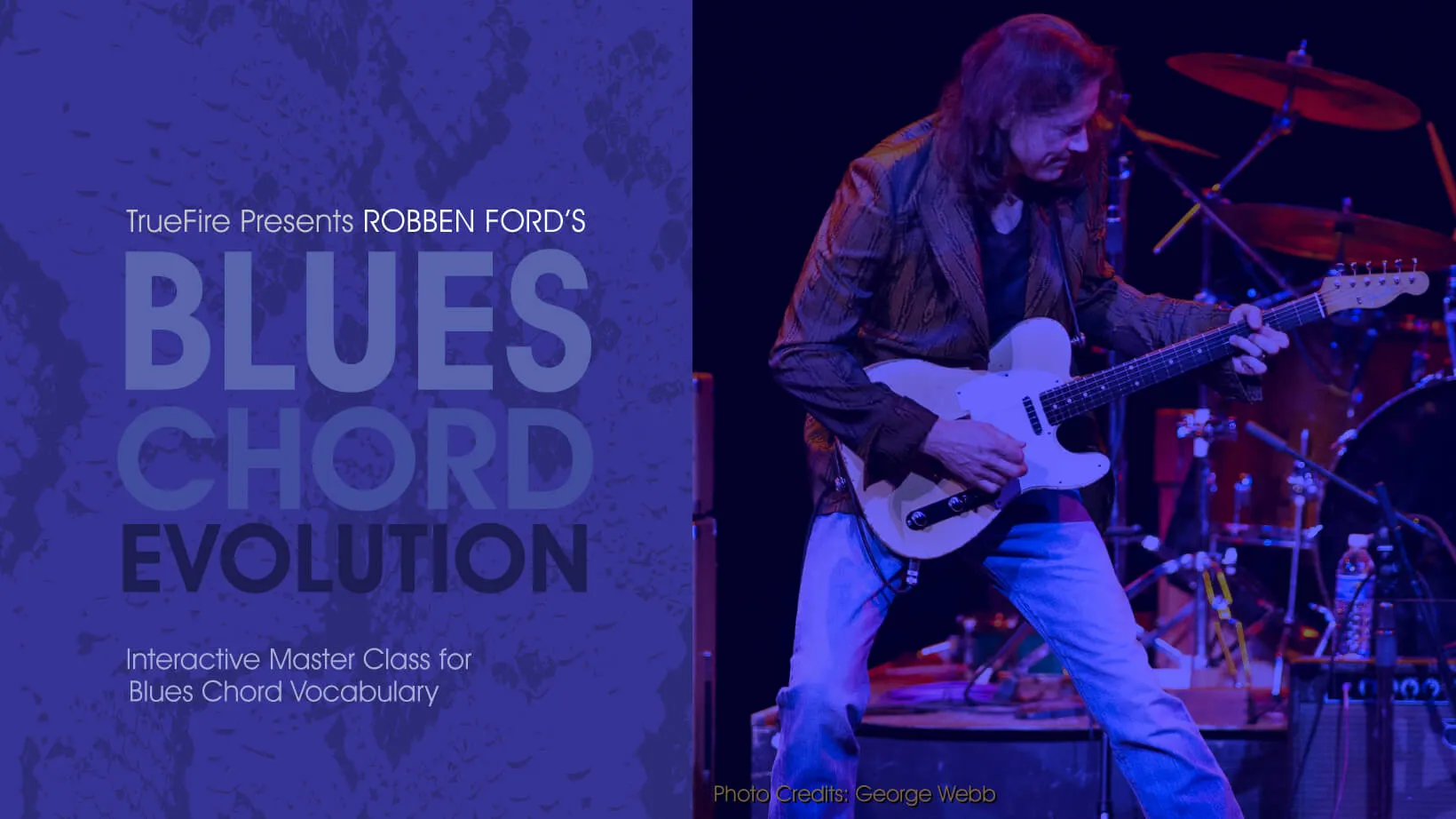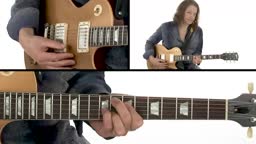

Blues Chord Evolution

Interactive Video Guitar Masterclass for Blues Chord Vocabulary

Marty FriedmanTommy EmmanuelSteve VaiEric GalesEric Johnson

Get this course and 1,000+ more with All Access

Try 14 days free. Cancel any time.

Purchase Individual Course for $24.99
Blues Chord Evolution

About this course

If you play the blues, you’re likely playing rhythm guitar 90% of the time, either comping for the vocalist or for another soloist. As most blues are comprised of simple 1-4-5 variations, you need command of a large vocabulary of chords to color up your rhythm parts and keep things interesting for the audience as well as for your band members.

Robben Ford’s Blues Chord Evolution is not only a compilation study of Robben’s favorite go-to blues chords, it’s also the quickest way to expand your own blues chord vocabulary.

”Over the years, I've developed a strong relationship with chords. It began with a book by a man named Mickey Baker, Jazz Vol. 1. Many of the things I learned in there, I saw that I could immediately apply to 12-bar blues playing, particularly Chicago blues. It was a perfect match! Over time, I learned my own way of applying these chords to the blues, which I'm excited to show you here in Blues Chord Evolution.”

Robben organized the course into 14 sections. Each section focuses on a specific chord type. All of the sections feature demonstrations, a performance study, and an analysis and break down.

You’ll start the course learning some basic open position chords (with a little embellishment). From there, you’ll learn major triad barre chords with some extensions. Then you’ll dig deep into how Robben uses minor 7th, 6th, 9th, and 11th chords. Dominant chords are next — dominant 7th, 9th, and 13th. Robben winds up the course with some altered chord voicings.

Robben will explain and demonstrate all of the key concepts and approaches along the way.  You’ll get standard notation and tabs for all of the performance studies. Plus, Robben includes all of the rhythm tracks for you to work with on your own. In addition, you’ll be able to loop or slow down any of the videos so that you can work with the lessons at your own pace.

Grab your guitar and let’s expand comp some blues with Robben Ford!

What you'll learn

  • Play a complete jazz/blues progression in A using 9th and 13th chords
  • Use voice leading to move smoothly between extended dominant chords
  • Apply rootless voicings over bass notes to create extended chords
  • Understand how the same voicing can be interpreted multiple ways (E sus, E13sus4, Bm9)
  • Recognize and apply altered dominants (flat 9, flat 13) in context
Release date: 08/01/2018 • 1h 47m runtime
Start Course
Sample lessons
More Minor Ninths and Elevenths
Chord Demo & Concept
More Minor Ninths and Elevenths
Performance
More Minor Ninths and Elevenths
Analysis & Explanation
Dominant 9's & 13's
Dominant 9's & 13's
Chord Demo & Concept

What's included

43 lessons • 14 charts • 7 Jam Tracks

Blues Chord Evolution
Hi, I'm Robben Ford and welcome to Blues Chord Evolution. Over the years, I've developed a strong relationship with chords. It began with a book by a man named Mickey Baker, Jazz Vol. 1 Many of the things I learned in there, I saw that I could immediately apply to 12-bar blues playing, particularly Chicago blues. It was a perfect match!

Over time, I learned my own way of applying these chords to the blues, which I'm excited to show you in this new course. We'll start out with some basic open position chords (with a little embellishment). From there, we'll look at major triad barre chords with some extensions. Next, we'll dig deep into how I use minor 7th, 6th, 9th, and 11th chords. After that, we'll be looking at some dominant chords — dominant 7th, 9th, and 13th. We'll wind up with some altered chord voicings, and I'll show you how I use them to move around the guitar.

Everything is tabbed, charted, and notated for you, plus you'll get all the backing tracks to work with on your own. So, grab your guitar and let's dig in!
Simple Open Chords
We're going to start with a real simple blues in G major. The chords are an open G major, an open C major as the IV chord, and an open D major as the V chord. Let's check it out.
Simple Open Chords
Here I'll perform a blues using simple open chords in G major. The chords are an open G major, an open C major as the IV chord, and an open D major as the V chord.

Take your time with the performance, and when you're ready, move on to the analysis & explanation section where we'll break it down. Let's take a look.
Simple Open Chords
Now let's break down our blues progression using simple open chords. The chords are all open, being a G major, a C major as the IV chord, and a D major as the V chord.
Open Triads Evolved
I could say that Bob Dylan is my favorite "white" bluesman, which might surprise people, but he did do a lot of things in the blues that weren't done before. Not only with his lyrics, but also in the way that he used his band, usually made up of studio musicians. With a group of people who hadn't really played with each other, Bob Dylan was able to create his own version of the blues.

It's something that I enjoy, and now I'm going to take you through a blues similar to something he might do. Let's check out the chords we'll use and get ready for the performance.
Open Triads Evolved
Here I'll perform a blues progression taking advantage of open chords, all of which are triads. This is similar to something that Bob Dylan might do — not necessarily sophisticated, but something that's all his own.
Open Triads Evolved
Now let's break down this progression. Again, we're using open triad chord voicings here. These have that open, tender, major sound that feels like home. There's nothing aggressive about it at all.

+ 36 more lessons

Start Course

Reviews

15 results

richollander

Verified buyer

04/28/26

Good

littlesister

Verified buyer

03/14/26

Blues Chord Evolution

Musicians never stop learning. With Robin Ford there is always plenty to learn. His courses are amongst the best.

Dddd

10/20/23

Yes

Up

Dub

10/20/23

Yeppers

Wayddub

Mishary

06/09/20

Master class from a master

Robben Ford is a legendary guitar player who easily communicates complex ideas into simple forms. Using simple tips, this class provides a lot of fodder for consideration while playing rhythm. Rhythm playing is often bemoaned as a necessity between solos, but in reality is just as important to the audience. Who wants to hear strummed six-string chords over and over ad infinitum? Robben shows how to use 7th and 9th and 13th chords to spice up the accompaniment, adding texture for the band and listener. From simple tips like fretting open G chords with fingers 2-4, leaving the first open for other possibilities, to mixing up 9th and 13th chords to add tension to a rhythm line.

Stop searching. Start improving with All Access.

Try 14 days free. Cancel any time.