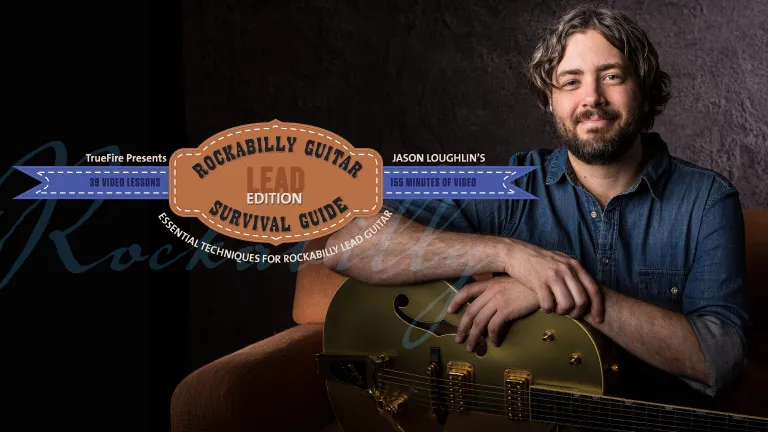

Rockabilly Survival Guide: Lead

Essential techniques and insight for rockabilly lead guitar.

Marty FriedmanTommy EmmanuelSteve VaiEric GalesEric Johnson

Get this course and 1,000+ more with All Access

Try 14 days free. Cancel any time.

Purchase Individual Course for $19.99
Rockabilly Survival Guide: Lead

About this course

Rockabilly personifies the American music scene of the 50’s. The burgeoning electronic revolution put the electric guitar in the hands of musicians. The record industry exploded into big business. Communications media exposed the general population to a wide variety of musical styles from the different cultures and regions of the country. And the musical styles themselves began cross-pollinating to trigger the music renaissance of the 60’s and beyond. Rockabilly blends Blues, Country, Western Swing, Boogie-Boogie, Honky-Tonk and Appalachian folk music — as American as you can get!

Rockabilly has evolved over the decades and the requisite techniques and harmonic considerations to play all of the styles and sub-genres make it both challenging and very rewarding to play, especially for guitarists.

Jason Loughlin’s Rockabilly Survival Guide for Lead Guitar is an intuitive hands-on curriculum designed to impart the specific techniques and harmonic considerations required to play lead Rockabilly guitar.

Jason organized this Lead edition into two main sections. In the first section, Jason guides you through 13 key concepts and techniques. In the second section, you’ll play your way through 7 Performance Studies covering a wide variety of Rockabilly grooves, tempos and keys.

The 13 key concepts and techniques that Jason focuses on include: Double Stops, Rockabilly & The Blues, Dead Thumb, Open Strings, Common Soloing Chords, the Bigsby, the Boogie, Travis Picking, Outlining Chords, Substitution, Using the ii V, Whole Tone & Diminished Scales and Chord Melody. These are the essential tools and harmonic blueprints for constructing engaging and creative Rockabilly solos.

In the second section, you’ll put all of your Rockabilly tools to work by following Jason’s blueprints for 7 diverse and colorful performance studies representing different styles or sub-genres of Rockabilly: Study #1: Rock and Roll, Study #2: Boogie, Study #3: Travis, Study #4: Swing King, Study #5: Trucker Twang, Study #6: Blues and Study #7: In A Chord Dance.

Jason demonstrates all of the leads over rhythm tracks and then breaks them down measure-by-measure, technique-by-technique. You’ll first learn the parts as performed by playing along with Jason and referencing the tab and notation. When your ready, you’ll work with the rhythm tracks on your own and craft your own Rockabilly lead parts.

All of the key demonstrations, performances and examples are tabbed and notated for your practice, reference and study purposes. You’ll also get Guitar Pro files so that you can loop and/or slow any section down as you work through the lessons. Plus, Jason generously includes all of the rhythm tracks for you to work with on your own.

Grab your guitar, a pair of blue suede shoes and let’s get your Rockabilly on!

What you'll learn

  • Play stacked fourths voicings and move them through chord changes
  • Create tension using diminished scale arpeggios
  • Apply tritone substitution over minor blues
  • Incorporate major 7 sounds over minor chords for noir/spy vibe
  • Balance simple blues phrases with complex harmonic ideas
Release date: 11/17/2014 • 2h 36m runtime
Start Course
Sample lessons
Bigsby
Bigsby
Concept 6
Chord Melody
Chord Melody
Concept 13
Study 1 - Rock and Roll
Overview
Study 1 - Rock and Roll
Performance

What's included

39 lessons • 19 charts • 10 Jam Tracks

Rockabilly Survival Guide: Lead
Hi, I'm Jason Loughlin and welcome to the rockabilly survival guide for lead guitar. The 1950's represented a perfect storm for music. The electric guitar is a brand new instrument, electronic innovation in America is at it's height, record labels had been stock piling recording of Appalachian music, folk, blues, boogies and calypso. Now northerners could hear what was going on in south. If you lived in a rural part of the country you may not have know what was happening in the next county. Music isn't being made in a vacuum anymore. One musical scene is now influencing another. Early Rockabilly can be boiled down to just a marriage of rock and hillbilly music. Some of it can be thought of as the orchestration of boogie piano. The other side of that coin are the tunes that are sped up versions of Appalachian or hillbilly tunes with the accents shifting from beats 1 and 3 to 2 and 4 or what people call the backbeat. The vocal stylings pull from the crooners like Bing Crosby for tone, Appalachian phrasing and blues inflections. Of course, it's impossible to put every rockabilly artist under this umbrella but it's a good place for us to start. Those early rockabilly guitar heroes were drawing early on from blues and country finger style blues for their solos. It's wasn't long though til elements of swing, rock and roll and yes even Latin music start to show there influences on their improvisation. The first round of Rockabilly guitarist that you should know are players like Scotty Moore, Paul Burlison, Grady Martin, Cliff Galop, Hank Garland and Les Paul. Rockabilly experienced a strong revival in the early 80's lead by Brian Setzer and The Stray Cats. This also gave rise to punkabilly or psychobilly who's stand outs are bands like The Cramps and Guano Bats. Rockabilly to this day resembles more of the nuances, visuals and clichés associated with the revival then it does the first wave. Regardless, it's still going strong with a worldwide follow of enthusiasts who are drawn to the guitar playing, the great songs built for a good time and the overall aesthetic. The course is divided into two sections. Section one will focus on the concepts behind rockabilly lead playing. We'll cover blues scales, dead thumb, Travis picking, bigsby tricks, whole tone and diminished scales to name a few. In the second section I'll taking all of our concepts using them in seven lead studies. Each one of these styles is arranged in a different style or sub-genre within rockabilly. Some of the styles we'll learn to solo over are swing, boogie, blues and truckbilly. I've provided all the backing tracks, notation and tab. Let's get started!
SECTION 1: Essential Concepts
In section one we are going to look at thirteen essential rockabilly lead concepts. All of the concepts define the rockabilly langauge. We are going to look at travis picking, bigsby tricks, double stops, using subsitutions, chord melodies and more. You'll have PDFs to help you shed each of these concepts and in some cases I provide backing tracks to practice with.
Double Stops
Double stops are any two notes played together. In rockabilly when most people think of double stops they think about how Chuck Berry used them. You can hear how he mirrors his piano player Johnnie Johnson's right hand. His style of using double stops stays in position for the most part. We also want to look at the way players like Danny Gatton uses double stops by moving across the neck diatonically.
Rockabilly & The Blues
Countless rockabilly tunes are based on blues tunes. A large portion of Elvis's sun catalog are covers of blues tunes. In addition to learning the blues scale we will take a look at some ways that rockabilly used the blues. One of the most powerful use of the blues scale is by Paul Burlison with Johnny Burnette. Paul would by the blues scale in octaves by fretting both the low and high E string. This gives us two notes that are two octaves apart.
Dead Thumb
The technique called dead thumb is more prevalent than people think in rockabilly. Yes it's more known as a solo blues concept but players like James Burton and Scotty Moore use it more than Travis picking. Classic solo "Hello Mary Lou", "Susie Q" and the rhythm for "Mystery Train" are all using dead thumb. The idea is we keep steady quarters on the root of the chord with our thumb while improvising on top. I'll show some drills for developing independence, incorporating hammer ons and pull offs and not just relying on open bass strings.
Open Strings
We haven't talk much about using open strings but rockabilly music like country music isn't afraid to be "guitaristic". First we will look at replacing notes in a lick with open strings. We'll do this by analyzing a couple cliché rockabilly licks. Another way open strings are commonly used is as pedal tones or droning notes.
Common Soloing Chords
Rockabilly has some harmonic calling cards that we want to make sure are in our bag of tricks. The major 6th chord is one of them. This is something you find quite a bit in western swing also. It's a nice way to add color without making a chord dominant. Another is the major 6/9 chord. This one tends to be a point of destination. It's usually at the end of a phrase or the last chord of the song. Lastly, we should take a look at the Dom 9 chord. There is a specific voicing that is found quite a bit in rockabilly. It often gets used to imitate a horn section hit. What makes it so unique is the voicing. The notes are arranged so the 9 and 3rd are a whole step away from each other. This gives us a nice dissonance in the middle of the chord.

+ 32 more lessons

Start Course

Reviews

10 results

Starglazer

Verified buyer

11/18/25

Good Title

A great course well put together a very knowledgeable Teacher. Thanks.
MyTrufire44

Verified buyer

01/01/25

Bonne leçon !

Comme d'habitude avec Jason Loughlin, une bonne leçon qui va me faire progresser. Un seul petit regret : il n'y a que les "Performances" qui bénéficient de l'affichage de la tablature synchronisé avec la vidéo. Cela oblige donc à imprimer quelques feuilles et à mémoriser pour pratiquer dans de bonnes conditions. Si on ne travaille qu'une leçon à la fois ce 'est pas un problème mais si, comme moi, vous profitez de votre "all access" pour travailler une quarantaine de leçons cela complique un peu les choses.

Molmart

Verified buyer

09/10/24

Great course, well structured!

Dave58

Verified buyer

04/03/22

Great!

Fantastic course, virtuoso teacher, everything I start up from Jason is a must of interesting teaching material. Very clearly explained and fascinating teaching material, with beautiful video images and meaningful tabs. Nice lesson examples.

S.E. N.

10/13/21

Not just survival, but a full course meal

Jason is a master of many styles, but to me he really shines in rockabilly. Jason nails the major concept of focusing on chord tones and embellishing them the way the early cats did. Word to the wise: Don't expect to go through the course beginning to end, mastering each lesson and moving on to the next. The material is far too dense for that. It will feel like drinking water from a fire hose, and you'll get overwhelmed. Concept 10 in part one could be an entire course! Jason will give you a ton of options, so internalize the ones you connect with and catalog those you don't for later. Once you get to the studies in part two, you can go back to the concepts for review. If you dig Jason and his mad chops, be sure to check out his TrueFire channel, "The Speakeasy."

Stop searching. Start improving with All Access.

Try 14 days free. Cancel any time.