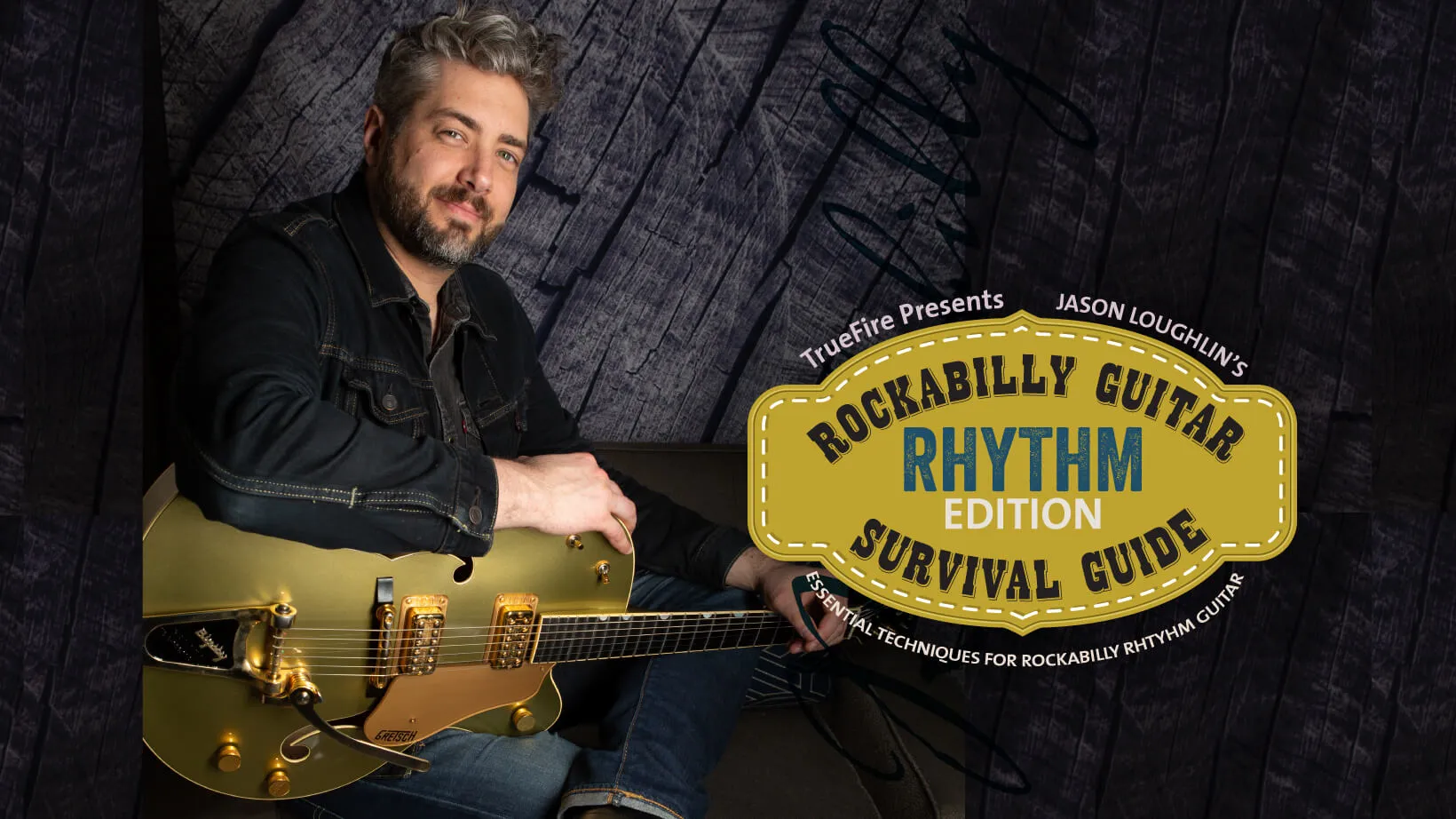
Rockabilly Guitar Survival Guide: Rhythm

Essential Techniques and Insight for Rockabilly Rhythm Guitar

Marty FriedmanTommy EmmanuelSteve VaiEric GalesEric Johnson

Get this course and 1,000+ more with All Access

Try 14 days free. Cancel any time.

Purchase Individual Course for $19.99
Rockabilly Guitar Survival Guide: Rhythm

About this course

Rockabilly is considered the older brother of rock and roll: It draws from the American songbook and incorporates Appalachia, country, blues, and even old pop tunes from the 30's and 40's. It takes songs from these genres, drives the tempos, and is played with an irreverent attitude. It's a true melting pot of what was happening musically, breaking down cultural barriers and changing how the guitar was played.

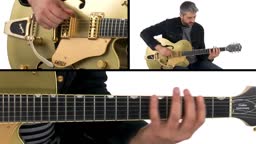
This Rhythm Edition of the Rockabilly Guitar Survival Guide by Jason Loughlin will take you through all the necessary concepts and techniques to play rhythm guitar in this style. The course is broken up into two sections: In the first section, Jason will run down the scales, chord shapes, strumming techniques, etc. that give rockabilly its signature character. Then in the second section, you'll work through 12 performance studies that put all these new concepts into musical context, inspired by some of the quintessential rockabilly tunes.

Jason will explain and demonstrate all of the key concepts and approaches along the way, and you’ll get standard notation and tabs for each of the performance studies. Plus, Jason includes all of the rhythm tracks for you to work with them on your own. In addition, you’ll be able to loop or slow down any of the videos so that you can work with the lessons at your own pace.

Grab your guitar and let’s rock it with Jason Loughlin!

What you'll learn

  • Use chord inversions in musical contexts
  • Apply rhythmic techniques including clave patterns
  • Create original performance studies using learned concepts
  • Apply techniques, harmony, and rhythm concepts in musical context
  • Develop authentic rockabilly rhythm guitar style
Release date: 03/28/2019 • 2h 31m runtime
Start Course
Sample lessons
Travis Picking
Travis Picking
Concept 7
Minor Shuffle
Minor Shuffle
Concept 11
Minor Shuffle
Minor Shuffle
Overview
Minor Shuffle
Minor Shuffle
Performance

What's included

56 lessons • 27 charts • 12 Jam Tracks

Rockabilly Survival Guide: Rhythm
Hi, I'm Jason Loughlin. Welcome to Rockabilly Guitar Survival Guide: Rhythm. In this course, we're going to learn the techniques and concepts that help define rockabilly rhythm guitar.

I've always thought of rockabilly as the older brother of rock and roll. Rockabilly adapted Appalachia, country, blues, bluegrass and even old pop tunes from the 30's and 40's, drove the tempo, added a two beats feel and played them with an irreverent attitude. This music spoke to a generation of young people and also helped to breakdown cultural barriers. Rockabilly rhythm guitar is a true melting pot of what was happening in the states musically. It incorporates fingerstyle, the adaptation of blues and boogie piano, swing, country, Latin grooves and American songbook.

I've broken this course into two sections: In the first section, I'll be showing you all the techniques, harmony, rhythms and concepts you will need to know to understand rockabilly guitar. In the second section, we'll work through 12 performance studies that will put all these new concepts into context. I've included notation, tab and all the backing tracks. Let's go cat, go!
SECTION 1: Essential Concepts
In Section 1, we'll be discussing all of the scales, harmony, chord shapes and concepts you will need to know for our performance studies. There's lots of great information in these lessons that really give you the insight to why I make the decisions I do in the studies. Take them, work them, write with them, improvise with them...they'll make you a better rockabilly rhythm guitarist.
Scales
There are four scales that you will need for fills, call-and-response, walking lines and counter melodies. By using a major pentatonic scale, minor pentatonic scale, major scale and a blues scale, we pretty much have our bases covered.

We'll start with a major scale. This scale will help you find any extensions and color tones you'll need for embellishing your major chords. The scale formula is W-W-H-W-W-W-H. "W" represents a whole step and "H" represents the half step. It's also described as Root-2-3-4-5-6-7-Root.

The major pentatonic is a close relative of the major scale. By simply leaving out the 4th and 7th we end up with our five note scale. The formula would be W-W-m3rd-W-m3rd or Root-2-3-5-6-Root.

The minor pentatonic scale formula is m3rd-W-W-m3rd-W or Root-b3-4-5-b7-Root. The blues is basically a minor pentatonic with a passing tone between the 4th and 5th. This note is called the #4th, the b5th or the "blue note". That passing tone can add a lot of tension. The blues scale formula is m3rd-W-H-H-m3rd-W or Root-b3-4-b5-5-b7-Root.
Chord Shapes
We need to know some basic chord shapes for us to use as templates. We can turn these into fancier chords and add embellishments with the scales we have learned. I'll show you three basic chord shapes for major chords and two for minor. From here we can turn these chords into dominant 7ths, major 6th, dominant 9ths, minor 6ths and minor 9ths.
Chord Inversion Essentials
Playing harmony on the top 4 strings of the guitar can help us stay out of the range of the bass and acoustic guitar and find our own sonic space. It's also a little easier to move through chord inversions so we can have harmonic movement when we are sitting on one chord. I'll show inversions for the major chords and minor chords. All other embellishments can be made by adding notes from our scales.
Using Diminished and Augmented Chords
These two chord qualities are often used as passing chords. They're always on their way to another chord. Diminished chords can be used as a shortcut to altering extensions on dominant chords. The augmented chord has a simple function. This is a major chord with a sharp 5th. It can be used when the I chord goes to the IV chord or when the V chord goes back to the I chord. It's the diminished chord that offers the most to us.

There are two kinds of diminished chords. First, let's start with the half diminished. This is made up of a Root-b3-b5 and b7. This chord can be built off of the 3rd of a dominant chord to access the 3rd-b7th-9th and 5th.

The other kind of diminished chord is called a full diminished chord. This means the 7th of the chord was double flatted. The chord would be root-b3-b5 and bb7. This chord shape can built off of the 3rd, 5th, b7th and b9th of a dominant chord. One of the fun things about this shape that it can be moved a minor 3rd up or down to get to it's inversions. This is due to the relationship between the chord tones. Each chord tone is separated by a minor 3rd. This shape can be used between I-IV, IV-I and V-I.
Strumming
Acoustic guitar plays a powerful role in rockabilly music, especially in early rockabilly. The early Sun recordings with Elvis and Johnny Cash are just trios consisting of upright bass, electric guitar and acoustic guitar. In these cases, the acoustic guitar is serving as the subdivision and the backbeat - the same role as a ride cymbal or hi-hat and snare drum. The eighth note strumming gives you the subdivision and the accents give you the feel of the snare. The acoustic along with the upright slapping on the backbeats provides you with all the information you need.

We'll learn a couple of classic strum patterns, changing the feel be pulsing the fretting hand, using crescendos, adding melody notes to reinforce accents, adding melodies into the strumming and muting. Listen for bass lines, listen for snare and kick and be dynamic. Sometimes it's helpful to imagine you're harmonizing the drum set.

+ 49 more lessons

Start Course

Reviews

14 results

MyTrufire44

Verified buyer

01/01/25

Une leçon qui me sera profitable

Comme d'habitude avec Jason, c'est du bon boulot. Un seul petit regret : seules les "performances" bénéficient de la lecture de la tablature synchronisé avec la vidéo.


Paolo v.

Verified buyer

10/27/24

Great work with tabs, multicam view, and lots of contents !

Talkinged

Verified buyer

01/16/23

Fun rhythms to learn

Many interesting rhythms and very clearly explained. It’s great how the teacher gives you the fundamentals which you can experiment with to make your own music.

Dave58

Verified buyer

04/03/22

Awesome

Fantastic course, virtuoso teacher, everything I start up from Jason is a must of interesting teaching material. Very clearly explained and fascinating teaching material, with beautiful video images and meaningful tabs. Nice lesson examples. That's why I bought both courses Lead and Rhythm from this series!

krvavi

07/20/21

Rockabilly Guitar Survival Guide: Rhythm

Rockabilly, my first love :-) I grew up with Elvis, Chuck, Cats and off course with Gene and Eddy :-) If you interested in Rockabilly guitar, grab this one, you wan't regret it!

Stop searching. Start improving with All Access.

Try 14 days free. Cancel any time.