Charles Limb, an otolaryngological surgeon at Johns Hopkins (also a musician), worked with a team of researchers to analyze and map what was happening in the brains of musicians as they played. The study determined that “musicians who are engaged with other musicians in spontaneous improvisation show robust activation in the same brain areas traditionally associated with spoken language and syntax.”
Many TrueFire educators compare music to language in a figurative sense. According to Doctor Limb’s recent findings, music is indeed a language both literally and scientifically. We build vocabularies of licks and then string those licks together to form ‘sentences,’ which in turn we solo and improvise with to tell our stories. Harmony and theory guides our musical expressions very similarly to the way that grammar guides our speech.
But what about diction? With speech, diction refers to ”the art of speaking so that each word is clearly heard and understood to its fullest complexity and extremity. Diction concerns pronunciation and tone, rather than word choice and style.” As musicians, our ‘diction’ is phrasing — the way we present, time and articulate the notes that we play when we’re telling our stories.
Strip all the blazing techniques and fancy fretwork away and the real distinction between a mediocre player and the player whose solos make the hair on your arm stand up is the player’s phrasing. Phrasing is what transforms your solos from black and white to cinematic color.
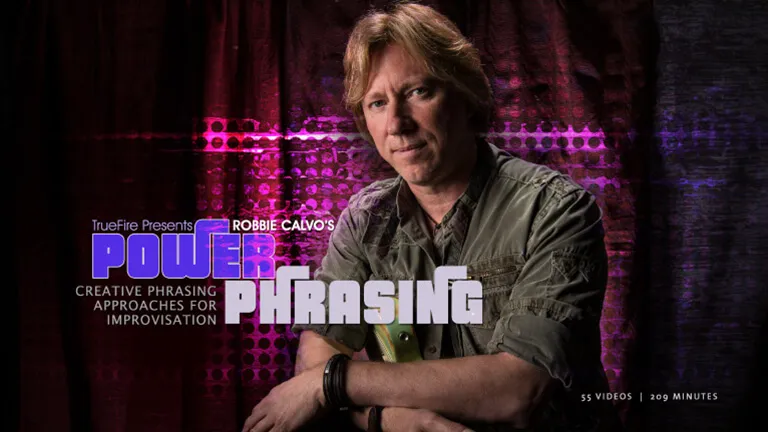
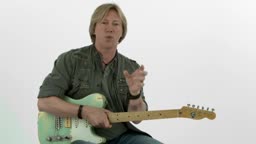
When’s the last time you practiced your phrasing? Exactly. It’s the single one aspect of our playing that the vast majority of us simply ignore. This is largely due to the fact that there’s simply not a lot of study programs available today that focus solely on the art of phrasing. That’s precisely why we asked Robbie Calvo to dig deep into the topic and provide you with a clear, practical and expeditious way for you to majorly color-up your phrasing.
“Many of my TrueFire courses have guided you towards sweet notes, tonal centers and musical expressions for the fingertips. It’s now time to add your soul to the mix with Power Phrasing to create expressive personal statements that embody the essence of who you are.”
Robbie leaves no stone unturned as he guides your quest for Power Phrasing: Why Is Phrasing So Important, Melodic & Rhythmic Displacement, Rhythmic Feel, Downbeats & Upbeats, Combining Start Points, Leaving Air and Space, Playing Between Vocal Phrases, Lead Fills, 16th Note Phrases, Comping/Phrasing, Triplet Shuffle, Slow Blues Shuffle, Developing Phrases, The Four Elements, Combining Rhythmic Feels, Sustained Phrases, Call & Response Phrases, Phrasing An 8-Bar Solo, Singing Your Own Phrases, The Power of Silence, 16 Note Shuffle, Swing 16ths, Dynamics, Ornamentation, Legato, Staccato and many more tools of the phrasing trade.
No boring theory or tedious exercise here — you will play and ‘phrase’ your way through a wide and engaging range of playalongs that Robbie has prepared for you in Power Phrasing. You will also glean a broad perspective and deep knowledge base of rhythm concepts — this alone will take greatly enhance your musicality.
Give your scale, licks, harmony, theory and chord studies a rest for the next month to hone your Power Phrasing chops. Technicolor solos and improvisations are just a click away…
What you'll learn
Learn to resolve phrases back to the root chord
Learn to phrase into the downbeat of bar one
Develop awareness of how solo lines interact with underlying riffs
Develop intentional control over atmospheric feel
Develop conscious control over where phrases start and end
The typical guitarist will spend years of practice learning a variety of pentatonic scale shapes, major scale patterns, arpeggios and even more exotic scale forms like the melodic minor and harmonic minor modes.
Hours of practice go into targeting the sweet note resolutions, tonal centers and crafting melodic lines but how much of that time is spent working on the rhythmic delivery of our melodic message?
I would argue that very little time is spent developing the rhythmic aspect of our solo lines and therefore the phrasing takes a back seat to the actual notes we play.
Many of my TrueFire courses have guided you towards the sweet notes, tonal centers and musical expressions for the fingertips. It’s now time to add your soul to the mix with Power Phrasing to create expressive personal statements that embody the essence of who you are.
Phrasing is the rhythmic vehicle for your melodic message and can be compared to a conversation between two people or the timing of a well paced monologue.
Conversations are vocal phrases that are paced using your own personality to express thoughts and opinions. We use inflections and punctuations to add excitement to a sentence; we pace our statements to allow them to be understood clearly and we use cadences to give the listener cues that it may be time for them to respond to our dialogue.
The listener then responds to our conversation using similar techniques as ours, using their own choice of punctuation and inflections to express their personal thoughts. Thus, a conversation begins of verbal communication that goes far beyond the use of words.
The analogy, then, for musicians would be that words constitute notes and pitch and punctuations and inflections represent the rhythms and groove.
I like to break phrasing down into 3 main components:
1. Note pitch 2. Rhythmic feel 3. Rhythmic/melodic placement. These 3 main categories can then be broken down into further sub categories to include the nuances and details of phrasing. Dynamics, ornamentation, sustain, rests, rhythmic combinations, feeling etc. constitute the subtleties and expressions we associate with fine musical phrasing. We’ll be studying all of these detailed components throughout the course.
Imagine for a moment listening to a speech delivered by a presenter with a monotone voice that stayed at one monotonous level. No dynamics, change of pace, breaths, personality or tonal inflections! You would lose the will to live very quickly!
Now take the same speech presented by a master presenter who adds the elements listed above and combines that with his or her unique personality, now you have a compelling speech that we all want to listen to. That is why phrasing is so important to our lead guitar playing. It’s our musical voice and personality combined with our personal note choices and rhythmic delivery.
Imagine having to listen to music where all of the phrases and melodies started on the downbeat of 1 - wouldn’t that get monotonous and boring? I think we’d all go crazy and crave something new and fresh to listen to. This is why our phrasing is so important and why we gravitate towards certain players. It’s not just the notes they play, it’s the rhythmic content and the placement of those elements.
A great way to expand our phrasing repertoire and add interest to our lines and licks is to move them across the beat and the rhythmic placement within a bar of music. Starting a phrase on the upbeat of 1 for example is going to yield very different phrasing results from the downbeat of 1. Starting your phrase on the upbeat of 2 adds even more space at the beginning of the bar and lets you breath into your phrases.
I’ll be showing you how to displace your melodies and rhythmic phrases within 3 different rhythmic feels throughout the course. We’ll start in the next section by applying this powerful technique to a straight 8th feel. Further into the course we’ll look at shuffle rhythms and swing 16ths.
Placing your phrases on the pulse and groove of a musical piece is going to support those phrases. Don’t underestimate the power of placing your lines on the same rhythmic pulse as the other instruments in the groove.
One of the first elements to consider when working on your phrasing development is to understand the rhythmic feel of the music you are playing over. Having a clear understanding of the rhythmic pulse and it’s subdivisions is going to be key to connecting your melodies to the groove. Your lines will always sound stronger if they are supported by another instrument. A good example of this would be playing a 16th note phrase when the drummer is playing 16th notes on the hi-hat. You’ll notice that your 16ths sound stronger than if you were playing 8th note lines.
In this section I’ll be showing you a great way to expand upon your phrase development through a series of rhythmic/melodic displacement exercises. Don’t get scared by the terminology, simply put we are just going to shift the start point of your phrases within the beat. You are going to immediately hear how powerful this is to achieving new rhythmic phrases and interesting new ways of expressing your licks and lines.
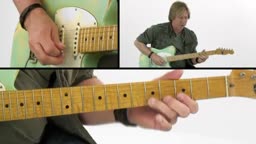
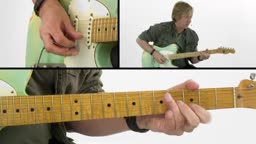
The intro demo I just played demonstrated moving simple phrases across each of the four beats that make a up a bar (measure) of a straight 8ths rhythm pattern.
I started sequentially at the downbeat of 1 for my first phrase. The second phrase started on the upbeat of 1. The next phrase started on the downbeat of 2 and then the 4th phrase started on the upbeat of 2.
I continued moving the start point of each phrase across the whole bar until I returned back to the beat 1 downbeat again. This is called rhythmic/melodic displacement.
This is a very simple but incredibly effective way of spicing up your lines and licks. The most incredible thing is you don’t have to learn any new licks, you just shift the start point to somewhere else within the bar - awesomeness abounds!
In this first playing section you will be learning how to shift the start point of your phrases between the down beat and upbeat of beat 1 in a measure of music. Each phrase we’ll play is approximately one bar in length. We will leave a bar of music after each phrase to allow for space and a clear perspective on how each change feels across the backing track.
Let’s play a few phrases over the track starting on the downbeat and listen to how that feels.
Now we’ll play a few phrases starting on the upbeat of 1 to see how that feels.
To really magnify the difference let’s play our downbeat of one phrases using Emaj/C#mi pentatonic and the upbeat phrases using the E minor pentatonic. Sounds pretty cool doesn’t it?!
This is where we get to jam together over the track. I’ll play the first lick and then you play in the space I leave for you to apply your phrases. We’ll start by playing phrases on the downbeat of 1. I’ll then indicate for us to start playing phrases on the upbeat of 1. We’ll then combine those ideas and placement points.
You can mix and match the E major pent and E minor pent if you’d like to.
We’ll now shift our focus to starting our phrases on the downbeat and upbeat of beat 2 within the bar. The first thing you’ll notice is that there is a little more space at the beginning of the bar to let the harmony introduce itself before our melodies begin.
I’ll venture to say that I think you’ll like starting your phrases on the upbeat best - something very appealing about phrases starting on the offbeat!
Let's listen to playing off the down beat of 2.
Okay that's cool, now the upbeat of 2.
Let’s try playing E major on the downbeats and E minor on upbeats.
Robbie Calvo’s Power Phrasing cuts straight to the heart of what makes a solo unforgettable — it’s not the speed or flash, it’s how you say it. Backed by brain science that proves music is a language, this course shows you how phrasing is your voice on the guitar — the difference between sounding like a robot and making people feel something. If your solos still feel black and white, it’s time to plug into Power Phrasing and start playing in full Technicolor.
R
Rockamoto
Verified buyer
01/03/22
It's all about the Phrasing!
Robbie's teaching method and the way he communicates really provided me with a clear understanding and gave a refreshing insight when it comes to phrasing.
Really enjoy his demonstrations and how fluid his lead lines emphasis space and dynamics.
Thank you Robbie!
K
Kimball
02/01/21
Simply Genius!
Once again, Robbie teaches in a way that makes you think,"Of course, that's so obvious, why didn't I think of that!" His style is very encouraging, as though he is saying that "You can do this!" Even when he tells us to count out the beat in our head so that we can come in on the offbeat, he does it in a way that is encouraging and makes it sound possible. The basic premise of moving licks from Beat 1 to other beats in the measure is like being given a skeleton key. So many new possibilities!
L
Liegeradfahrer1
Verified buyer
01/27/21
Extraordinay
W
wholmer
12/31/20
Best class I have taken for Lead Phrasing
I give this class 5 stars because I have had trouble in the past trying to learn to connect licks into solos. Robbie is so relaxed and easy going that you fell comfortable right from the start. The structure is well planned and progress is from easy to not so easy but you are ready for it if you follow along and practice!