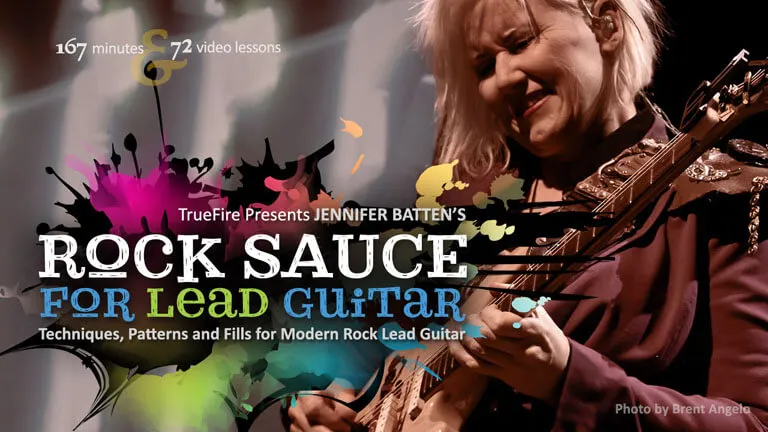

Rock Sauce For Lead Guitar

Techniques, patterns and fills for modern rock rhythm guitar

Marty FriedmanTommy EmmanuelSteve VaiEric GalesEric Johnson

Get this course and 1,000+ more with All Access

Try 14 days free. Cancel any time.

Purchase Individual Course for $14.99
Rock Sauce For Lead Guitar

About this course

Rock guitarists play rhythm 95% of the time, and we certainly don’t get to solo as much as we’d like to, but when we do — game on! And the game today requires a deep bag of techniques and a wide palette of colors to call on during those few moments of bliss up front and center, under the spotlight.

Few guitarists have deeper bags, wider palettes, and more experience under the spotlight than Jennifer Batten, who has played on Michael Jackson's Bad, Dangerous and History world tours as well as a three-year stint touring in Jeff Beck's band. Jennifer is also the consummate educator and she’s back on the TrueFire stage, up front and center, with Rock Sauce for Lead Guitar.

Jennifer organized the Rock Sauce: Lead Guitar curriculum into two sections. In the first section, Jennifer presents 20 lead guitar concepts and techniques that underpin her signature approach and style. In the first section, Jennifer presents Pentatonic & Blues Scales, Dorian & Aeolian Modes, Mixolydian & Dominant, Owning Melodies, Studying Other Players, Conversational Phrasing, Adding To Your Trick Bag, Tonal Variety, The Art of Listening, Effects Processors & Pedals, Hand Slaps & Slides, Sonic Exclamation, Bending Notes, Harmonic Octave Tapping, Tapping Basics, Exploring Tapping Further, Natural Harmonic Melodies, Tremolo Sauce, Intervallic Jumps and Sweep Picking.

In the second section, Jennifer demonstrates all 20 of the concepts and techniques across a diverse series of 17 lead guitar studies. For each study, Jennifer first overviews the concepts and techniques that will be employed over the rhythm track and then performs a solo over that rhythm tracks, which is designed to showcase those particular concepts and techniques in a real world musical context.

After the performance examples, Jennifer breaks the solos down technique-by-technique, part-by-part. Using Jennifer’s breakdowns, along with the supplied tab and notation, you’ll learn the solos as performed and can play them along with Jennifer at tempo. Next step is playing the solos by yourself over the supplied rhythm tracks. The final step, and the mission of this learning experience, is to integrate those concepts and techniques into your own solos and improvisations.

The 17 lead guitar studies cover a wide variety of tempos, keys and rock feels and all focus on one or more of the essential concepts and techniques: Sweeping Sauce, Tremolodic Bends, Between The Thirds, Bluesy Double Stops, Legato Stretches, Harmonic Melodic, Natural Harmonic Sauce, Nastophonics, Power Trem, Skip To My Intervals, Chromatic Automatic, Bluesy Mixo, Tap Quest, Tropical Combo Sauce, Alternate Picked Pedal Trip and Whammy Kick.

The stage is yours. Game on!

What you'll learn

  • Master the minor third to major third approach over dominant chords
  • Play scalar passages using only natural harmonics
  • Integrate tremolo bar technique while playing harmonics
  • Create melodic lines in B minor using harmonics
  • Understand how to use chromatic notes to connect chord tones
Release date: 01/08/2014 • 2h 47m runtime
Start Course
Sample lessons
Bluesy Double Stops
Bluesy Double Stops
Overview
Bluesy Double Stops
Bluesy Double Stops
Performance
Bluesy Double Stops
Bluesy Double Stops
Breakdown
Emoto-Trem
Emoto-Trem
Overview

What's included

72 lessons • 20 charts • 16 Jam Tracks

Rock Sauce for Lead Guitar
In this "Rock Sauce for Lead Guitar" course, I want you to become a collector of colors. By colors I mean techniques and nuance. The more you know, the more "colors" you have to draw from when soloing. There is an endless choice of ways you can approach playing a note or phrase. The list of techniques we'll explore is: bending, hammer ons, pull offs, tapping, sweeping, sliding, tremolo bar use (bending down, bending up, vibrato and fluttering), natural harmonics, tapped and fretted harmonics, pinch harmonics, tremolo picking, muting, string skips, double stops, percussive picking, and expression pedal techniques.
SECTION 1: Lead Concepts
In the "Lead Concepts" part of the course, we are going to be taking a look at 20 concepts that have really made my playing come alive. We'll be covering all sorts of techniques to add to your bag of tricks; from hammer-on and pull-offs to slides, to tapping. We'll look at different ways to pick, and focus on going from playing just the notes, to playing with a style that will really grab your listener by the throat.
Pentatonic & Blues Scales
I don't want to get into a comprehensive study of all scales in this course. I just want to make sure you know the very basic and most used scales of rock and pop music soloing. Pentatonic scales are five note scales. In the fingering in the chart provided, there are only two notes per string, so they are the easiest scales to memorize. To turn them into blues scales, you just add one note per octave, which is the flatted 5th.
Dorian & Aeolian Modes
Without getting too deep into theory, dorian and aeolian modes are the two minor sounding scales you should know. If you play an A dorian mode, you are actually in the key of G major, so think of the key root note as one whole step (2 frets) below the A root. If you play A aeolian, you are in the key of C major. The key root note is a minor third (3 frets) above your A root.
Mixolydian & Dominant
The mixolydian mode is my favorite and is used most commonly to solo over dominant 7th chords. I like to combine a minor blues scale with the mixolydian mode because it gives me 9 notes to choose from instead of the 5 from a pentatonic scale or 7 from a diatonic scale. The mixolydian mode is important to know for the blues. Once you have a handle on the scales from segment 1, 2 and 3, you're good to go. You can get many years of mileage out of them. Loads of players have made entire careers from that information alone, and never add anything else.
Owning Melodies
The differences between your favorite players, aside from their note and rhythmic choices, are the subtle nuances they incorporate that are ingrained in their musical personalities. For this example I'll use the melody from a Charlie Mingus composition played by most guitarist's favorite guitar player; Jeff Beck. You'll never hear him play a melody the same way twice. The key to enjoyable improvisation is to keep exploring, whether you're playing a melody or a solo.
Studying Other Players
The tools available today make it as easy as possible to learn other people's solos. There are plenty of apps available that allow you to slow music down to whatever speed you want, and loop anything from a few notes to a whole solo or more. Don't worry about becoming a clone of someone else, unless learning solos from only one guitarist year after year is all you ever do, and those lines become your entire vocabulary! All the greats were influenced by players that preceded them. Beck->Cliff Gallup, Eddie Van Halen->Eric Clapton, Robben Ford->Mike Bloomfield, Adrian Belew->Jimi Hendrix. Learn phrases and solos not only from other guitar players, but from other instruments, and singers as well. Other instruments can have a completely different approach. Ultimately whatever you learn and filter through your brain over time, will come out as you. You'll subconciously make choices to retain that which really resonates with you and the rest will fall by the wayside.

+ 65 more lessons

Start Course

Reviews

15 results

JohnJAnthony

Verified buyer

05/25/26

Jennifer Rules!

Jennifer’s courses are always incredible! So helpful and she breaks the concepts down so well!

r624bhvpb6

Verified buyer

01/21/24

Great Course for Rock Techniques

Excellent course, I really like all of Jennifer’s learning materials. She explains thing very clearly and in an easily understandable manner. I highly recommend this book for learning some great rock guitar techniques.

dwa79

Verified buyer

05/23/23

Start Here and Go Where You Want

No frills approach packed with a lot of information that is good for players of all levels. The course provides enough overview of various techniques to not only get you started but also take it as far as you want to go.

roboboro

Verified buyer

04/23/21

This Course is Inspiring and Fun!

Jennifer Batten is a creative accomplished guitarist. We are so lucky she is also a great teacher. In this course she shares some of her creative techniques for “coloring” a solo. There is so much great material here to tryout and learn. If just a few of these techniques become part of your lead repertoire, your solos will begin to fly!

Mario64

Verified buyer

07/06/20

A very informative course, made with a simply language perfectly understandable even for the beginner not used to all such technical terms. A big amount of tricks and techniques who increase the everyone's experience.

Stop searching. Start improving with All Access.

Try 14 days free. Cancel any time.