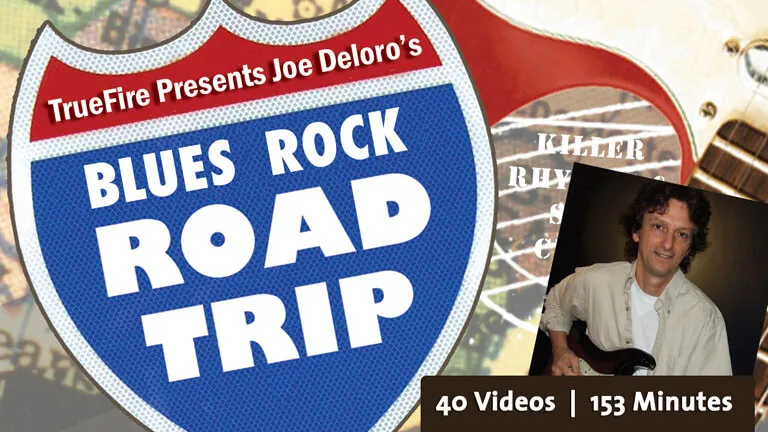
Blues-Rock Road Trip

Blues rock guitar stylings from London, Chicago, Texas, NYC and beyond

Marty FriedmanTommy EmmanuelSteve VaiEric GalesEric Johnson

Get this course and 1,000+ more with All Access

Try 14 days free. Cancel any time.

Purchase Individual Course for $5.00
Blues-Rock Road Trip

About this course

Take a 1-4-5, crank up the drive, blow long improvised solos and you've got a few of the necessary ingredients to start working on your blues-rock bag. But that's just the beginning - everything else you'll need can be found in this groundbreaking video course by Joe Deloro, master blues-rocker and educator with dozens of top titles to his credit.

Blues Rock Road Trip features a series of video guitar lessons, which examines the many facets and geographical influences that make up this extraordinarily popular style of guitar. From London to Chicago to Texas and points beyond, Blues Rock: Road Trip will fill-up your tank as you learn to play essential blues-rock rhythm guitar patterns, licks, techniques and a set's worth of new grooves to take out to the next jam or gig.

The course leverages TrueFire's new interactive video quick-learning system to get players up and running quickly without hours of tedious theory and exercises.

Blues Rock Road Trip is a hands-on playing course, which guides the student through 10 distinct rhythm patterns and variations, 10 distinct solos and variations, plus dozens of extra blues-rock licks and other tricks of the blues-rock trade.

What you'll learn

  • Execute hybrid picking technique for octave melodies
  • Improvise using open string pull-offs and pedal tones
  • Use arpeggios to outline chord progressions
  • Create jazz-influenced solo lines over minor chord progressions
  • Execute a complete blues solo over bars 11-12 and through a full chorus
Release date: 02/24/2005 • 2h 33m runtime
Start Course
Sample lessons
Rockin' D: Rhythm
Rockin' D: Rhythm
Part 1
Rockin' D: Rhythm
Rockin' D: Rhythm
Part 2
Rockin' D: Solo
Rockin' D: Solo
Part 1
Rockin' D: Solo
Rockin' D: Solo
Part 2

What's included

40 lessons • 20 charts • 11 Jam Tracks

Very Berry: Rhythm
Like most established musical styles, Blues-Rock is easier to play than it is to understand. Although expressed in two words, it's a varied mixture of many elements. In order to understand it, you need to know the necessary historical roots, the underlying music theory, and then connect the dots. And, those dots take a fair amount of effort to locate since they're mostly found on an obscure musical map of eras, people, places, and sounds. For example, just making the connection between The Rolling Stones', "(I Can't Get No) Satisfaction" (initially recorded at Chicago's Chess Records in 1965) and Muddy Water's, "I Can't Be Satisfied" (recorded at and released on Chess Record's predecessor, Aristocrat Records in 1948) leads in many directions. And, although Blues-Rock is at the least a hybrid of Blues and Rock, many other styles (Country, Gospel, R&B, Folk etc.) have been merged successfully with it over the years. The primary connection on this trip though, is with the Blues itself. Not to worry. In this lesson and those that follow, the text in part one of each lesson (the rhythm part) will focus on the underlying concepts and theory. Then, in part two (the solo part), the text will cover the basic roots, cities, and/or regions, so we can comfortably navigate, and connect a few dots along the way. As the title above suggests, we're about to look into a bit of the Chuck Berry rhythm and lead approach, loosely based on his classic, Johnny B. Goode, from Chuck's Chess Records era (1955-66). Most importantly, Johnny B. Goode is a very cool straight/shuffle hybrid. Here's why. As far as the rhythm part is concerned, it's very unusual in its approach to a 7th chord 12 bar blues shuffle in Bb. Instead of doing the obvious, shuffling barred 7th chords (with triplet-based eighth notes) to match with the shuffle feel of the bass, drums, and piano, it tightly goes against them, with "power" chords (instead of 7ths), played with a straight feel (even eighth notes). Sounds weird, but as you'll see and hear on the original recording, the audio example below, and the lesson ahead, if it's done with care, it creates a very cool groove when combined with a straight eighth lead part as in Johnny B. Goode. Also, by using power chords (root and fifth) the 7th chord sound is lighter, since it's only stated by the piano and inferred by the bass and lead parts. In addition, the "two against three" (rhythm and lead vs. piano, bass, and drums) effect is nicely balanced throughout the song, because when the lead parts aren't present, the lead vocal (also straight eighth notes) replaces it. Also, this sound works best with a 5 or 6-piece band, not two opposing guitars. Finally, although Johnny B. Goode's not your typical shuffle, it just proves the cliche one more time - if it sounds great, it is great! So check out the audio example below to hear the full effect of the straight rhythm and lead against the shuffled bass and drums. Like all the other audio examples in this course it features a slightly different version of the rhythm and lead guitar parts played together with the bass and drums.
Very Berry: Rhythm
Like most established musical styles, Blues-Rock is easier to play than it is to understand. Although expressed in two words, it's a varied mixture of many elements. In order to understand it, you need to know the necessary historical roots, the underlying music theory, and then connect the dots. And, those dots take a fair amount of effort to locate since they're mostly found on an obscure musical map of eras, people, places, and sounds. For example, just making the connection between The Rolling Stones', "(I Can't Get No) Satisfaction" (initially recorded at Chicago's Chess Records in 1965) and Muddy Water's, "I Can't Be Satisfied" (recorded at and released on Chess Record's predecessor, Aristocrat Records in 1948) leads in many directions. And, although Blues-Rock is at the least a hybrid of Blues and Rock, many other styles (Country, Gospel, R&B, Folk etc.) have been merged successfully with it over the years. The primary connection on this trip though, is with the Blues itself. Not to worry. In this lesson and those that follow, the text in part one of each lesson (the rhythm part) will focus on the underlying concepts and theory. Then, in part two (the solo part), the text will cover the basic roots, cities, and/or regions, so we can comfortably navigate, and connect a few dots along the way. As the title above suggests, we're about to look into a bit of the Chuck Berry rhythm and lead approach, loosely based on his classic, Johnny B. Goode, from Chuck's Chess Records era (1955-66). Most importantly, Johnny B. Goode is a very cool straight/shuffle hybrid. Here's why. As far as the rhythm part is concerned, it's very unusual in its approach to a 7th chord 12 bar blues shuffle in Bb. Instead of doing the obvious, shuffling barred 7th chords (with triplet-based eighth notes) to match with the shuffle feel of the bass, drums, and piano, it tightly goes against them, with "power" chords (instead of 7ths), played with a straight feel (even eighth notes). Sounds weird, but as you'll see and hear on the original recording, the audio example below, and the lesson ahead, if it's done with care, it creates a very cool groove when combined with a straight eighth lead part as in Johnny B. Goode. Also, by using power chords (root and fifth) the 7th chord sound is lighter, since it's only stated by the piano and inferred by the bass and lead parts. In addition, the "two against three" (rhythm and lead vs. piano, bass, and drums) effect is nicely balanced throughout the song, because when the lead parts aren't present, the lead vocal (also straight eighth notes) replaces it. Also, this sound works best with a 5 or 6-piece band, not two opposing guitars. Finally, although Johnny B. Goode's not your typical shuffle, it just proves the cliche one more time - if it sounds great, it is great! So check out the audio example below to hear the full effect of the straight rhythm and lead against the shuffled bass and drums. Like all the other audio examples in this course it features a slightly different version of the rhythm and lead guitar parts played together with the bass and drums.
Very Berry: Solo
Chicago's still a Blues town today, mostly because it was a Blues Mecca in the 50's and 60's. There's still a variety of great Blues clubs in the area, as well as the Midwest's most important annual free Blues festival. But before all of this, it was a Jazz town in the 20's and 30's. Let's start there. You'll see why. Chicago's Jazz era began roughly, when the great trumpeter, Louis "Satchmo" Armstrong caught a train up to the "Windy City" in 1922, to play a dream gig with fellow New Orleans native and mentor, Joe "King" Oliver. Chi-town was a beacon of opportunity then for Armstrong, as Hot Dixieland Jazz ("Hot" meaning that all the musicians improvised collectively, in a way, sort of like what Cream would do 45 years later) was just catching fire there. And, the highlife of the "Roaring Twenties", prohibition, bootlegging (the "Jazz Age") were all getting underway. Of course, it all crashed when the Great Depression came in the 30's and the "roar" was forever silenced. After World War II, in the 40's and 50's, the northern route of opportunity "Satchmo" traveled two decades earlier was taken up again in force. Reaching from New Orleans all the up way to Chicago and beyond, it was traveled by many southern Bluesmen looking for gigs and/or recording careers in the bigger cities like Memphis, St. Louis, Cincinnati, Chicago, and Detroit. Whether traveling by, U.S. Highways 61, 55, & 85 or the Illinois Central rail line, it all gradually became known as, "The Blues Highway." During that period country blues artists like Muddy Waters, Howlin' Wolf, Willie Dixon, and Buddy Guy all headed north for a better life - and maybe even the Big Time. Some, like the Wolf and Earl Hooker who stopped first to try their luck in Memphis at Sam Phillip's Sun Records before moving on northwards. Whether they traveled by railway or highway, this time, instead of New Orleans Jazz, they brought electrified Mississippi Delta Country Blues. Their "Great Migration" fired up a unique musical melting pot, and pioneered Chicago's new urban Blues sound. By the time "Johnny B. Goode" was released in 1958, Chicago's music machine was not only established, but successfully pushing the envelope beyond the urban Blues, courtesy of Chess Records. Chuck Berry, Bo Diddley, and Chess had now put Chicago on the map as a Rock and Roll city, but not without the help of the Blues and other styles. To connect the dots for this lesson we head south on the Blues Highway from Chicago to St Louis. There, in his hometown in 1952, Chuck Berry began playing with the popular Sir John's Trio, led by pianist Johnnie Johnson. Three years later in '55 he was just 19 and ready to move on. So he traveled up to Chicago to see Muddy Waters perform, and then try his luck at Chess on a tip from Muddy. Although his overall sound was unique, it was nevertheless derived from Rock-A-Billy, R&B, and the Blues, and therefore could also be thought of as Blues-Rock. That is, as described in the preceding "rhythm" lesson theory notes, while the piano, bass, and drums were played with a traditional blues shuffle feel, the rhythm and lead guitar parts were based on a straight feel, as in Country, Bluegrass, and Rock-A-Billy music. And of course, Chuck's classic lyrics traced a line from the country to the city. And so, with a bit of a stretch we've arrived at the dawn of Blues-Rock and/or Rock & Roll in Chicago.

Very Berry: Solo
Chicago's still a Blues town today, mostly because it was a Blues Mecca in the 50's and 60's. There's still a variety of great Blues clubs in the area, as well as the Midwest's most important annual free Blues festival. But before all of this, it was a Jazz town in the 20's and 30's. Let's start there. You'll see why. Chicago's Jazz era began roughly, when the great trumpeter, Louis "Satchmo" Armstrong caught a train up to the "Windy City" in 1922, to play a dream gig with fellow New Orleans native and mentor, Joe "King" Oliver. Chi-town was a beacon of opportunity then for Armstrong, as Hot Dixieland Jazz ("Hot" meaning that all the musicians improvised collectively, in a way, sort of like what Cream would do 45 years later) was just catching fire there. And, the highlife of the "Roaring Twenties", prohibition, bootlegging (the "Jazz Age") were all getting underway. Of course, it all crashed when the Great Depression came in the 30's and the "roar" was forever silenced. After World War II, in the 40's and 50's, the northern route of opportunity "Satchmo" traveled two decades earlier was taken up again in force. Reaching from New Orleans all the up way to Chicago and beyond, it was traveled by many southern Bluesmen looking for gigs and/or recording careers in the bigger cities like Memphis, St. Louis, Cincinnati, Chicago, and Detroit. Whether traveling by, U.S. Highways 61, 55, & 85 or the Illinois Central rail line, it all gradually became known as, "The Blues Highway." During that period country blues artists like Muddy Waters, Howlin' Wolf, Willie Dixon, and Buddy Guy all headed north for a better life - and maybe even the Big Time. Some, like the Wolf and Earl Hooker who stopped first to try their luck in Memphis at Sam Phillip's Sun Records before moving on northwards. Whether they traveled by railway or highway, this time, instead of New Orleans Jazz, they brought electrified Mississippi Delta Country Blues. Their "Great Migration" fired up a unique musical melting pot, and pioneered Chicago's new urban Blues sound. By the time "Johnny B. Goode" was released in 1958, Chicago's music machine was not only established, but successfully pushing the envelope beyond the urban Blues, courtesy of Chess Records. Chuck Berry, Bo Diddley, and Chess had now put Chicago on the map as a Rock and Roll city, but not without the help of the Blues and other styles. To connect the dots for this lesson we head south on the Blues Highway from Chicago to St Louis. There, in his hometown in 1952, Chuck Berry began playing with the popular Sir John's Trio, led by pianist Johnnie Johnson. Three years later in '55 he was just 19 and ready to move on. So he traveled up to Chicago to see Muddy Waters perform, and then try his luck at Chess on a tip from Muddy. Although his overall sound was unique, it was nevertheless derived from Rock-A-Billy, R&B, and the Blues, and therefore could also be thought of as Blues-Rock. That is, as described in the preceding "rhythm" lesson theory notes, while the piano, bass, and drums were played with a traditional blues shuffle feel, the rhythm and lead guitar parts were based on a straight feel, as in Country, Bluegrass, and Rock-A-Billy music. And of course, Chuck's classic lyrics traced a line from the country to the city. And so, with a bit of a stretch we've arrived at the dawn of Blues-Rock and/or Rock & Roll in Chicago.

B's Boogie: Rhythm
Fast boogies are a fun ride, both for players and listeners alike (think; La Grange by ZZ Top, Eric Johnson, Zap, etc.) So what's a boogie? Well rhythmically, boogies are regional and related to their good cousins, shuffle and swing. That is, boogies are based on deriving their primary rhythm from triplets (2/3 thirds-1 third: "1-let, etc.") instead of the usual, even eighth notes (1/2 and 1/2: "1-and, etc.") Pitch-wise, boogies are often primarily based on a single chord (think; Boom Boom by John Lee Hooker, or On The Road Again Canned Heat). But, never say never, chord changes are cool, too (think; One Bourbon, One Scotch, One Beer by John Lee Hooker.) B's Boogie looks back to the basics of a Jeff Beck up-tempo classic, Jeff's Boogie (The Yardbirds, Roger The Engineer, 1966). Here's why. Besides being up-tempo, the rhythm part of this instrumental is based on dominant 9th chords rooted on the 5th string. So what again? Well, generally speaking, 9th chords are the usual suspects in slow tempo blues tunes like T-Bone Walker's, Stormy Monday, and moderate tempo funk-fests like James Brown's, "Lickin' Stick". Here with B's Boogie, things are different, it's all up-tempo 9ths for the first ten bars, and then there's a traditional turnaround based on G7 to D7. Beyond that, the 1st chorus theme and following solos avoid predictability because they're only 1 phrase long (4 bars, instead of 12). And, they constantly switch between minor and major tonalities (with various chromatic neighbors dropping by). Beyond that, be sure to check out the JB original, it takes the solos out farther, and even connects with the good vibes of the Wizard of Wakesha, Les Paul.
B's Boogie: Rhythm
Fast boogies are a fun ride, both for players and listeners alike (think; La Grange by ZZ Top, Eric Johnson, Zap, etc.) So what's a boogie? Well rhythmically, boogies are regional and related to their good cousins, shuffle and swing. That is, boogies are based on deriving their primary rhythm from triplets (2/3 thirds-1 third: "1-let, etc.") instead of the usual, even eighth notes (1/2 and 1/2: "1-and, etc.") Pitch-wise, boogies are often primarily based on a single chord (think; Boom Boom by John Lee Hooker, or On The Road Again Canned Heat). But, never say never, chord changes are cool, too (think; One Bourbon, One Scotch, One Beer by John Lee Hooker.) B's Boogie looks back to the basics of a Jeff Beck up-tempo classic, Jeff's Boogie (The Yardbirds, Roger The Engineer, 1966). Here's why. Besides being up-tempo, the rhythm part of this instrumental is based on dominant 9th chords rooted on the 5th string. So what again? Well, generally speaking, 9th chords are the usual suspects in slow tempo blues tunes like T-Bone Walker's, Stormy Monday, and moderate tempo funk-fests like James Brown's, "Lickin' Stick". Here with B's Boogie, things are different, it's all up-tempo 9ths for the first ten bars, and then there's a traditional turnaround based on G7 to D7. Beyond that, the 1st chorus theme and following solos avoid predictability because they're only 1 phrase long (4 bars, instead of 12). And, they constantly switch between minor and major tonalities (with various chromatic neighbors dropping by). Beyond that, be sure to check out the JB original, it takes the solos out farther, and even connects with the good vibes of the Wizard of Wakesha, Les Paul.
B's Boogie: Solo
As mentioned in the preceding lesson text, "B's Boogie" is based on The Yardbirds', "Jeff's Boogie." Although recorded in London in 1966 it has a strong connection to Chicago in the late 50's. In fact, it sort of picks up where "Johnny B. Goode" leaves off, so let's start there. In December of 1957 Chuck Berry recorded "Guitar Boogie" during the same sessions as "Johnny B. Goode" with the same band as well. Likewise, both "Guitar Boogie" and "Jeff's Boogie" are instrumentals and, have enough similarities to connect them. For example, both are based on the 12 bar Blues and, the solos in both are often limited to stop-time during the first four bars of each chorus, and Beck even develops some of Berry's solo ideas further. Just listen to the original recordings; you'll make the connections. Jeff wasn't overly dependant on the Berry style though, and incorporated many other influences in his hopped-up tribute, such as the humorous Pop-Jazz of Les Paul. All of the above is really just to underscore the Post-War fascination with and modernization of American Blues and Rock & Roll through Blues-Rock by Jeff Beck and The Yardbirds, and countless other British musicians during the mid-sixties. Since London was the apex of the British music scene during that era, it typified that atmosphere, and also served as the launching pad for the second wave of British Blues-Rock after The Rolling Stones.

+ 33 more lessons

Start Course

Reviews

9 results

arpeggio5

Verified buyer

01/31/26

Both are good courses

Derij

Verified buyer

11/26/25

A really good quality corse.

This is a great addition for anyone looking to improve your blues playing. Rhythm or lead it's got you covered.

DWreck

Verified buyer

02/05/25

Great course

Very cool history of the blues

Veronica

10/21/21

A fantastic Blues Rock Road Trip

Having the opportunity to learn from a great instructor like Joe can really help you understand the concepts that make the blues phenomenal. The lesson has a good balance because you can learn techniques in rhythm guitar and lead guitar, the concepts are understandable at all times which helps you to progress in a continuous and dynamic way. The lesson is highly recommended and is a lot of fun to learn to play.

sindibad

06/16/20

Blues Rock Road Trip

It is a good old-fashioned work tool for people who want to take their time to get it right.

Stop searching. Start improving with All Access.

Try 14 days free. Cancel any time.