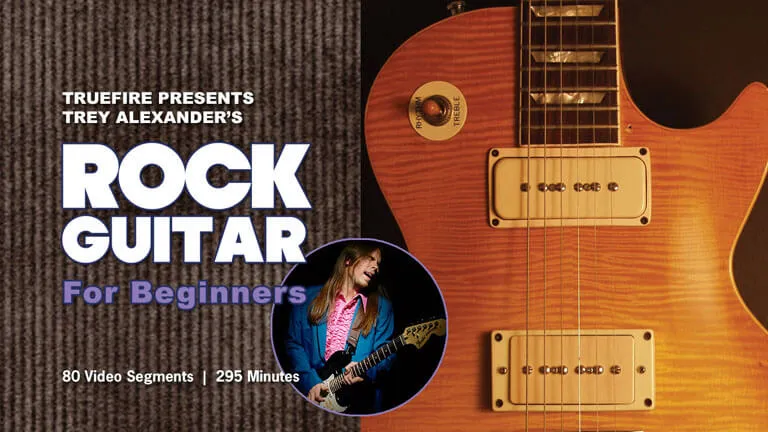
Rock Guitar For Beginners

Learn to play electric rock guitar riffs, chords and rhythms

Marty FriedmanTommy EmmanuelSteve VaiEric GalesEric Johnson

Get this course and 1,000+ more with All Access

Try 14 days free. Cancel any time.

Purchase Individual Course for $5.00
Rock Guitar For Beginners

About this course

If you've always wanted to learn how to play rock guitar - or even started once or twice in the past only to put it down in frustration - these Freshman Series beginner guitar lessons are likely the perfect approach for you. Rock Guitar for Beginners is a jump-start method designed to get you up and strumming quickly without having to work through tedious theory, scales and exercises. In fact, you'll be rockin' in your very first week of working with the course.

Rock Guitar for Beginners is tailored specifically for adults who don't have the time or desire for formal training. To get you on the fast track, we've deliberately steered clear of music theory, reading notation and exercises (there's plenty of time for all that good stuff later). Instead, you'll dig in immediately learning rock chords, strumming, keeping time and building a solid vocabulary of rock licks. Best of all, you'll learn how to read tab so you can easily learn how to play guitar and hundreds of your favorite songs.

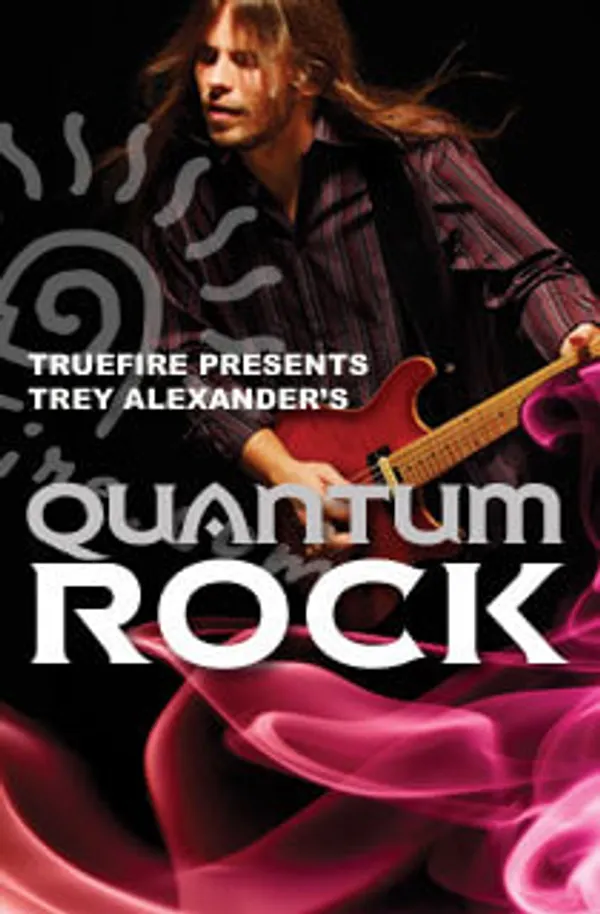
Your extremely capable guide to the world of rock guitar is none other than Trey Alexander, voted Guitar Hero 2006 by Guitar Player magazine and a distinguished panel of judges. "The astonishing focus, devotion, and versatility Trey Alexander displays each time he picks up a 6-string should make the Pennsylvania fretboard phenom a true inspiration to any guitar slinger (or other musician) lucky enough to catch him in action."

Alexander starts from scratch, teaching you how to tune, how to hold the pick and how to play your first rock chord and lick. Trey explains every step and breaks each example down so you know exactly what to play and how to play it. He shows you how to strum and pick in time, how to get your chords to sound clean, while teaching you a variety of rock chord progressions and riffs. On-screen chord diagrams and beat counters help you to stay on track, and jam tracks for each lesson make practicing fun - just play along with Trey and the practice rhythm tracks. By the end of the course you'll be able to play power chords, rock rhythms, solos and a variety of rock grooves that you can jam and improvise over.

What you'll learn

  • Play multiple rock rhythm progressions using power chords
  • Navigate power chords using the chromatic scale
  • Integrate pentatonic scales with droning note patterns
  • Play rhythms on beats 2 and 4
  • Apply pedal tone technique in soloing contexts
Release date: 03/07/2008 • 4h 55m runtime
Start Course
Sample lessons
Parts Of The Guitar
Parts Of The Guitar
Tuning The Guitar
Tuning The Guitar
Replacing A String
Replacing A String
Reading Tablature
Reading Tablature
Part 1

What's included

80 lessons • 32 charts • 7 Jam Tracks

Rock For Beginners
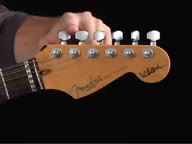
I would like to start off by talking a little bit about your instrument. So let's get started: Tuning Pegs: There are many different kinds of tuning pegs ranging from classic tuners that you find on an acoustic guitar all the way to the locking tuners that you use on electric guitars to make those monster whammy bar dives! These gears are what you will keep your instrument in tune with. They will raise and lower the pitch of each string and are ratio to give an accurate method to tuning the guitar. The Nut: The nut located here is a small piece of bone, plastic, brass, stainless steel or graphite that guides the strings onto the fret board, giving it consistent lateral string placement. The Frets: The frets are usually made of Nickel alloy of stainless steel and embedded along the fret board to give us different pitches. The way that it does this is it shortens the strings and gives them a smaller vibration length giving them a different pitch. The Bridge: The bridge is what holds the strings into place onto the body. They also create vibrations that ring through the guitar. There are action adjustments and intonation adjustments that are located here. But it is probably a good idea to let your local repairman take care of those things. The Pick Guard: This little piece of plastic is usually what protects the front side of your guitar from all of those Led Zeppelin and Pete Townshend battle stage strums. It also provides a place for pick ups to be installed and is kind of nice when you switch pickups to try and locate different sounds and such. Pick Ups: If you wanna play rock and roll which I think we are all probably on the quest to do, you are going to need pickups. This lets us go from not being heard at all to knocking out our parent's windows. I know my Mom can attest for this. I turned up my amp to the point of destruction quite a few times. I kept trying to tell her it is the only way to get that cool EVH sound. I don't think she cared what kind of tone it was. I called it the EVH she called it WTL (way too loud). Volume/Tone/Tone: Depending on if you are playing with a Les Paul style guitar or a Strat style you find that you either have 1 volume and 2 tones or 2 volumes and 2 tones. The volume knob turns the main output or volume up or down. Remember although loud is way cool there is a bit of professionalism in the rolled back volume that lets the other players be heard with having to use the turbo ultra loud change the rotation of the earth button. The Tone knobs are what takes the guitar from smooth jazz to rock and rock and blues all the way to the sweet and smooth sounds of Eric Johnson. Really experiment with these functions. They drastically change the way you sound and the way you play. Have fun with that. Pick up selector: This device changes the pickups and there are quite a few different combinations. My guitar has a 5-way switch. This allows me to have five positions to play on. A Les Paul has three. Both have plenty of combinations to wield the tone of kings but for me I am a Strat guy. I think either you are a Strat man or Paul man. I love them both but at the end of the day I wanna play a Strat. Input: Where we plug our guitars in.
Parts Of The Guitar
I would like to start off by talking a little bit about your instrument. So let's get started: Tuning Pegs: There are many different kinds of tuning pegs ranging from classic tuners that you find on an acoustic guitar all the way to the locking tuners that you use on electric guitars to make those monster whammy bar dives! These gears are what you will keep your instrument in tune with. They will raise and lower the pitch of each string and are ratio to give an accurate method to tuning the guitar. The Nut: The nut located here is a small piece of bone, plastic, brass, stainless steel or graphite that guides the strings onto the fret board, giving it consistent lateral string placement. The Frets: The frets are usually made of Nickel alloy of stainless steel and embedded along the fret board to give us different pitches. The way that it does this is it shortens the strings and gives them a smaller vibration length giving them a different pitch. The Bridge: The bridge is what holds the strings into place onto the body. They also create vibrations that ring through the guitar. There are action adjustments and intonation adjustments that are located here. But it is probably a good idea to let your local repairman take care of those things. The Pick Guard: This little piece of plastic is usually what protects the front side of your guitar from all of those Led Zeppelin and Pete Townshend battle stage strums. It also provides a place for pick ups to be installed and is kind of nice when you switch pickups to try and locate different sounds and such. Pick Ups: If you wanna play rock and roll which I think we are all probably on the quest to do, you are going to need pickups. This lets us go from not being heard at all to knocking out our parent's windows. I know my Mom can attest for this. I turned up my amp to the point of destruction quite a few times. I kept trying to tell her it is the only way to get that cool EVH sound. I don't think she cared what kind of tone it was. I called it the EVH she called it WTL (way too loud). Volume/Tone/Tone: Depending on if you are playing with a Les Paul style guitar or a Strat style you find that you either have 1 volume and 2 tones or 2 volumes and 2 tones. The volume knob turns the main output or volume up or down. Remember although loud is way cool there is a bit of professionalism in the rolled back volume that lets the other players be heard with having to use the turbo ultra loud change the rotation of the earth button. The Tone knobs are what takes the guitar from smooth jazz to rock and rock and blues all the way to the sweet and smooth sounds of Eric Johnson. Really experiment with these functions. They drastically change the way you sound and the way you play. Have fun with that. Pick up selector: This device changes the pickups and there are quite a few different combinations. My guitar has a 5-way switch. This allows me to have five positions to play on. A Les Paul has three. Both have plenty of combinations to wield the tone of kings but for me I am a Strat guy. I think either you are a Strat man or Paul man. I love them both but at the end of the day I wanna play a Strat. Input: Where we plug our guitars in.
Tuning The Guitar
Electric tuners are a must have. They have many brands on the market now from Korg to the Intellitouch Tuner. There are so many good tuners so the best thing to do is go to the local music shop and check them out. They will give an easy and quick read out so that you are able to tune up quick and precise. This will be an asset to you and you should always carry one with you. One of the most frustrating things that I can remember doing is popping a string. Especially when you just get your guitar and you are watching a video like this one and we think we are almost in tune and "POP". Then we make sure we still have our eyeballs and say "crap what am I going to do now"? "MMMOOOOOOMMMM!!!!! Or Hunnnnnnnny, can we go to the music store?" and then she comes and says "you already broke the thing". So before you do that let me help you out. I am going to demonstrate to you how to change your string and then I am going to show you some tricks to staying in tune.
Replacing A String
Electric tuners are a must have. They have many brands on the market now from Korg to the Intellitouch Tuner. There are so many good tuners so the best thing to do is go to the local music shop and check them out. They will give an easy and quick read out so that you are able to tune up quick and precise. This will be an asset to you and you should always carry one with you. One of the most frustrating things that I can remember doing is popping a string. Especially when you just get your guitar and you are watching a video like this one and we think we are almost in tune and "POP". Then we make sure we still have our eyeballs and say "crap what am I going to do now"? "MMMOOOOOOMMMM!!!!! Or Hunnnnnnnny, can we go to the music store?" and then she comes and says "you already broke the thing". So before you do that let me help you out. I am going to demonstrate to you how to change your string and then I am going to show you some tricks to staying in tune.
Reading Tablature
Tab is a short word for Tablature. It is a form of musical notation which tells players where to place their fingers on a particular string rather than which pitches to play. This notation method was very common during the Renaissance and Baroque eras. It is by no means the best way to read music but you may find it to be a very fun, quick, and exciting way of learning. I would like you to take note that you should learn how to read music but in my experience the really dedicated students will always take it to that level and it is very important to have fun learning how to play first, that way it is exciting to us. Besides I don't think any of us want to be playing Mary Had A Little Lamb for the next five lessons, do we? OK cool. Let's get started.
Reading Tablature
Tab is a short word for Tablature. It is a form of musical notation which tells players where to place their fingers on a particular string rather than which pitches to play. This notation method was very common during the Renaissance and Baroque eras. It is by no means the best way to read music but you may find it to be a very fun, quick, and exciting way of learning. I would like you to take note that you should learn how to read music but in my experience the really dedicated students will always take it to that level and it is very important to have fun learning how to play first, that way it is exciting to us. Besides I don't think any of us want to be playing Mary Had A Little Lamb for the next five lessons, do we? OK cool. Let's get started.
Chromatic Scale
Chromatic derives from the Greek word Chroma meaning color, which is kind of cool. Hence probably the reason why we call it art. Chromatic notes are traditionally understood as harmonically inessential embellishments, shadings, or inflections of Diatonic notes. The notes of this scale are as follows: Let's start at C C#/Db D D#/Eb E F F#/Gb G G#/Ab A A#/Bb B C These are the notes of the chromatic scale. We want to take note of the sharps and flats. The sharp is a small number symbol and the flat is like a lower case b. The Chromatic scale is one of the first things I was ever taught. This is one of the most important things you will learn and it will be an essential part of learning how to connect all those uber cool rock licks. This will also help you in the upcoming sections on how to move passages and solos around the fret board!

+ 73 more lessons

Start Course

Reviews

11 results

MoSlater

Verified buyer

01/10/26

Brilliant course.

Denis L.

12/13/24

Great

Love how simple yet musical it is.

rpd63

Verified buyer

07/20/23

Good Start!

Rock Guitar For Beginners is a very good introduction to getting started playing rock guitar. The course builds didactically and makes you want more.

Manomano

Verified buyer

02/19/21

Accurate Description

Helpful course

wholmer

12/23/20

Perfect for a complete beginner to start

These lessons will get you on the right path for a solid foundation right from the start. I know, I’ve taken a LOT of self-taught courses over the years and kept realizing I had holes where I missed some techniques. Finally, I just started over with this set of lessons when I found Truefire. It filled in all the missing holes!

Stop searching. Start improving with All Access.

Try 14 days free. Cancel any time.