




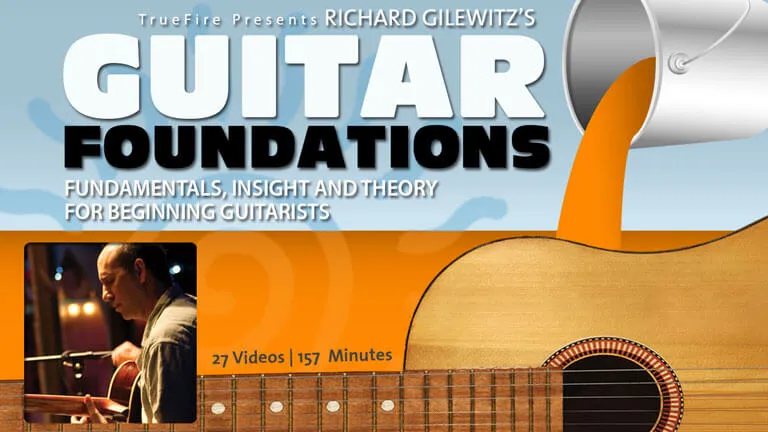

Guitar Foundations

Fundamentals, insight and theory for beginning guitarists

Marty FriedmanTommy EmmanuelSteve VaiEric GalesEric Johnson

Get this course and 1,000+ more with All Access

Try 14 days free. Cancel any time.

Purchase Individual Course for $5.00
Guitar Foundations

About this course

Richard Gilewitz?s Guitar Foundations is an innovative course of study as it serves multiple purposes for multiple levels of play. Gilewitz set out to create a modular course of study focused on building solid foundations for playing, practicing and performing acoustic guitar.

"I've identified what I consider to be the most crucial fundamentals for the beginning guitarist," says Gilewitz. "However, throughout my teaching career, I've also observed that many seasoned players have serious gaps in their own knowledge with respect to basic music theory, structured picking pattern 'languages' to aid in both memorizing and creating tunes, and most importantly, the effective use of a metronome to aid in timing issues."

Beginners will learn the fundamentals from the ground-up with a simple building block approach that unlocks the mystery of music theory, explains chord types, and the design of different keys. Intermediate players can select slabs of discussion about suspended and 9th chords, plus inversions, and how to build upon existing picking patterns to create new sounds utilizing triplets and 16th notes. Even advanced players will benefit from revisiting and perhaps even retooling their techniques. All levels will enjoy tackling a spruced up 12 bar blues with restoration of chord and scale shapes along with rhythm patterns.

What you'll learn

  • Combine strumming and fingerpicking within progressions
  • Create simple songs using diatonic chord progressions
  • Understand Roman numeral chord notation
  • Understand how to construct major, minor, and seventh chords
  • Develop right hand fingerstyle technique with a flexible 'menu' approach
Release date: 11/25/2009 • 2h 37m runtime
Start Course
Sample lessons
Guitar Anatomy
Guitar Anatomy
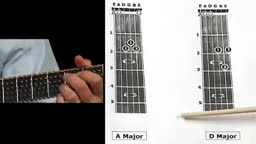
Chords
Chords
Major & Minor
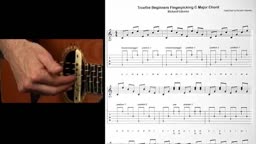
Picking Patterns
Picking Patterns
Chord Construction
Chord Construction
Part 2

What's included

27 lessons • 18 charts

Guitar Foundations
Welcome to my new video with my friends at TrueFire. I am thrilled that I have been invited to share my knowledge and approach to helping with the creation of a foundation of what I feel are some of the most crucial fundamentals for the beginning guitarist.

Throughout my teaching career, I have encountered many seasoned players as well that appear to have gaps in their knowledge regarding basic music theory, a structured picking pattern ‘language’ to aid in both memorizing and creating tunes, and most importantly, the effective use of a metronome to aid in timing issues.

It is my hope that after working diligently with this video players at all levels can fill in the gaps and solidify their launchpad!
Left & Right Hand
Fortunately for musicians worldwide, there is a universal language allowing a consistent fingering and notation for both the left and right hands. Many classical guitarists obviously are familiar with the p, i, m, a naming convention and it is encouraging to see that many steel string fingerpickers are catching on as well.

The left hand for fretting is commonly agreed upon as 1, 2, 3 and 4 from index to pinky, respectively.

Not to leave out the left handed player, all can be considered reverse for the two hands if you might prefer to play that way.
Right Hand
One thing to keep in mind regarding the right hand positioning of the fingers for the fingerstyle guitarist is that there is not necessarily one approach. Sitting positions as well as guitar neck angles while holding the guitar on the left leg (such as many classical players tend to use) should all be considered for your style of play.

I seem to have found that the three base positions seem to offer me a certain amount of a grounding location but I do vary in and out of the basic positions mentioned as needed.
Left & Right Hand
The left and right hand notations are crucial to memorize since they will be referred to constantly in a good deal of the music you will learn. Keep in mind that often times in classical music only a portion of the suggested fingerings is supplied and be sure not to confuse a circled number above musical notation with a finger as that notation tends to refer to a particular string to be played.
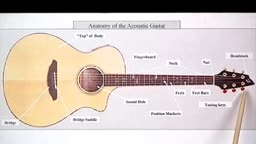
Guitar Anatomy
Guitar Anatomy is basically understanding the names of the internationally recognized guitar parts. While conducting a seminar for children I was once asked by a nervous participant what that was around the hole in the guitar. I simply said, “Well, it’s a guitar!” I believe he actually intended on asking about the guitar pickup that was in the soundhole.

I suppose the point here is that it’s just simply a good idea to know what the parts of the instrument are agreed to be called universally. And yes, around the hole IS a guitar!
Chords
Major and minor chords are the most commonly used guitar chords utilized in composing a piece of music. There tends to be a structure at a very basic level and from there a variety of moods or as I once heard it, chord qualities, can be interspersed to allow for a broader depth within a tune. Sometimes, however, some terrific pieces of music are comprised of no more than Major and minor chords.
Technique & Tuning
Regarding the tuning of your instrument it seems that with the incredible availability of tools and toys for the modern day guitarist such as a variety of tuners, many students and players run the risk of, as I once heard it, “ruining their ear.” I think the point was that tuners are too often used ahead of time and the human ear is not utilized as often for continued ear training. I would recommend using the tuner as a checking device after you’ve made your initial efforts.

+ 20 more lessons

Start Course

Reviews

3 results

Jazzadrin

04/26/25

This is a great intro/primer course for guitarists trying to begin Fingerstyle/Fingerpicking Guitar

This course is old, but don't let that deter you, there's quality content in here. Richard explains things very clearly and really helps one not only dive in to beginning fingerstyle guitar techniques and concepts, but also general guitar and musical fundamentals as well. This course is easy to get through and very straight to the point. Lots of playing examples throughout, and plenty of knowledge and tips are clearly explained, Richard is a great instructor. Thanks a lot for this course! Highly recommended to any one wishing to begin Fingerstyle guitar, it's a great introduction course that will help you move towards intermediate playing. Another great beginning course that I highly recommend of TrueFire is Trevor Gordon Hall's Fingerstyle Guitar for Beginners. If you utilize that course in conjunction with this great course you will assuredly reach intermediate level Fingerstyle guitar proficiency and be ready for more challenging concepts with your new found skills and developing technique. Good luck, fellow musicians, keep growing and keep having fun!

DaveyH2O

Verified buyer

04/14/21

Guitar Foundations review

As a returning guitar player who's been not playing for 30+ years, Guitar Foundations is the perfect course for me to get my feet wet again. Richard is an amazing instructor. I'm very please with my purchase.

bladeshred

Verified buyer

03/22/20

Good Course

I learned a lot from this course...recommended

Stop searching. Start improving with All Access.

Try 14 days free. Cancel any time.