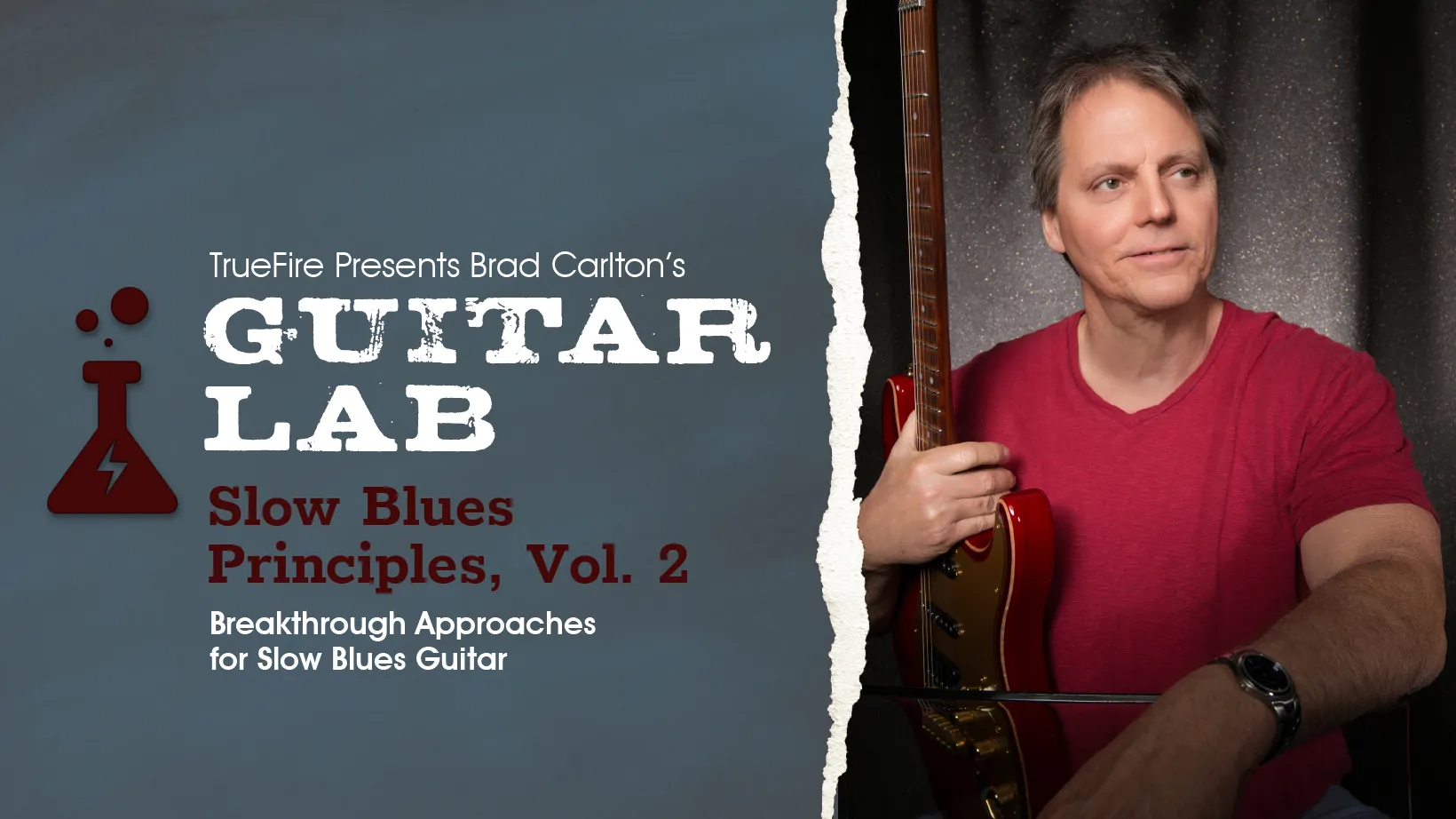
Guitar Lab: Slow Blues Principles, Vol. 2

Master the essentials of slow blues

Marty FriedmanTommy EmmanuelSteve VaiEric GalesEric Johnson

Get this course and 1,000+ more with All Access

Try 14 days free. Cancel any time.

Purchase Individual Course for $5.00
Guitar Lab: Slow Blues Principles, Vol. 2

About this course

Guitar Lab: Slow Blues Principles Vol. 2 picks up where Volume 1 left off, expanding your ability to navigate chord changes and deepen your feel for the slow blues groove. Brad Carlton returns to guide you through the next level—focusing on dominant 7th chords (I7, IV7, V7), blues scales, and the modes within those scales.

You’ll also dig into the rhythmic core of the style, learning to master slow triplet phrasing, subdivisions, and dynamic expression. With lessons on accents, timing, and practice strategies, you’ll develop more than just technique—you’ll shape your sound and avoid falling back on the same old licks.

Whether you're refining your feel or rethinking your approach, this course will help you play with more soul, control, and character.

What you'll learn

  • Navigate and articulate I7, IV7, and V7 chords in blues solos
  • Apply blues scale modes over chord changes
  • Master rhythmic subdivisions in slow triplet feel
  • Apply multiple articulation options to the same melodic phrase
  • Develop original blues vocabulary beyond standard licks
Release date: 06/02/2025 • 1h 29m runtime
Start Course
Sample lessons
The Blues Scale | Mode I
Lesson & Demonstration

What's included

9 lessons • 1 charts • 2 Jam Tracks

Slow Blues Principles Vol. 2
Hi, I’m Brad Carlton, and welcome to Volume Two of Slow Blues Principles.

In this course, we’re going to build on everything you learned in Volume One and take it further. You’ll learn how to navigate and articulate the chords in a Southern blues context—think I7, IV7, and V7 progressions.

We’ll dive into blues scales, explore the different modes of the blues scale, and take a deep look at rhythm—especially how to feel and play over a slow triplet groove. I’ll break down the math behind it, including all the subdivisions of a basic eighth-note triplet.

You’ll also pick up ideas on playing with dynamics, adding accents, and developing a practice approach that helps you avoid falling into the trap of repeating the same old licks.

So grab your guitar—let’s play some blues.
The Blues Scale | Mode I
If you're gonna play blues, the Blues Scale is essential—and the good news is, if you already know the Minor Pentatonic, you're most of the way there. Just add the sharp four (or flat five), which sits between the four and five. In this lesson, I'm using jam tracks in F and C to demonstrate how to navigate slow blues progressions. We're sticking with the classic I–IV–V format, and I’ll walk you through the scale degrees, note names, and fretboard positions so you fully understand what you're playing. We’ll also talk about dynamics—how to control them with your picking hand, not by moving more, but by how tightly you hold the pick. That’s something a lot of players overlook, especially in band settings where everything’s cranked up. But in solo playing, especially with styles like classical guitar, those subtle changes matter. So as we work through the C Blues Scale, I’ll give you a few exercises to help you articulate rhythm, express dynamics, and lock in your pitch across the fretboard.
The Blues Scale | Mode III
When you’re playing over the IV chord in a blues—like F7 or F9 in a C blues—you’re actually using mode three of the C Blues Scale, which starts on the third note, F. The good news is you don’t have to learn a whole new scale—you already know the C Blues Scale, you’re just shifting your focus from C to F. The key is training your ear to hear that shift, not just relying on finger patterns. A lot of players focus too much on speed and dexterity, but if you want to truly sound musical, you need to balance that with ear training and learning to hear chord changes. So instead of aimlessly noodling, take a second to visualize the range—start and end on F to F within the C Blues shape. That way, when the progression jumps between the I7 and IV7 chords (which happens often in a 12-bar blues), you’re ready to follow it musically and confidently.
The Blues Scale | Mode V
When you're playing over the V chord in a blues—like G7 in a C blues—you can stay rooted in the C Blues Scale by using mode five, which starts on G. This works beautifully because G is the fifth note of C, so it lines up naturally. Instead of switching to a different scale like G minor pentatonic, we’re staying consistent and just shifting our perspective within the same scale. You’ve got to really hear these relationships, not just play them by shape. That means learning to recognize strong and weak tones—not thinking in terms of “right” and “wrong” notes, but understanding how different notes function over different chords. I break down the intervals and how they sound so you can train your ear alongside your technique. And I’ll be honest—after teaching for over 55 years, I’ve seen that most players, even those with decades of experience, often haven’t fully developed their ears. So I’m here to help you build that foundation, connect your ears to your hands, and grow into the player you’re capable of being.
Rhythmic Subdivisions | 12/8, Eighth Note Triplets
Let’s talk rhythm—one of my absolute favorite topics. Drums were actually my first instrument, so I’ve always thought rhythm-first, even as a guitarist. One of the best compliments I ever got came from a drummer I worked with in a fusion band when I was 22—he told me I brought out the best in him. That kind of interplay comes from deeply internalizing rhythm, listening closely, and never losing the groove. I’ve spent years studying drummers—solo, in clinics, and even in Indian classical music where rhythm gets incredibly deep. If you want to improve, you’ve got to listen to drummers, keep your foot tapping, and train your internal clock. Most players I’ve taught struggle with rhythm and pitch control—those are the two big ones. Anyone can learn the right notes, but bad timing or intonation will wreck your sound. In this lesson, we’re focusing on eighth-note triplets in a slow blues groove—counting them clearly as “one triplet, two triplet…” and feeling that pulse confidently. Whether you’re thinking in 4/4 or 12/8, the idea is to lock into that slow, steady swing and start making rhythm a strength.
Rhythmic Subdivisions | Shuffle Eighths
If you count a triplet as “one triplet, two triplet,” that’s the backbone of the blues groove we’re working with—and it’s everything. I’ll say it again: groove matters more than speed, tone, or theory. If your groove isn’t solid, no one’s going to want to listen. But if you’ve got a great feel, even with limited technique, you’ll connect with people. Now, if you leave the "trip" out, you get “one-let, two-let”—that’s shuffle eighths. A great way to internalize this is to play muted ghost strokes—downstrokes that emphasize the feel and spacing. It’s about training your ear and your hands to feel the rhythm. When you're soloing, start simple. Think about it like a vocal performance—no one sings with a million words a second. Space matters. Mix whole notes, quarter notes, triplets, and shuffle eighths to shape your phrasing. Start mellow and build energy over each chorus. Don’t just add more notes—make the ones you play sing, with vibrato, bends, and feel. That’s what turns scales into music.
Rhythmic Subdivisions | Sextuplets, 16th Note Triplets
The faster you want to play, the shorter your note values need to be—that’s just how rhythm works. When we count triplets as “one triplet, two triplet,” we’re dividing each beat into three equal parts, and in a slow blues feel, that can be notated as 12/8 or felt like a rolling waltz—“1-2-3, 1-2-3.” From there, we can kick things up a notch by moving into sixteenth notes or even sixteenth-note triplets (sextuplets), which really raise the energy. Practicing these different subdivisions is key, especially if rhythm doesn’t come naturally to you—and that’s okay. Some people just feel rhythm intuitively, others have to work at it, but either way, you can get better. I’ve had students who couldn’t sing in tune or lock into a groove at all when they started, and they made huge progress. So don’t get discouraged. We’ll explore ways to play and pick these faster groupings, using different accents and articulations—like slurs and legato—to change the texture and intensity. Rhythm can get deep and complex, like musical quantum physics. But that’s part of what makes it so fun.

+ 2 more lessons

Start Course

Reviews

5 results

minicolossal

Verified buyer

09/04/25

Great for improvise

That's a great lesson, explain the theory and technique clearly. Great for improvise and writing music.


efinnane

Verified buyer

07/11/25

Learn to make music

A really good teacher. This course helps you to understand the theory behind blues improvisation. It is ultimately about making music, which involves more than technical skill.

vjuracak

Verified buyer

07/09/25

Slow Blues is fantastic

Extraordinary Brad

Kladuke

Verified buyer

07/02/25

Great Teacher, If You're Ready

Brad is a good teacher. He teaches the "why", which is really good. . . but you have to be ready to commit to it to get the full benefit of what he's talking about. He's not teaching cheap shortcuts like some of these guys.

Oelin

Verified buyer

06/30/25

Additional tabs

Very good but it would be helpfull when there were tabs additional

Stop searching. Start improving with All Access.

Try 14 days free. Cancel any time.