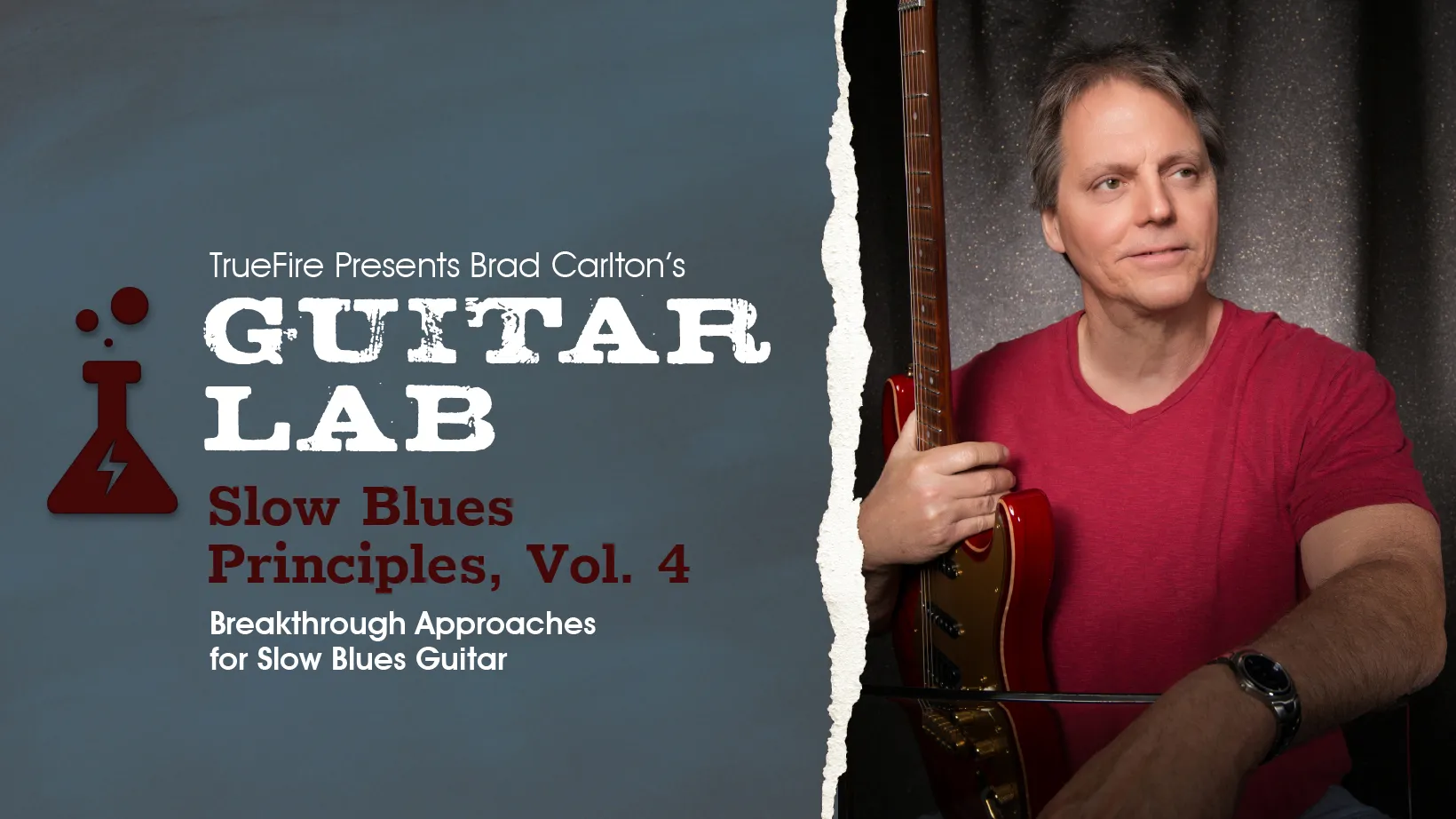
Guitar Lab: Slow Blues Principles, Vol. 4

Master the essential moves of slow blues guitar

Marty FriedmanTommy EmmanuelSteve VaiEric GalesEric Johnson

Get this course and 1,000+ more with All Access

Try 14 days free. Cancel any time.

Purchase Individual Course for $5.00
Guitar Lab: Slow Blues Principles, Vol. 4

About this course

Guitar Lab: Slow Blues Principles Vol. 4 continues your journey into the soul of slow blues with Brad Carlton as your guide. This volume builds on the foundation of the previous lessons, introducing new techniques and concepts designed to deepen your feel, phrasing, and overall command of the style.

You’ll explore a wide range of slow blues ideas—from subtle articulations and melodic phrasing to more advanced rhythmic and harmonic approaches. Brad breaks everything down in his clear, systematic style, giving you practical tools you can plug into your own playing right away.

Whether you’re refining the basics or expanding your creative palette, this course delivers the insight and inspiration you need to play slow blues with more depth, emotion, and confidence.

What you'll learn

  • Apply the blues scale over all three chords in a slow blues progression
  • Create melodic phrases using the blues scale
  • Use proper dynamics and palm muting for blues feel
  • Visualize and navigate different blues scale forms across the fretboard
  • Add the flat 5 to minor pentatonic to create blues scale
Release date: 08/01/2025 • 1h 40m runtime
Start Course
Sample lessons
Blues Scale Form | 6th String Root
Lesson & Demonstration

What's included

8 lessons • 1 charts • 1 Jam Tracks

Slow Blues Principles Vol. 4
I'm Brad Carlton, and in Slow Blues Principles Volume Four, we’ll be diving into the blues scale and how to use it over all three chords in a slow blues progression. You'll also get an in-depth look at the fretboard—learning how to visualize different scale forms both in position and diagonally. Along the way, I’ll show you a variety of melodic moves, techniques for manipulating the strings to get expressive, bluesy tones, and how to handle key notes like the flat five and flat three.

So grab your guitar, and let’s get started.
Blues Scale Form | 6th String Root
In this lesson, we’re diving into the essentials of the blues scale—specifically the C minor pentatonic and how to bring it to life with feel, phrasing, and dynamic expression. We’ll work on getting the groove right, using shuffle rhythms and triplet feel, while exploring how articulation, palm muting, and right-hand technique shape the sound. As we add the flat 5 to create the full blues scale, we’ll learn how to use it tastefully, resolving it up or down to avoid clashing. We’ll also cover different fingerings and positions to make our playing more expressive, using hammer-ons, pull-offs, slides, and bends to mimic the sound of a blues vocalist. The goal here isn’t just to play the notes—it’s to make them sing, groove, and tell a story.
Blues Scale Form | 4th String Root
In this lesson, we’re focusing on how to play with feel, dynamics, and intention—especially when we're working with live backing tracks. We’ll look at how to leave space in our phrasing, respond to the energy of the band, and avoid overplaying when the track is mellow. From there, we’ll shift into working with scale forms up the neck and learn how to connect riffs across octaves using the layout of the fretboard. We’ll explore how different scale positions lend themselves to specific techniques like slides, bends, hammer-ons, and pull-offs—and how string tuning (especially the B and G strings) affects our patterns. We’ll also cover damping techniques, efficient fingerings, and ways to keep things clean when moving quickly. It’s all about learning to see the fretboard more clearly and using technique to make our blues lines more expressive and musical.
Blues Scale Form | 2nd String Root
In this lesson, we’re shifting our view of the fretboard by exploring a blues scale form rooted on the 2nd string. This gives us new melodic options and phrasing ideas while reinforcing how intervals and patterns move across the neck. We’ll work on locking into the feel of the blues while navigating this position, and we’ll pay attention to how the B string’s tuning affects the shape of the scale. As always, it’s not just about playing the notes—it’s about how we shape, slide, and bend them to really make the guitar sing.
Blues Scale Form | 5th String Root
Here, we’re diving into a blues scale form that starts from the 5th string root. This position helps us access different phrasing possibilities and makes it easier to move vertically through the neck. We’ll focus on the subtle shifts in feel and technique that come with this root location, including how it naturally connects to neighboring shapes. It’s a great opportunity to work on our tone, articulation, and ability to move fluidly between licks while keeping things vocal and dynamic.
Blues Scale Form | 3rd String Root
This lesson takes us into a blues scale form built off the 3rd string root. Because of how the guitar is tuned, this one can feel a little different under our fingers—but that also opens up unique phrasing options. We’ll dig into how to navigate this shape smoothly, and we’ll work on integrating it with our other positions to give our lines more freedom and flow. It’s a chance to build both fretboard awareness and musicality, all while keeping the feel front and center.
Blues Scale Form | 6th String Root Diagonal
Now we’re expanding our view of the fretboard by taking a diagonal path up and across the neck from a 6th string root. This form lets us break out of single-position thinking and start connecting ideas over a broader range. We’ll focus on maintaining strong phrasing and consistent tone as we shift through positions, using slides and other expressive techniques to keep things smooth and intentional. It’s a powerful approach for playing longer, more vocal lines without sounding boxy or mechanical.

+ 1 more lessons

Start Course

Reviews

3 results

markj

Verified buyer

09/08/25

Super gemacht

minicolossal

Verified buyer

09/04/25

Great for improvise

That's a great lesson, explain the theory and technique clearly. Great for improvise and writing music.

Ohio5665

Verified buyer

08/25/25

Guitar Lab: Slow Blues Principles Vol 4

Another great Brad Carlton course! learning alot from this volume!

Stop searching. Start improving with All Access.

Try 14 days free. Cancel any time.