Closer Look: Thumb Control (JamPlay)
Essential Fingerstyle Techniques for Thumb Control



Get this course and 1,000+ more with All Access
Try 7 days free. Cancel any time.

About this course
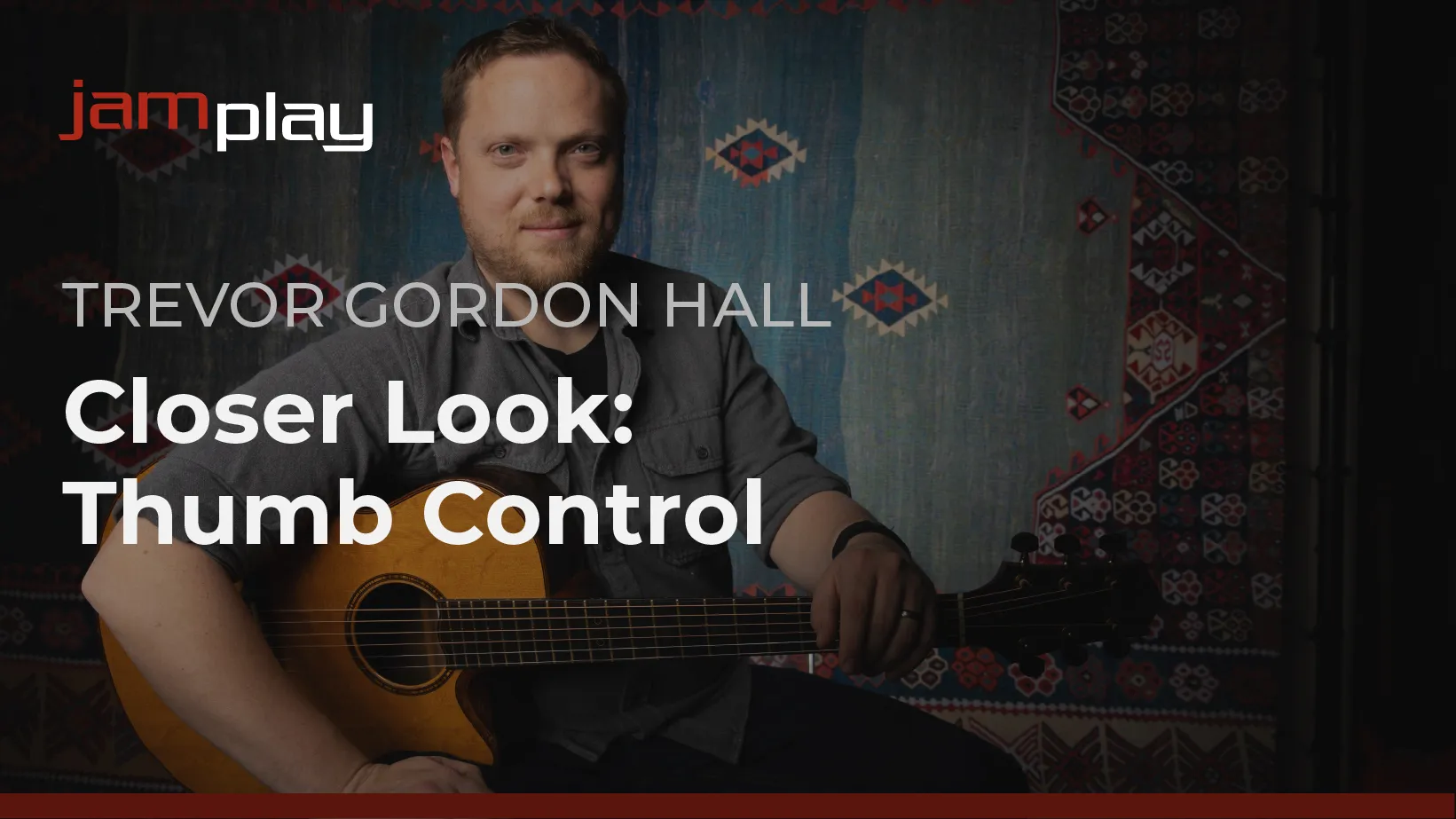
Trevor Gordon Hall’s 'A Closer Look at Thumb Control' offers a targeted approach for enhancing thumb dexterity in fingerstyle guitar. Ideal for late-stage beginners, the course begins with optimizing fretting hand thumb positioning, moving to advanced picking hand techniques.
Participants will learn about independent thumb bass lines, artificial harmonics, and specialized fingerstyle methods, equipping them with skills to resolve thumb-related challenges and elevate their playing.
”This course focuses on helping you develop thumb control with effective techniques and problem-solving strategies. This course is ideal for late-stage beginners and will be highly beneficial if you already have some familiarity with different picking patterns, basic chord progressions, and navigating the fretboard.
We'll start by examining the thumb on the fretting hand, understanding its optimal positioning to enhance comfort and clarity on the fretboard. Next, we'll focus on your picking hand, working on independent thumb bass lines, and integrating your thumb and fingers to play independent lines.
We'll then delve into banjo rolls, building sequences with the thumb, index, and middle fingers and exploring different spots on the fretboard for consistency. We'll also cover artificial harmonics, highlighting the thumb's vital role in producing clear notes.
Finally, we'll explore the unique options fingerstyle offers for the thumb, including percussion, backbeat, and slaps.
By the end of this course, you'll have specific tools to address any issues with the thumb and unlock new dimensions in your fingerstyle playing.”
Trevor is a pioneering voice on the international stage and is widely respected by fans, students, and artists for his mastery of fingerstyle guitar.
"Trevor is not only a fascinating guitarist but a great composer as well as a musical inventor. I delighted in all the harmonic beauty and rhythms! This young man is extremely dedicated to his music and a great steward of the God-blessed talent given to him" - Phil Keaggy.
"Trevor is one of the most unique and creative guitarists around. I love what he does with the Kalimbatar!" - Andy McKee.
"Creative imagination flourishes within certain artists and certainly does so in Trevor Gordon Hall. Ingenuity always causes surprise, and this gentleman's abilities are exceptional..." - Pat Martino.
You’ll have TrueFire’s interactive learning tools at your fingertips to personalize your workspace and learn at your own pace.
All of the demonstrations and performances are tabbed, notated, and synced to the video with controls for looping, slow motion, fretboard animation, and many other tools designed to accelerate the learning process.
Grab your guitar, and let’s dig in with Trevor Gordon Hall!
Participants will learn about independent thumb bass lines, artificial harmonics, and specialized fingerstyle methods, equipping them with skills to resolve thumb-related challenges and elevate their playing.
”This course focuses on helping you develop thumb control with effective techniques and problem-solving strategies. This course is ideal for late-stage beginners and will be highly beneficial if you already have some familiarity with different picking patterns, basic chord progressions, and navigating the fretboard.
We'll start by examining the thumb on the fretting hand, understanding its optimal positioning to enhance comfort and clarity on the fretboard. Next, we'll focus on your picking hand, working on independent thumb bass lines, and integrating your thumb and fingers to play independent lines.
We'll then delve into banjo rolls, building sequences with the thumb, index, and middle fingers and exploring different spots on the fretboard for consistency. We'll also cover artificial harmonics, highlighting the thumb's vital role in producing clear notes.
Finally, we'll explore the unique options fingerstyle offers for the thumb, including percussion, backbeat, and slaps.
By the end of this course, you'll have specific tools to address any issues with the thumb and unlock new dimensions in your fingerstyle playing.”
Trevor is a pioneering voice on the international stage and is widely respected by fans, students, and artists for his mastery of fingerstyle guitar.
"Trevor is not only a fascinating guitarist but a great composer as well as a musical inventor. I delighted in all the harmonic beauty and rhythms! This young man is extremely dedicated to his music and a great steward of the God-blessed talent given to him" - Phil Keaggy.
"Trevor is one of the most unique and creative guitarists around. I love what he does with the Kalimbatar!" - Andy McKee.
"Creative imagination flourishes within certain artists and certainly does so in Trevor Gordon Hall. Ingenuity always causes surprise, and this gentleman's abilities are exceptional..." - Pat Martino.
You’ll have TrueFire’s interactive learning tools at your fingertips to personalize your workspace and learn at your own pace.
All of the demonstrations and performances are tabbed, notated, and synced to the video with controls for looping, slow motion, fretboard animation, and many other tools designed to accelerate the learning process.
Grab your guitar, and let’s dig in with Trevor Gordon Hall!
What you'll learn
- Navigate chromatic descending chord shapes from 11th to 2nd fret
- Maintain right-hand pattern consistency while changing left-hand positions
- Produce artificial harmonics using proper thumb technique
- Develop right-hand independence and autopilot picking patterns
- Develop independent thumb bass lines separate from finger melodies
Release date: 01/11/2024 • 1h 46m runtime
Sample lessons

Fretting Hand: Playing Bass Notes
Lesson

Independent Thumb Picking
Lesson

Banjo Rolls
Lesson
What's included
11 lessons • 10 charts • 10 Jam Tracks
Hi, Trevor Gordon Hall here, and welcome to this course where we'll take a closer look at thumb control for fingerstyle guitar. Often, many frustrations encountered in fingerstyle guitar can be traced back to the thumb. In fingerstyle, the thumb plays a crucial role, as it has many more tasks than in other genres.
My goal in this course is to help you develop the right path with proper technique and problem-solving strategies for both your picking and fretting hand thumbs. We'll start by examining the thumb on the fretting hand, understanding its optimal positioning to enhance comfort and clarity on the fretboard.
Next, we'll focus on the picking hand, discussing independent thumb bass lines and how to integrate your thumb and fingers in playing independent lines. We'll then delve into banjo rolls, building sequences with the thumb, index, and middle fingers, and exploring different spots on the fretboard for consistency.
We'll also cover artificial harmonics, highlighting the thumb's vital role in producing clear notes. Finally, we'll explore the unique options fingerstyle offers for the thumb, including percussion, backbeat, and slaps.
This course is ideal for late-stage beginners and will be highly beneficial if you already have some familiarity with different picking patterns, basic chord progressions, and navigating the fretboard. By the end of this course, you'll have specific tools to address any issues with the thumb and unlock new dimensions in your fingerstyle playing. I had a great time putting this course together and can't wait to get started with you.
My goal in this course is to help you develop the right path with proper technique and problem-solving strategies for both your picking and fretting hand thumbs. We'll start by examining the thumb on the fretting hand, understanding its optimal positioning to enhance comfort and clarity on the fretboard.
Next, we'll focus on the picking hand, discussing independent thumb bass lines and how to integrate your thumb and fingers in playing independent lines. We'll then delve into banjo rolls, building sequences with the thumb, index, and middle fingers, and exploring different spots on the fretboard for consistency.
We'll also cover artificial harmonics, highlighting the thumb's vital role in producing clear notes. Finally, we'll explore the unique options fingerstyle offers for the thumb, including percussion, backbeat, and slaps.
This course is ideal for late-stage beginners and will be highly beneficial if you already have some familiarity with different picking patterns, basic chord progressions, and navigating the fretboard. By the end of this course, you'll have specific tools to address any issues with the thumb and unlock new dimensions in your fingerstyle playing. I had a great time putting this course together and can't wait to get started with you.
In this lesson, we will delve into the often-overlooked aspect of guitar playing: the fretting hand thumb's positioning and movement. We will guide you through exercises focusing on thumb placement while transitioning between various chord shapes. You'll learn the importance of a relaxed and correctly aligned thumb, and how this influences the ease of chord transitions and the ability to stretch for complex chords. The lesson emphasizes the need to avoid anchoring the thumb in one spot, facilitating smoother movement across the fretboard. By the end of this lesson, you'll understand how the thumb's position not only aids in playing different chords but also in enhancing the overall sound and playability of the guitar.
In this lesson, we'll build upon our understanding of the fretting hand thumb's role in fingerstyle guitar. We will delve into techniques for using the thumb to play bass notes, crucial for adding depth and warmth to chords. You'll learn how to balance the thumb's position for various chords, ensuring clarity and ease in playing. The lesson will cover specific chord sequences, demonstrating the thumb's flexibility in transitions and its importance in maintaining the melody and bass harmony. By mastering these techniques, you'll enhance your fingerstyle guitar skills, gaining a more dynamic and expressive playing style.
In this lesson, we will explore the pivotal role of the thumb in fingerstyle guitar, focusing on developing an independent thumb that works in concert with the other fingers. You'll learn the importance of coordinating the thumb with the rest of the hand to create distinct bass note patterns, as demonstrated in styles like those of Chet Atkins and Jerry Reed. We'll dive into reading tablature vertically, understanding how thumb and finger patterns intersect, and practice a specific exercise involving an A minor chord and a pull-off. This approach will enhance your precision and efficiency in fingerstyle playing, helping you achieve a more harmonious and rhythmic sound.
In this lesson, we will focus on mastering the three-four time signature in fingerstyle guitar, emphasizing the coordination of different thumb positions. You'll learn how to play bass notes effectively on the low E and A strings, and how to extend the thumb up to the F note. We'll cover the importance of thumb placement to avoid muting open strings and explore a series of chord progressions involving C, F, G, and A minor. The lesson will guide you through specific picking patterns, highlighting the technique of skipping a finger when skipping a string. By the end of this lesson, you'll have enhanced your ability to seamlessly integrate bass notes and chord shapes in three-four time, enriching your fingerstyle playing.
In this lesson, we will explore the IPM sequences in fingerstyle guitar, a technique essential for developing banjo roll styles and enhancing overall playing fluidity. We'll examine how these patterns, prominent in the styles of legendary guitarists like Jerry Reed, Chet Atkins, and Merle Travis, can improve control, accuracy, and timing in your playing. The lesson emphasizes understanding the natural movement of your fingers and using this knowledge to master the IPM sequence. We'll also focus on the importance of timing over speed, ensuring each note aligns perfectly with the rhythm. By the end of this lesson, you'll be equipped with the skills to incorporate IPM patterns into your playing, enriching your approach to fingerstyle guitar.
In this lesson, we will explore expanding finger patterns that follow the natural direction of your fingers, with a focus on integrating more complex thumb movements. You'll learn a descending chromatic pattern on the left hand, practicing precision and timing to ensure the music is quick but not rushed. We will start with a specific chord positioning on the fretboard and engage in an active thumb, middle, and index finger pattern on the right hand. This lesson also includes transitioning between chords while maintaining the picking pattern, emphasizing the importance of fluidity and comfort in switching finger positions. By mastering these techniques, you'll enhance both your speed and accuracy in fingerstyle guitar playing.
+ 4 more lessons
Reviews
No reviews yet
Complete this course and be the first to share your experience.
Stop searching. Start improving with All Access.
Try 14 days free. Cancel any time.