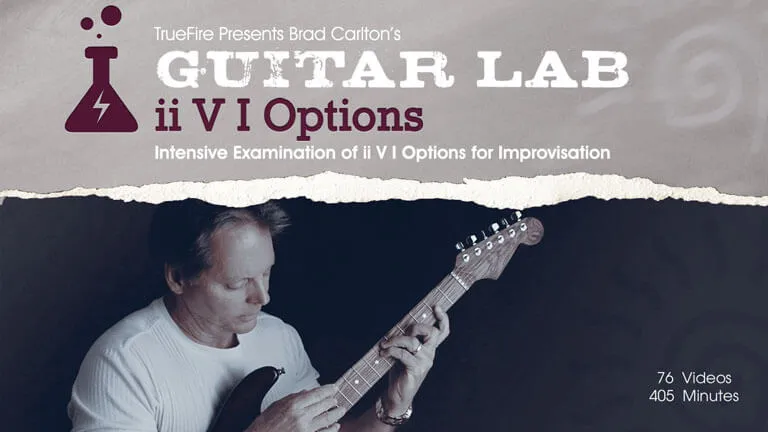
Guitar Lab: ii V I Options

Intensive examination of the the ii V I progression for improv

Marty FriedmanTommy EmmanuelSteve VaiEric GalesEric Johnson

Get this course and 1,000+ more with All Access

Try 14 days free. Cancel any time.

Purchase Individual Course for $5.00
Guitar Lab: ii V I Options

About this course

The concept of harmony can be an overwhelming subject. This is because of the math that's involved. When you're studying multiple voices in which each voice is a separate melody, the options really start to add up. My goal with this series of courses is to teach you how to view information on the fingerboard by playing standard progressions through which you will be focusing on voice leading as you apply various harmonic options.

The ii V I progression is one most important building blocks in all of music. We will begin by focusing on guide tone/root structures. These will form the foundation upon which we will then add various voices on different strings. This method is far superior than the standard way of applying a number of "grips" in which there is no consideration for the melodic voice leading. An added benefit of this approach is that it will give you melodic moves that are grounded over harmonic progressions which you can use when you're soloing.

You will be given many examples of ii V I progressions in the key of D major. You'll then learn how to use these as models for developing your own voicings. In addition to strengthening your theoretical understanding of chord/ scale relationships, you'll be challenged with various fingering options. Some of these may seem a little radical at first, but the ability to sustain voices will be the reward for your technical struggles.

What you'll learn

  • Apply piano-style voicings to guitar
  • Create altered dominant voicings (b9, #9, b5, #5, sus4)
  • Use partial voicings (3-note groups) when full voicings are impractical
  • Incorporate open strings into close voicings
  • Understand and execute all four inversions of minor 7, dominant 7, and major 7 chords
Release date: 06/21/2013 • 6h 44m runtime
Start Course
Sample lessons
Middle Voice Movement
Three-Voice Structures
ii7 and V7sus4
ii7 and V7sus4
Relationship & Theory
Guide Tone/Root Structures
Add Voice on 1st String
Scale Options
Scale Options
Fingerboard Mapping

What's included

76 lessons • 4 charts

Guitar Lab: ii V I Options
The concept of harmony can be an overwhelming subject. This is because of the math that's involved. When you're studying multiple voices in which each voice is a separate melody, the options really start to add up. My goal with this series of courses is to teach you how to view information on the fingerboard by playing standard progressions through which you will be focusing on voice leading as you apply various harmonic options.

The ii V I progression is one most important building blocks in all of music. We will begin by focusing on guide tone/root structures. These will form the foundation upon which we will then add various voices on different strings. This method is far superior than the standard way of applying a number of "grips" in which there is no consideration for the melodic voice leading. An added benefit of this approach is that it will give you melodic moves that are grounded over harmonic progressions which you can use when you're soloing.

You will be given many examples of ii V I progressions in the key of D major. You'll then learn how to use these as models for developing your own voicings. In addition to strengthening your theoretical understanding of chord/ scale relationships, you'll be challenged with various fingering options. Some of these may seem a little radical at first, but the ability to sustain voices will be the reward for your technical struggles.
Guide Tone/Root Structures
The first thing I want to address is chart number one. These are your enharmonics which simply means pitches that are spelled differently or numbered differently but sound the same. The reason it's important for you to know this information is that in a scale formula you will number notes from one to eight (eight being the octave). When you use chord symbols, the various extensions and altered tones may extend up into the second octave. Make sure that you know these enharmonics so you don't get confused with any of the analyses of the chord voicings. There are times when I may number notes in the first octave and other times in the second octave.This lesson focuses on guide tone/root structures. Throughout this group of lessons we will be in the key of D and will be using the A and C forms of the CAGED system for our I chord location. From there we will then move as far down the neck and up the neck as physically possible to capture extensions and altered tones.The beauty of these guide tone root structures is that they clearly outline the three different qualities of chords that make up the ii V I progression. Not only are they useful for comping the when you need to play in a rather lean fashion, but they provide a foundation for extended harmony.This lesson will use diagrams one through six and examples one through five.
Guide Tone Structures
This lesson is really quite simple. There are times when you do not want to include the root as your lowest voice, so in this lesson we are going to take everything you learned in lesson one and delete the root. Your bass player will love you for this skill and perhaps your pianist too.This lesson will use diagrams one through six and examples one through five.
b5 Substitution in Bass
One of the quickest and easiest ways to make the ii V I progression sound jazzier is to apply the flat five substitution principle over the V chord. To do this, all you need to do is change your bass note to a note that is a flat five from the root. You'll receive many examples in which the first time I play the ii V I progression, the bassline will follow the numbers. Then so you can easily and clearly understand this flat five substitution, I will follow with an example in which this principle is applied to the V chord.This lesson will use diagrams seven and eight and examples six through eight.
Upper Voice Movement
Now we will build upon what you've learned in the previous lessons. We will look at the options available for our upper voice. These options are shown in diagrams nine through 11. Examples nine through 16 show applications of this modified voice for the ii V I progression. This allows you to have a moving line on top of two static voices.It's absolutely critical that you take the examples in this course and develop your own voice leadings using information presented. This will build your inventory of harmonic moves for the ii V I progression. I also encourage you to transpose these to various keys. You might even prepare some jam tracks in which you are playing the ii V I progression in some different keys. I will really get these things under your fingers and you be prepared to play any tune.
Middle Voice Movement
Now we will build upon what you've learned in the previous lessons. We will look at the options available for our middle voice. These options are shown in diagrams 12 through 14. Examples 17 through 22 show applications of this modified voice for the ii V I progression. This allows you to have a moving line in between two static voices.It's absolutely critical that you take the examples in this course and develop your own voice leadings using information presented. This will build your inventory of harmonic moves for the ii V I progression. I also encourage you to transpose these to various keys. You might even prepare some jam tracks in which you are playing the ii V I progression in some different keys. I will really get these things under your fingers and you be prepared to play any tune.
Lower Voice Movement
Now we will build upon what you've learned in the previous lessons. We will look at the options available for our lower voice. These options are shown in diagrams 15 through 17. Example 23 gives you a walking bass line with guide tone punctuations for the ii V I progression.It's absolutely critical that you take the examples in this course and develop your own voice leadings using information presented. This will build your inventory of harmonic moves for the ii V I progression. I also encourage you to transpose these to various keys. You might even prepare some jam tracks in which you are playing the ii V I progression in some different keys. I will really get these things under your fingers and you be prepared to play any tune.

+ 69 more lessons

Start Course

Reviews

2 results

darbyogil

Verified buyer

12/09/24

Great like everything Brad Carlton puts out makes you work at it good for retention
David J.

Verified buyer

08/17/12

I recieved a lesson from Brad Carlton and in one lesson it changed the way I approach my guitar playing, I look forward to purchasing the videos but also to a one on one lesson again.

Stop searching. Start improving with All Access.

Try 14 days free. Cancel any time.