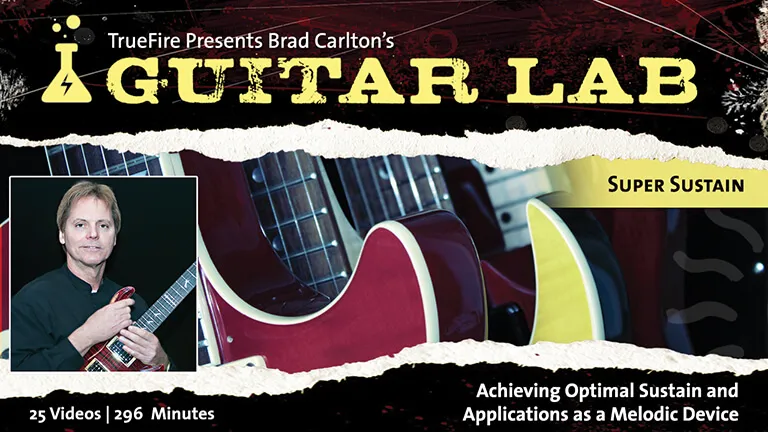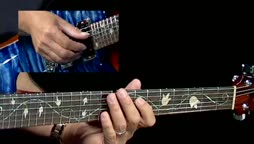

Guitar Lab: Super Sustain

Achieving Optimal Sustain and Applications as a Melodic Device

Marty FriedmanTommy EmmanuelSteve VaiEric GalesEric Johnson

Get this course and 1,000+ more with All Access

Try 14 days free. Cancel any time.

Purchase Individual Course for $5.00
Guitar Lab: Super Sustain

About this course

Admit it. You've spent the bucks on an endless array of gear, and invested hundreds of hours tweaking your "sound" to achieve that sweet, super sustain that you so covet - and yet, you still can't quite get to second base without sounding too wet and over-effected. True?

Sustain opens up an infinite palette of colors and textures to craft your lines, melodies and improvisations with. Sustain is one of the sonic qualities that explains why we guitar players yearn to emulate sax and horn players as much as we do. Sustain is why Jeff Beck rocks our world with two or three tasty notes. Yes indeed, sustain is very much an intrinsic quality of the "perfect tone" we all seek.

So many of us start off trying to achieve tone with pedals, effects or by over-driving our amps. Yup, that's somewhat gratifying and there's certainly a time and place for all that BUT what really separates the men from the boys is what's happening with the hands on the fretboard.

Great sustain is really all about technique and NOT pedals and effects. And that's what this Guitar Lab course is all about; developing and finessing the range of techniques you need to employ to achieve Super Sustain.

There's no one more qualified than Brad Carlton to guide you through this intensive examination of sustain and its underlying techniques. "This Guitar Lab syllabus is designed to refine the touch of your fretting hand so you can control the delicate relationship between the string and the fret, which also happens to dramatically improve your intonation across all of your techniques."

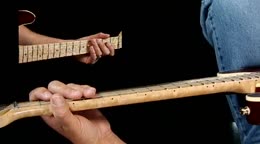
"We will also focus on dampening with both hands, which cleans up your playing, making your sustain even more powerful. I have included an over the shoulder camera angle for the fretting hand to help you in assessing your own hand positions. In addition to the many exercises that I've prepared to help you develop your dampening and Super Sustain skills, we will also work through 46 technique combinations to show you how to create different licks with the same melodic material."

Super Sustain: Syllabus
Picking Hand: Dampening Exercises
Fretting Hand: Dampening Exercises
Fretting Hand: Sustain Exercises
Technique Combinations: Part 1
Technique Combinations: Part 2
Technique Combinations: Part 3
C Major Pentatonic Scale
C Ionian Mode
C Lydian Mode
C Mixolydian Mode
C Lydian b7 Mode
C Minor Pentatonic Scale
C Dorian Mode
C Aeolian Mode
C Phrygian Mode
C Phrygian Dominant Scale
Modal Approach
Pentatonic Approach
Arpeggio Approach
C to G Melodic Moves
G to Am Melodic Moves
Am to F Melodic Moves
F to C Melodic Moves

As you can likely tell by the syllabus, Guitar Lab: Super Sustain is not just about technique. Carlton demonstrates and has you work through all of the techniques in a musical context so you are able to put those skills to work by making music with them. Put that distortion pedal away now and get to work!

What you'll learn

  • Apply minor pentatonic over minor chord progressions
  • Use common tones to create rhythmic interest in solos
  • Comp effectively using power chords and guide tones
  • Recognize interval patterns within pentatonic scales
  • Understand the relationship between relative major and minor pentatonic scales
Release date: 10/11/2011 • 4h 56m runtime
Start Course
Sample lessons
Fretting Hand
Fretting Hand
Sustain Exercises
C Minor Pentatonic
C Minor Pentatonic
Scale
Modal
Modal
Approach
Am to F
Am to F
Melodic Moves

What's included

24 lessons • 9 charts • 3 Jam Tracks

Super Sustain
Super Sustain is guaranteed to improve your playing in a number of areas. Learning how to make the guitar sustain involves refinement of fretting hand touch to the point where you know exactly how much physical exertion is necessary to keep the string in contact with the fret. This also improves your intonation in all areas of guitar playing. We will be focusing on the E minor pentatonic scale as our source for a number of legato techniques and will be viewing the information along the string axis. This will enhance your knowledge of the fingerboard and break you out of the tunnel vision approach which can occur when thinking in positions. We will also focus on dampening with both hands which will clean up your playing. I have included an over the shoulder camera angle for the fretting hand which will help you in assessing your hand positions.

In addition to many exercises involving dampening and sustain, we will cover 46 technique combinations which will allow you to create different licks with the same melodic material.
Picking Hand
This lesson focuses exclusively on picking hand dampening(or damping). This will involve a hybrid picking approach involving the pick, fingers, side of the thumb, and heel of the hand. Not only will this technique serve you in normal guitar playing, but if you ever decide to play slide guitar it will be indispensable in executing a clean sound.I want to stress that I view techniques as tools in a huge rollaway toolbox. Each technique is available when needed which means you won't always use picking hand dampening. But if you have it when you need it you'll be glad you got it ingrained in your muscle memory.Picking hand dampening also serves as a means of applying staccato to your notes which simplifies this issue in certain licks.
Fretting Hand
This lesson covers fretting hand dampening which truly brings an element of finesse to your touch. As a starting point for learning this technique think of touching a note as placing a finger against the string but not depressing the string against the fret. This is your dampening posture which needs to be a part of your muscle memory so you know what it should feel like after fretting a note and then applying fretting hand dampening. Part two of fretting hand dampening is the gentle release of the finger perpendicular to the string so as not to disturb the string and cause it to vibrate. We all know what it's like to lift a finger off the string and get what I would term a ghost pull off. I always tell people that releasing a fretted note is a two-part affair: a quick release of the muscular tension in the fretting finger at the point where you want the tone to cease, and then a slower, gentle lift of the finger off the string. You can actually learn how to do this at a pretty quick tempo but you must practice slowly at first.
Fretting Hand
This lesson will improve your sustain by addressing left-hand slurs as applied to the E minor pentatonic scale along the string axis. The slurs which will be used are: Hammer ons from nowhere, hammer ons, pull offs, and legato slides. The concept of overtones in a high gain situation will be demonstrated which will further encourage you to explore this issue of how you touch the guitar.Since we are using the minor pentatonic scale as our source for all melodic material, we will explore how the two intervals exist in the scale when dealing with adjacent notes. These two intervals are: the major second which is a whole step and the minor third which is a step and a half. The minor pentatonic scale consists of the following tones: 1 b3 4 5 b7. The major second interval occurs between the b3 and 4, the 4 and 5, and the b7 and 1. The minor third interval occurs between the 1 and b3 as well as the 5 and b7.The latter part of this lesson explores viewing the scale in terms of every other note which involves major third and perfect fourth intervals. Seeing this information along the string axis will help you to create a more fluid sound in your playing. It will also enable you to delve into some of the modern wide intervallic melodic moves.
Technique Combinations
This lesson presents 10 technique combinations involving the following techniques: picking hand dampening, fretting hand hammer ons (hammer ons from nowhere), vibrato, legato slides, picking, and pulls offs.I will demonstrate these moves in various places throughout the E minor pentatonic scale. You can then practice on your own against the jam tracks and apply all the things you've learned through each lesson.It will be very important that when you are jamming against the tracks, you stay on task and focus on this linear approach to the fingerboard. I suggest you discipline yourself to not play in your normal comfort zone. This means no autopilot, no mindless play, no relying on pure muscle memory. Do this for the first part of your practice session, and after you've got a handle on some of this information, implement it into your normal playing. This is the approach if you want to improve.
Technique Combinations
This lesson presents 13 technique combinations involving the following techniques: picking hand dampening, fretting hand hammer ons (hammer ons from nowhere), vibrato, legato slides, picking, bends, releases, and pulls offs.I will demonstrate these moves in various places throughout the E minor pentatonic scale. You can then practice on your own against the jam tracks and apply all the things you've learned through each lesson.It will be very important that when you are jamming against the tracks, you stay on task and focus on this linear approach to the fingerboard. I suggest you discipline yourself to not play in your normal comfort zone. This means no autopilot, no mindless play, no relying on pure muscle memory. Do this for the first part of your practice session, and after you've got a handle on some of this information, implement it into your normal playing. This is the approach if you want to improve.
Technique Combinations
This lesson presents 23 technique combinations involving the following techniques: picking hand dampening, fretting hand hammer ons (hammer ons from nowhere), vibrato, legato slides, picking, bends, releases, pre bends, chops(picking hand staccato), and pulls offs.I will demonstrate these moves in various places throughout the E minor pentatonic scale. You can then practice on your own against the jam tracks and apply all the things you've learned through each lesson.It will be very important that when you are jamming against the tracks, you stay on task and focus on this linear approach to the fingerboard. I suggest you discipline yourself to not play in your normal comfort zone. This means no autopilot, no mindless play, no relying on pure muscle memory. Do this for the first part of your practice session, and after you've got a handle on some of this information, implement it into your normal playing. This is the approach if you want to improve.

+ 17 more lessons

Start Course

Reviews

3 results

guitarguy234

Verified buyer

11/09/25

Still playing with it!

Quite the lab, still working with it, so far it’s good!

Skipper1

Verified buyer

07/04/21

Cool course!

Technical and straight to the point. No short cuts, you get what you put in. I liked it.

Jeffochka

10/25/18

Super Sustain? Super Awesome!

Do you wish you could play with the natural sustain guitar greats like Jeff Beck and Jimmy Page have without relying on effects pedals? This is definitely easier said than done and often feels just out of reach for most players. Then Brad Carlton comes up with this master course on getting sustain in your playing. Don’t be fooled. It is not just about sound or tone but developing your technique. Brad will guide you through 46 technique combinations. You will improve both left-hand and right-hand techniques, as well as work through various modes, ultimately applying what you learn through key changes. Amazing stuff. Wish I had taken this course years ago!

Stop searching. Start improving with All Access.

Try 14 days free. Cancel any time.