A variety of new and traditional percussive techniques are now prerequisite for virtually every performing and recording style of acoustic guitar. Michael Hedges, Preston Reed, Andy McKee and Vicky Genfan slap and tap their way through solo guitar performances with brilliant precision and energy. John Mayer thumps out a mean bass line with his thumb. Kelly Joe Phelps uses a pinky move on his pick guard. Tommy Emmanuel's percussive techniques are nothing short of amazing. Dave Matthews, Tim Reynolds, James Taylor, Janis Ian, JJ Cale, Greg Brown, Rodney Crowell and dozens of other top caliber players Slap, Frail and Thump to spice up their performances and compositions.
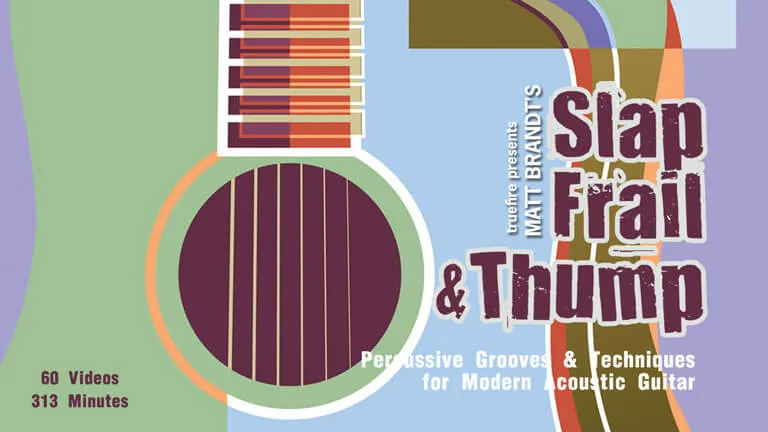
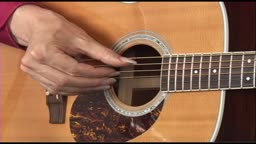
Slap, Frail and Thump covers three essential percussive techniques for singer-songwriters, accompanists and solo guitar performers; palm slaps (for percussion and melody), frailing (traditionally a banjo picking technique) and thumping (combo slap and frail). Slap, Frail and Thump is demonstrated primarily on a six-string acoustic guitar for steel-string players; however all of the techniques can be readily applied to electric, 12-string and nylon-string guitar as well.
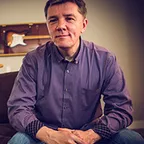
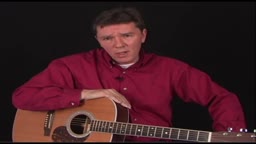
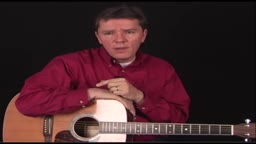
Matthieu Brandt, Dutch recording artist and top European guitar educator, presents Slap, Frail and Thump, the first course to drill so deep into the un-chartered waters of percussive guitar techniques. Brandt, who also authored TrueFire's highly popular Jump Blues course, thoroughly researched the artists and their techniques to distill the information presented in Slap, Frail and Thump.
Students play their way through Slap, Frail and Thump starting with relatively simple grooves and progressing to quite intricate and challenging accompaniments. Students learn 12 original arrangements to get a grip on the techniques in context and work through 180 exercises covering every nuance of palm slaps, frails and full hand frails (thumps).
Students will learn how to use the techniques in band settings, solo guitar performances or as a singer-songwriter across all styles spanning rock, blues, country, shuffles and funk. Even players with little or no fingerstyle skills can quickly incorporate these techniques in their playing.
Whatever your style, or level of play, Slap, Frail and Thump will add new energy, range and excitement in your playing.
What you'll learn
Use pedal tones to connect chord progressions
Play double stop melodies while maintaining rhythmic groove
Create a smooth intro for a shuffle song using pedal tone technique
Introduction
Welcome to Slap, Frail and Thump.
This course is about adding percussive techniques to your guitar playing, which will work on acoustic and electric guitar and in a solo or band setting. These techniques are used by players like John Mayer, Dave Matthews, James Taylor, Janis Ian, JJ Cale, Greg Brown, Rodney Crowell and many others.
Slapping and frailing will get you a steady beat and solid groove while you're singing, without the need of a drummer or a bass player. If you are using it in a band setting, you'll be able to play strong intros and backup parts. But with these techniques you'll also be able to play melodies on top of the groove instead of just banging away chords.
What these lessons are not about, is guitar pyro techniques. Even players with limited fingerstyle experience can add slapping and frailing to their bag of tricks. We'll start with relatively simple grooves and in about 170 exercises and 12 original songs we'll work towards very intricate and challenging accompaniments.
The first percussive technique we'll get into is the palm slap.
Basic Grooves 1 & 2
Welcome to Slap, Frail and Thump.
This course is about adding percussive techniques to your guitar playing, which will work on acoustic and electric guitar and in a solo or band setting. These techniques are used by players like John Mayer, Dave Matthews, James Taylor, Janis Ian, JJ Cale, Greg Brown, Rodney Crowell and many others.
Slapping and frailing will get you a steady beat and solid groove while you're singing, without the need of a drummer or a bass player. If you are using it in a band setting, you'll be able to play strong intros and backup parts. But with these techniques you'll also be able to play melodies on top of the groove instead of just banging away chords.
What these lessons are not about, is guitar pyro techniques. Even players with limited fingerstyle experience can add slapping and frailing to their bag of tricks. We'll start with relatively simple grooves and in about 170 exercises and 12 original songs we'll work towards very intricate and challenging accompaniments.
The first percussive technique we'll get into is the palm slap.
Basic Grooves 3
The palm slap grooves we play here all consist of chords that are divided into two parts; the bass and the top three strings. This gives you four different sounds to work with: a full chord plucked, a palm slap, the top of the chord plucked and the bass of the chord 'popped'. Different placements of these parts will get you different grooves. Some will feel more 'syncopated', some are thick and down to earth. Leave the tempo very slow when you start with a new pattern so you can keep the groove the same throughout a whole progression. Consistency is the key here; too much variation will throw you and your audience off.
Basic Grooves 4
The palm slap grooves we play here all consist of chords that are divided into two parts; the bass and the top three strings. This gives you four different sounds to work with: a full chord plucked, a palm slap, the top of the chord plucked and the bass of the chord 'popped'. Different placements of these parts will get you different grooves. Some will feel more 'syncopated', some are thick and down to earth. Leave the tempo very slow when you start with a new pattern so you can keep the groove the same throughout a whole progression. Consistency is the key here; too much variation will throw you and your audience off.
Basic Grooves 5
The grooves in these exercises can sound light or thick, depending on how much elements there are in a bar and where these parts are played. Start playing these patterns slowly and gradually speed up. At this point there's not a lot going on chord wise, so if you want to you can look straight at your right hand and concentrate on how and where you slap the strings. Once you have the groove down, you can look away and try to feel the groove. Using a metronome can help you make these patterns steady. Stomp your foot on each beat and if the tempo is too high: stomp your foot on beat 2 and 4.
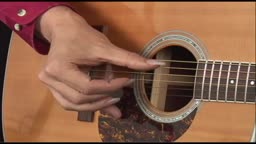
Playing palm slaps is a combination of a very crude movement (the slap) together with some very intricate finger movements.
The exact way you play it and the sounds you produce are very personal. Do not get put off by the fact that you don't sound exactly like the audio examples in the video or on the jam track. Just keep the grooves going and experiment with different hand positions and different hand motions.
Basic Grooves 6
The grooves in these exercises can sound light or thick, depending on how much elements there are in a bar and where these parts are played. Start playing these patterns slowly and gradually speed up. At this point there's not a lot going on chord wise, so if you want to you can look straight at your right hand and concentrate on how and where you slap the strings. Once you have the groove down, you can look away and try to feel the groove. Using a metronome can help you make these patterns steady. Stomp your foot on each beat and if the tempo is too high: stomp your foot on beat 2 and 4.
Playing palm slaps is a combination of a very crude movement (the slap) together with some very intricate finger movements.
The exact way you play it and the sounds you produce are very personal. Do not get put off by the fact that you don't sound exactly like the audio examples in the video or on the jam track. Just keep the grooves going and experiment with different hand positions and different hand motions.
3 Part Grooves 1
In the previous sections we've worked with some basic grooves in which we broke up the chord in a maximum of two different parts; the bass and the top of the chord. In this section we'll go a step further and divide the top of the chord into another two elements giving us three different chord parts: the bass, one middle string and the top two strings of the chord. With this approach we'll discuss one of the most popular palm slap grooves.
I have always wanted to play rhythmic slapping, and now I can. He explains things in great detail. After watching the lessons and practicing I can actually play his songs. I love his style and choice of songs to teach. I hope he does more guitar lessons. Even my 21 year old son said "Dad I like the new songs you are playing". Quite a complement for his 70 year old dad.
L
Larryq
Verified buyer
02/17/21
Have not started course yet but looks good.
N
Nike
05/29/20
NIce course for guitarists who wants to amplify and to make your music more spicy. Also I discovered new aspects of playing guitar with adding more percussive elements like slap etc
S
sdfrets
Verified buyer
05/13/20
Just what I was looking for.
I play a lot of solo acoustic music, and was actually just looking for a couple of slapping rhythms that I could add, without too much work : )
And this is a great set of lessons (many lessons) to do just that.
Matt’s explanations are clear, he really breaks things down. Great educator.
I was able to incorporate new rhythms almost immediately. And I keep going back and learning as needed.
(Works great on a Tele as well).
A
Alex M.
04/26/20
Well Structured Course
The main thing I've found with this course is the way Matthieu breaks every tune and lesson down into small, easy to manage pieces, then builds on these in clear and logical manner to get to the final structure and technique for the song. He then takes it a step further with some additions and suggestions to vary what has just been learned so you can take these concepts and apply to other areas of your playing.
His teaching style is very relaxed, but at the same time very thorough and concise. Techniques and subtleties are well explained and clearly demonstrated. The songs themselves are great stand alone pieces and several of them have made it into my selection of go to tunes for warming up or just playing for enjoyment.