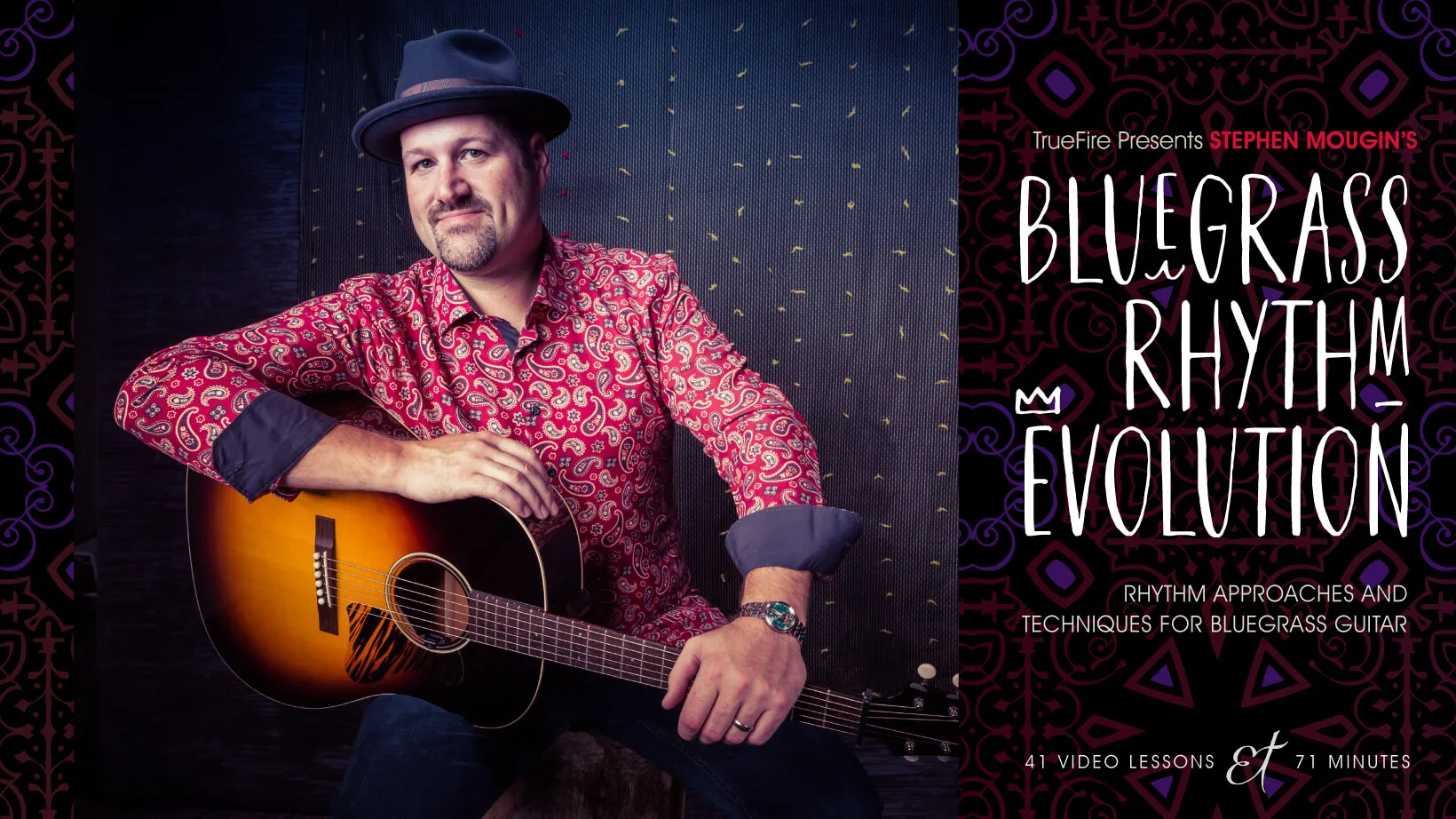
The three most important elements in playing bluegrass guitar today are rhythm, runs, and leads. Many of the great bluegrass guitar players also happen to be great vocalists, and there’s a direct correlation between the rhythm patterns they choose and the songs they sing.
In Stephen Mougin’s Bluegrass Rhythm Evolution, you’ll focus on the evolution of bluegrass rhythm patterns, from the founders of the genre in the forties, to today’s contemporary artists. Stephen designed the curriculum to broaden your palette of rhythms to help you select the appropriate pattern for the bluegrass songs you play.
Stephen Mougin is one of the most respected Jack-of-All-Trades in acoustic music. A touring guitarist currently with Sam Bush; an accomplished songwriter for dozens of top bluegrass bands; a sought-after producer with his own studio, Dark Shadows; and a widely respected vocal, guitar and mandolin teacher. We’re thrilled to welcome Stephen to the family with his first TrueFire course, Bluegrass Rhythm Evolution.
”There's no "one way" to play bluegrass rhythm guitar. Typical bluegrass rhythm is performed out of a G, C, or D shape, using a capo to access additional keys. We're going to explore some interesting components in the style of several players. Keep in mind that none of these folks played exactly like this all of the time, or even all of the way through a song. Bluegrass Rhythm Evolution will be a enlightening glimpse into their rhythm playing and hopefully, will encourage you to dig deeper.”
In the first section of the course Stephen presents a variety of key concepts and techniques: The Role of Bluegrass Guitar, Alternating Bass Patterns for G, C, D, A, E, F, and B7 chords, How To Practice Alternating Bass Patterns, and Using a Capo to Change Keys.
In the second section, Stephen guides you through a series of performance study sets organized chronologically to demonstrate the evolution of bluegrass rhythm guitar.
”In these performance studies, we'll be looking at the way several important bluegrass guitar players adapted the standard bluegrass strum into their own style. Starting with founding members of the genre, we'll trace the evolution of bluegrass rhythm guitar into modern stylings. These studies will illustrate what each of these players contributed to the bluegrass rhythm guitar repertoire.”
For each set, Stephen will first show you the rhythm pattern and how it applies to a common chord progression, and then he’ll show you how to apply it to new song. He’ll first perform the new song, and then break it down for emphasizing the key techniques.
All of the performance studies are tabbed and notated for your practice, reference and study purposes. You’ll also get Guitar Pro files so that you can play, loop and/or slow down the tab and notation as you work through the lessons. Plus, Stephen includes all of the backing tracks for you to work with on your own.
Grab your guitar and let’s play some bluegrass with Stephen Mougin!
What you'll learn
Apply chopping technique to create rhythmic dynamics
Create a full, self-sufficient sound for solo or duo performance
Apply the rhythm pattern to the song Aunt Dinah's Quilting Party in G
Pluck alternate bass notes while maintaining rhythm
Understand how to use percussive techniques to add interest to rhythm playing
Hi, I'm Stephen Mougin and welcome to Bluegrass Rhythm Evolution. There's no "one way" to play bluegrass rhythm guitar. Typical bluegrass rhythm is performed out of a G, C, or D shape, using a capo to access additional keys.
We're going to explore some interesting components in the style of several players. Keep in mind that none of these folks played exactly like this all of the time, or even all of the way through a song. It will be a fun glimpse into their playing and will, hopefully, encourage you to dig deeper.
For each set, I'll first show you the rhythm pattern and how it applies to a common chord progression, and then I'll show you how to apply it to new song. You'll also have each in standard notation and tablature and can loop and slow down any of the tunes and rhythm patterns so you can work through them at your own pace. So, grab your guitar and let's get started.
The rhythm guitar is the "meat and potatoes" of the bluegrass band sound. It provides lots of continuous rhythm as well as plenty of low-mid tonal content. Typically, bluegrass guitar is "boomier" than what would be appropriate in other genres.
The alternating bass pattern is fantastic for an unaccompanied guitar or a player who plays in a very traditional setting. As you'll see in the rest of this course, this truly is the heart and soul of every player in the business. Even if they don't play this particular rhythm, they've all spent a great deal of time and energy learning how to do this so they would know how to alter it and make it their own.
(User listening tip: "Love Me Darling Just Tonight")
In a G chord, pluck the low E string, strum, pluck the D string, strum.
The trick with this one is skipping your pick between the low E string and the D string. To break it down, grab a metronome and practice just picking those two notes back and forth. Once you've got a handle on it, try adding the strums between them.
In a C chord, pluck the A string, strum, pluck the D string, strum, OR: pluck the A string, strum, move 3rd finger to low E string to pluck, strum.
As I mentioned, there are two ways to do this, depending on how you feel like playing it and how you want it to sound. The moving finger version is a little "stronger" sounding because you're playing the root and fifth, while the other version uses the root/third. Use your metronome to practice each pattern, but choose one for each section of your song.
In a D chord, the pattern is backwards. Pluck the D string, strum, pluck the A string, strum. Just like the G pattern, isolate the string plucks and practice with your metronome, adding the strums back in when you're comfortable.
Because this pattern is going down in pitch (rather than up like G and C), it'll take your pick a minute to get used to it!
An A chord is similar to the D chord. A string, strum, E string, strum.
Since your right hand has the D pattern already, you just have to move to the next lower string(s). If you are looking for a way to alter the sound of this one, try grabbing the extended A chord with your pinky on the high E string (5th fret A note).
Found this to be a great intro to bluegrass rhythm playing.
D
dielli
Verified buyer
11/27/22
Just as it says on the tin, a great introduction to Bluegrass rhythm styles. The material is presented clearly, and the instructor is pleasant and good company.
P
PhilboBaggins
Verified buyer
10/30/22
Great for expanding your approach to acoustic chords and strumming
Clear and simple instruction. Wide range of styles covered in the material. After you learn a few strumming/picking patterns, you’re off to the races. You can take anything you’ve learned here and apply it to rhythm and chords in other genres. All around a great package to help you build those blue grass foundations!
T
tompedersen
Verified buyer
10/19/21
Loved the Focus on Style Variations
While the presentation of rhythm techniques were great, the thing that set this course apart for me was the focus on style variations from different artists. I knew they were different and awesome, but now I know why and how. Great Course!
G
gretsch1
Verified buyer
08/26/21
A great help when you are moving to a different genre of music.