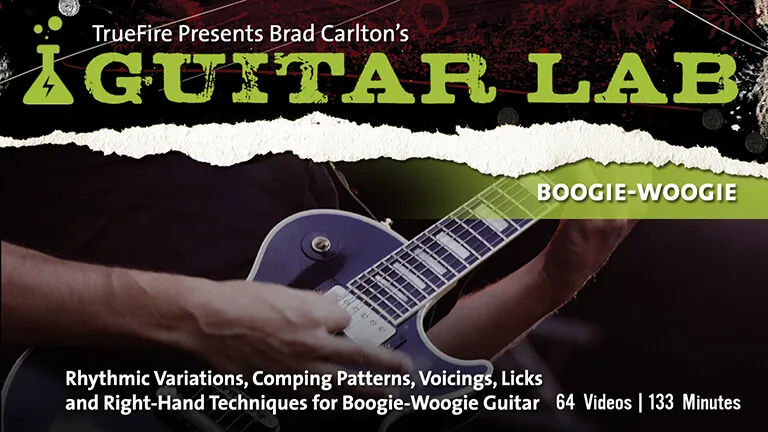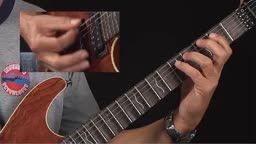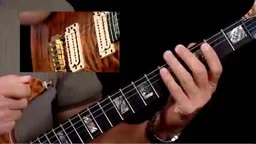
Guitar Lab: Boogie-Woogie

Rhythmic variations, comping patterns, voicings, licks and right-hand techniques for boogie-woogie guitar

Marty FriedmanTommy EmmanuelSteve VaiEric GalesEric Johnson

Get this course and 1,000+ more with All Access

Try 14 days free. Cancel any time.

Purchase Individual Course for $5.00
Guitar Lab: Boogie-Woogie

About this course

The New Harvard Dictionary of Music defines Boogie-Woogie as a "piano blues style featuring percussive ostinato accompaniments that involve steadily repeated bass patterns, one or two bars long that delineate the 12-bar blues progression, sometimes with IV in measure 2 or 10." It also states that, "Melodies range from a series of repeated figures reinforcing the explicit beat (including tremolos, riffs, rapid triplets) to polyrhythmic improvisations."

We're pretty sure that the preceding definition was lost (and thankfully so!) on the likes of Muddy Waters, John Lee Hooker, Chuck Berry and the hundreds of other brand-name guitarists who helped establish boogie-woogie guitar as one of the cornerstones of blues and rock and roll music. Whether you play blues, rock, jazz or country, mastering the rhythmic nuances and endless variations of the "boogie" is an essential skill set whatever your level of play happens to be.

TrueFire's Guitar Lab: Boogie-Woogie is without question the most thorough and intensive examination of this popular style for guitarists, bar none. True to form, Brad Carlton drills down deep with a curriculum that starts at the beginning with all of the basic building blocks and builds progressively up to an extremely advanced level.

You'll learn how to build on the basic 5, 6, b7 formula in a wide variety of ways; how to modify voicings by viewing each string in the structures independently; how to easily navigate the fretboard with scale degrees; how to play in any key. Carlton covers picking, articulation, dampening, rhythmic feels, accents, right hand options, the "heartbeat" component, "harp" style licks, moveable as well as open position forms, rhythmic "kicks", swing and straight rhythm peels and a range of approaches for building licks utilizing the b3 to 3 move.

You might think you know how to boogie-woogie. You might even think that the boogie isn't all that important to you as a player. Think again. The rhythmic and fretboard knowledge alone is worth the price of admission. But if you've got a blues and rock bag, TrueFire's Guitar Lab: Boogie-Woogie is a must for the shed. Let's boogie!

What you'll learn

  • Execute hybrid picking with string skipping
  • Apply upstroke techniques from different strings within chord voicings
  • Create keyboard-style guitar parts by letting notes ring
  • Create fuller-sounding licks through octave doubling
  • Incorporate flat 3 to 3 moves as rhythmic punctuation
Release date: 03/26/2009 • 2h 13m runtime
Start Course
Sample lessons
Articulation: Left and Right
Hand Dampening
Harp Style Licks
Harp Style Licks
with Open E String
Adding a Second Voice
to the Boogie-Woogie Part 1
Straight 8th "Heartbeat"
with Kick on "and of 4"

What's included

63 lessons • 34 charts

Open Position Forms
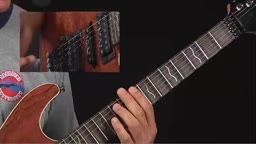
This lesson presents the basic boogie-woogie pattern (5, 6, b7) in the keys of E, A and D. You'll learn how to efficiently execute the fingerings with economy of motion. This pattern resides on two adjacent strings the lower of which will always be the root, and the 5, 6 and b7 scale degrees will be played on the higher string. The lower string will always be open and the 5, 6 and b7 will always occur in the 2nd, 4th, and 5th frets of the higher string. You will finger these boogie-woogie patterns with the 1st, 3rd, and 4th fingers.
Scale Degree
All theory is derived from the major scale (1234567). The boogie-woogie uses the 1, 5, 6, and b7 from the mixolydian mode. You will learn how to see these scale degrees on the fingerboard in this lesson. The root will usually be the lower voice and the 5, 6, b7 tones will occur in the higher voice. Because no 3rd appears in this boogie-woogie pattern, it accommodates both dominant 7 and minor 7 harmony. Blues emcompasses both tonalities so as you can see, this is a very important kingpin of rhythm guitar.
Movable Boogie-Woogie
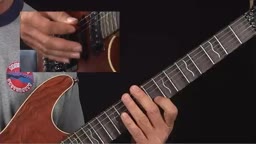
This lesson presents the movable patterns of the basic boogie-woogie. You will learn technical tips for ease of execution as there are some large stretches involved especially in the lower keys on the fingerboard. In the previous lesson you learned the boogie-woogie in the keys of E, A, and D utilizing the 3 open bass strings as the root. This lesson teaches a movable form (fingering) of the boogie-woogie thus allowing you to play in any key. You will learn technical tips to help you execute this basic move which occurs in blues, rock, country, pop and many hybrid styles of music.
Straight vs Shuffle
This lesson deals exclusively with the two rhythmic feels: straight eighths and shuffle (or swing) eighths. I'll show you how to count these rhythms so you'll be rock solid. As I always say, "If you can count it and sing it, you'll know what it's supposed to sound like and you'll know how to play it correctly". If you've been reticent about counting, don't skip this lesson. You will learn specific verbal counts to distinguish straight eighths and shuffle eighths. Understanding rhythm is not difficult, you just have to count.
Articulation: Left and Right
Articulation refers to the length of a note. Staccato is short, legato is long. Proper articulation can make the difference between a passage sounding musical or not. Dampening is how staccato is executed and this lesson deals with both hands in this regard. Dampening also controls unwanted string noise and is imperative in maintaining a relaxed fretting hand. I will show you specific exercises to develop both left and right hand staccato. You will probably be amazed at how much muscular tension can be eliminated in your fretting hand.
Alternate Note Placement
As the title of this lesson implies, knowing the options of where to play something greatly increases your options for constructing variations on a line. This is critical when adding additional voices. We play an instrument which has multiple locations for the same note and when combined with fingering options, it can be quite overwhelming. But therein lies the great treasures of our instrument. One of the greatest "rut-busters" that I know of is this issue of alternate note placement.
Right Hand
This lesson presents an overview of right hand options. They include: picking, hybrid picking, and finger picking. Picking can involve consecutive downstrokes, alternate picking, or a combination of the two. Another option would be the use of the thumb alone. Each of these approaches provide a unique sound. Consideration of the desired groove, feel, articulation and tone all contribute to the decision of what to use at any given moment. If you can play all the options, then you're equipped for any musical circumstance that you may encounter.

+ 56 more lessons

Start Course

Reviews

7 results

barnzie

Verified buyer

01/24/25

Again I was very impressed with this course and all the previous courses I own. Thanks again for the high quality of musicians wr receive.

guitarguy234

Verified buyer

10/22/24

When I’ll open it ,I’m sure it’ll be good!

babashem

Verified buyer

04/29/21

Still watching

Enjoyed it thoroughly

2canoe

Verified buyer

04/26/21

Loads of Information and great Instruction

Brad's Guitar Lab Boogie-Woogie is a real eye opener. A great approach to concentrate on a specific part of the blues music makeup the Boogie-Woogie. Brad breaks it down to the standard basic 1 5 6 flat 7 shuffle, takes you all over the neck with that and of course if you know where those notes are you'll know where to find everything else. Non typical approaches, variations, kicks, intervals, various tempos .....much more...best if you get Brad to show you. Loads of information and great instruction.....Thanks Brad and Truefire...

wholmer

01/04/21

Brads Guitar Lab series is awesome! He takes an element of every aspect of guitar playing and dissects it, laying open so you can easily understand it. The bite size lessons and his teaching method are really very well thought out and very comprehensive. I am always pleased with the outcome.

Stop searching. Start improving with All Access.

Try 14 days free. Cancel any time.