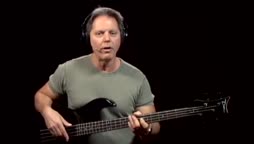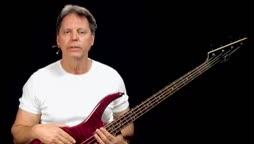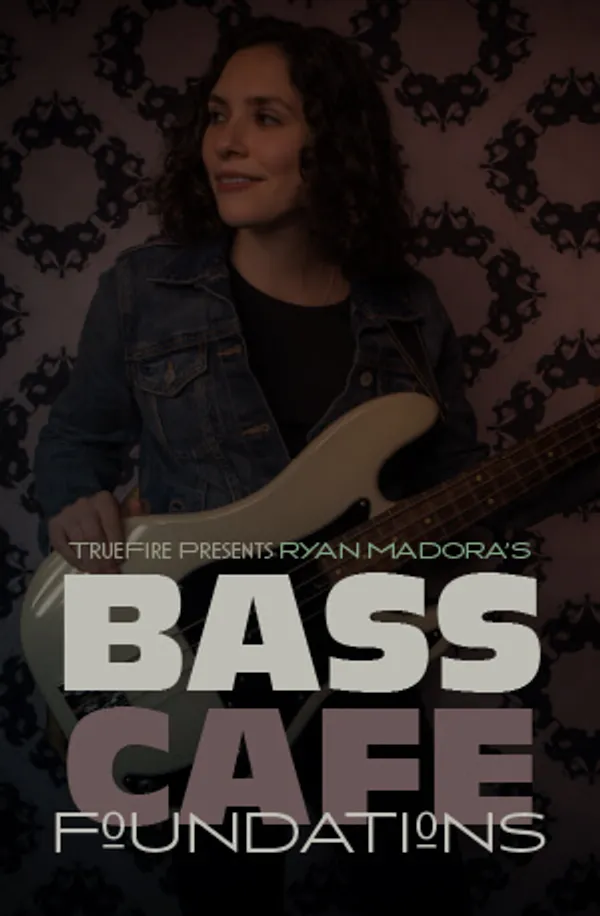
Every guitarist knows that the key to achieve the all-important "groove," especially in a blues band setting, is a capable bass guitar player. Additionally, almost every guitarist has at one point or another picked up a bass and messed around with it, but most haven't taken the time to actually learn the instrument correctly. Luckily for us all, Brad Carlton has cooked up a killer set of beginner bass lessons designed to get you from ground zero to blues bass hero in a quick, fun, and interactive way.
In this Freshman Series course, Brad Carlton teaches you basic theory, breaks down essential techniques, explains ear training, and most importantly, shows you how to get that groove and be a real bass player. In the end, Blues Bass will take you from an absolute beginner to solid player holding down the groove in a 12 bar blues format.
You'll start with the extreme basics like learning how to hold and tune the bass guitar and then dive deeper into right and left hand techniques and simple bass line constructions.
You'll learn a ton of variations along the way like 6th arpeggios, 7th arpeggios, straight eighth and shuffle eighth rhythms, I IV V layouts on the fingerboard to accommodate all keys, the “quick change”, ascending and descending turnarounds, and “the skip.”
The best part is that this course is fully interactive. Not only will you receive 5 jam tracks with drums and guitar so you can be the bass player sitting in the driver's seat driving the band, but you'll also have the opportunity to actually play along with Brad Carlton for more hands-on learning.
Tab, fingerboard diagrams, and charts for different combinations of notes are also included. You'll have a great overview of your options for creating great blues bass lines. Everything you need to get up and running with the bass guitar is included in this course, and it's guaranteed to give you the chops to add "Blues Bass Player" to your resume. Dig in and get that groove!
What you'll learn
Apply 7/6 arpeggios over 12-bar blues progressions
Use pedal tone technique to practice scale degree relationships
Create custom bass line patterns using 7/6 arpeggio notes
Blend 6th arpeggios with 7/6 arpeggios for variety
This course will take you from absolute beginner to solid player holding down the groove in a 12 bar blues format. Topics included are: how to hold and tune the bass, picking and fretting hand technique, straight eighth and shuffle eighth rhythms, various arpeggios used as a source for basslines, I IV V layouts on the fingerboard to accommodate all keys, the “quick change”, ascending and descending turnarounds, and “the skip.”
You receive fingerboard diagrams, bass tablature, and various jam tracks to get you up and running as a player right away. Everything you learn in this course will create a foundation upon which you can build for years to come.
2Holding the Bass and Tuning
There are two parts to this lesson. In the first half you'll learn how to hold the bass. Since the bass is a rather large instrument with a longer scale length than the guitar, it's important that you hold it in a manner which will allow you access to the notes on the neck.
The video will demonstrate this with many suggestions as to what to avoid so that you are as comfortable as possible.
In the second half of this lesson you will receive some tips on how to tune the bass. It's a good idea to use an electronic tuner which is compatible with the lower frequencies that exist on the bass.
3Picking Hand
This lesson focuses exclusively on the picking hand. We will begin with an explanation of an ideal posture which allows maximum tone, dynamic control, and efficiency with a minimal amount of movement. You will learn to alternate your index and middle fingers to provide a foundation for executing higher-speed passages. You'll also learn how to dampen notes for a staccato effect.
Staccato means the note is shortened in duration and is one of the most effective tools for bringing a bass line to life. You will also see how you can move your hand along the string axis for tonal variation.
As a bass player, you always want to have a thick full round tone and it starts with your picking hand. You will learn about rest strokes and their application to produce this tone.
4Fretting Hand
Your fretting hand needs to be efficient and strong in order to be able to sustain the constant stream of notes that occur when you're playing the bass. You don't get to bail out and rest when you're a bass player. This lesson will teach you proper hand position to assist you in playing different kinds of bass lines.
You will learn a more relaxed posture utilizing the first and fourth fingers for a three fret span which is especially effective for root-fifth-octave formations. You will also learn a strict one finger per fret approach which allows you to have access to 16 notes in any given position.
It is wise to begin this technique in the higher frets which are closer together and then gradually work your way down the neck as your hand becomes more flexible. A very important secret is to utilize the length of your first finger when you need to execute bigger stretches.
5Rhythm 101
Straight vs. swing: the two most important rhythmic feels.
6Straight 8th Grooves
How to create the rhythmic feel for most rock music.
7Swing 8th Grooves
How to create the rhythmic feel for most blues music.
Im an electric guitar palyer who plays blues and wanted to learn bass for my home recordings. So it wasn't very difficult for me to start with a bass guitar. I think this course is pretty good for people like me. Sometimes I notice missing backing tracks but I have drums in my DAW software, so it's not a problem at all. However it might be confusing for some people. It also may be I just didn't look for those tracks carefully enough. I like simplicity of the material which nevertheless provides a confident start. At least in my case. After first lessons and a little bit practice (mostly picking hand position and things like that) I'm able to record my first simple but well sounding bass line for one of my songs.
B
BradleyM
Verified buyer
09/23/22
Blues Bass
Brad Carlton is an exceptional teacher. I have several of his guitar courses that I am working through.
Based on these courses and his teaching style, I thought this will be the best way to learn bass guitar.
I went out and bought an electric and acoustic bass and am just getting into playing a different instrument.
I am progressing slowly, but loving every minute of it.
Thank you Bad and thank you True Fire
M
Macw59
Verified buyer
09/01/22
Bit difficult to Follow
Found it difficult to understand certain things he was talking about, and couldnt really see his finger positions on the higher strings. Keeps referring to charts that I can't see or find
C
Charlie30252
Verified buyer
07/10/22
Awesome course!
M
Mariobucetti
Verified buyer
08/15/21
A very valuable course well taught.
I've been looking for something like this for a while.
Grateful to have found it.
Thank you