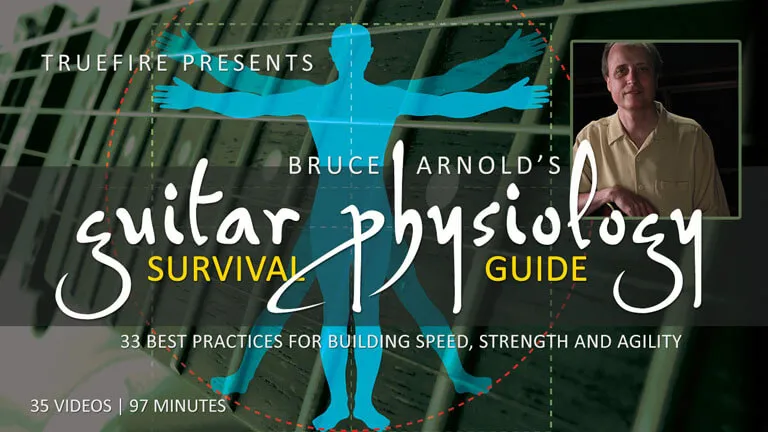
Guitar Physiology Survival Guide

33 best practices for building speed, strength and agility

Marty FriedmanTommy EmmanuelSteve VaiEric GalesEric Johnson

Get this course and 1,000+ more with All Access

Try 14 days free. Cancel any time.

Purchase Individual Course for $9.99
Guitar Physiology Survival Guide

About this course

Ask any guitarist for a wish list and you'd likely find speed, strength and fretboard agility on it along with fantastic tone and a '59 Les Paul. As we all know, the quest for perfect tone is never-ending, and the '59 can be yours if you win the lottery. But you can't buy speed, strength and agility. However, it's easier to acquire than you think with Bruce Arnold's Guitar Physiology at your fingertips.

No fancy gizmos or gadgets enclosed. No secret miracle exercises. No intervallic, string-skipping, 3-notes-per-string, speed-enhancing pyrotechnic scales to work up from 60 to 350 BPM. No kidding. Just sound advice on how to get your technique happening so you can play like a demon and do it for hours.

Bruce Arnold has been teaching guitar for thirty years. Voted "Best Teacher" in 1984 at Berklee, Arnold went on to teach at the New England Conservatory, Dartmouth and The New School. Today, he heads up guitar programs at Princeton University and New York University. He's also a monster player, composer and recording artist. Bruce knows his stuff.

"Over my many years of playing and teaching guitar, I've discovered that the key to building speed, strength and agility is HOW you play the guitar rather than WHAT you play. Of course, it's important to practice scales, various picking techniques and other exercises but if you're not holding the guitar properly or positioning your shoulders, arms, hands and fingers properly then you will NEVER achieve the speed, strength and agility you desire. It's simply not physically possible. In fact, if you don't develop a solid foundation of physical and functional techniques, you'll likely expereience repetitive stress injuries."

Arnold suffered more than his fair share of stress injuries and spent many years working with physical therapists recuperating from those injuries and more importantly, learning how to prevent them. Modifying specific physical aspects of his playing not only eliminated his pain, it significantly enhanced his technique and stamina. Garnered from personal experience and then further honed as he shared his techniques with hundreds of his students, Arnold's Guitar Physiology now presents all of his best practices for HOW to play the guitar.

"The overall idea is to move and position your body, arms, hands and fingers in the most natural way when you're playing and practicing. It is only through this type of movement that you can develop a technique that can be used for a lifetime, without injury. I know these techniques work because hundreds of my students have also developed phenomenal technical ability and today enjoy very fruitful careers in music with little or no physical problems."

Guitar Physiology Syllabus:

Getting to Home Base
No Pain IS Gain
Mind and Hands
Body in Natural State
Developing a Sound
Musical Mind & Stress
Importance of Rhythm
Technical vs. Musical
Physical Position
Guitar Placement
Best Straps and Guitars
Left-Hand Techniques 1
Left-Hand Techniques 2
Left-Hand Fingertips 1
Left-Hand Fingertips 2
Fingertip Pressure
Left-Hand Thumb Position
Positioning Left-Hand Wrist
Palm of Left-Hand
Elbow of Left Arm
Left Shoulder Considerations
Holding the Pick: Again, keep it relaxed!
Picking Considerations 1: Don't pick deep!
Picking Considerations 2: Don't pick too wide!
Picking Considerations 3: Keep a consistent attack!
Right-Hand Position: Keep it close and loose!
Right-Hand Wrist: Float freely but steadily!
Right Forearm: The initiator of movement!
Right Forearm Exercises: The EKG Method
Forearm Development: More Forearm Studies
The Right Elbow: Slight to NO movement!
The Right Shoulder: Keep it relaxed!
Please be advised, Bruce Arnold's Guitar

Physiology is NOT a medical guide of any kind nor is it a substitute for therapy if you're already experiencing stress injury. See a specialist!

Guitar Physiology is also no quick fix. Depending on how long you've been playing, you will likely need to re-learn many of the physical qualities that you don't even think about anymore; how you hold and use the pick, where you position your elbows or forearms, the angle of your wrists, the positioning of your finger in relationship to the strings, even how you strap on a guitar -- it's all critical.

Arnold recommends that you only try to modify or re-learn one element of your playing at a time and so the process may be a lengthy one as you develop new playing habits and muscle memory. Take your time and Guitar Physiology will indeed deliver the speed, strength and agility you wish for.

What you'll learn

  • Implement alternate picking instead of all downstrokes
  • Understand proper forearm-driven picking motion versus wrist-driven motion
  • Learn proper rest intervals when experiencing pain
  • Develop even articulation across all notes
  • Develop awareness of hand and wrist health
Release date: 05/18/2011 • 1h 37m runtime
Start Course
Sample lessons
Body in Natural State
Find YOUR natural state
Physical Position
Physical Position
Practice as you would play
Left-Hand Techniques 2
Finger Position
Picking Considerations 1
Don't pick deep!

What's included

35 lessons • 24 charts

Guitar Physiology
Welcome to Guitar Physiology!

Through my over 30 years of teaching and the problems I've personally had with repetitive stress injuries, I've figured out many answers to technique problems on the guitar. But the best thing is to avoid those problems in the first place and that is what I'd like to show you here. Now some of the suggestions you will find in the DVD may seem odd and some are quite new.

The overall idea is to move your body in the most natural way when you are playing. It is only through this type of movement that you can ensure that you develop a technique that can be used for a lifetime, without injury. I know these techniques work because they have given me years of pain free playing, and my students have had fruitful careers in music with no physical problems and have developed phenomenal technical ability on the guitar.

Keep in mind that the techniques presented will in many cases fly in the face of the way your favorite guitarist plays or what you have read in a magazine is the "right" way to play. But just because your favorite guitarist plays one way doesn't mean it will work for you. Everyone has different sized bodies and hands. What works for a person with long fingers and arms could be completely wrong if you have a totally different build. You need to develop a technique that takes your specific dimensions into mind. Also keep in mind that behind the scenes many musicians suffer from repetitive stress injuries while at the same time the media is recommending that you play like them.

Figuring out how to play correctly isn't easy and many professionals think it's just their bodies giving up on them when it's really the technique they are using. How many times have you seen musicians wearing wrist or elbow warmers? They are not wearing these because they are cool; they are wearing them because there is a problem. How many times have you seen a musician going through stretching exercises on or off stage? These are all signs that there are deeper problems. If you are playing correctly in most cases you don't need a regimen of stretching or therapeutic devices to be worn on your body.

Of course, In some cases these things will be appropriate. Take the instance of someone who has a lot of body tension that has built up through the years. Yoga exercises or some gentle stretching can help these people to get to a more harmonious place with their bodies.

Many players try to use tension to limit motion and gain speed. They compensate for this tension by trying to build muscle mass to counteract the stress on the body. This is no long term regimen for fast technique. It may work a few years for a teenaged player but as you get older your body will not be able to continue with this type of punishment. I've seen way too many cases of great guitarists turning to other occupations because they have totally blown out their wrist and elbow on their picking hand. Plainly speaking, there is never a case in which tension is the answer.

There will always be situations not covered in this Guitar Technique course that come up. Some students are just prone to issues of how to interface with the guitar correctly. Sometimes the answers can be simple and sometimes they are complex. In most cases I need to physically see the person's problem to address it correctly.

I usually don't recommend trying to change both your right and left hand at the same time unless you are a complete beginner. Complete beginners know nothing else so they work fine with starting with correct technique in both hands. But for a person who realizes that a new technique is the only way forward either because they have injured themselves or their technical ability has stagnated, it's best to change one hand at a time. This is because it is traumatic and frustrating to start all over with both hands; doing one at a time is a more rewarding approach.

Before I changed to the technique found in this course I had constant problems. I also had the situation that the more I practiced the worse I played. This was caused by misusing my muscles so they became fatigued. I also found that if I played a gig I'd play great for the 1st set and get worse and worse as the night went on. Again my muscles were getting fatigued. If this sounds familiar then you've come to the right place to solve these problems.

Lastly remember that the way musicians play hasn't been completely codified. It is being honed as we speak. All musicians can always refine their technique to a higher place. The concepts presented here are time tested over 30 years but I'm always refining my practice technique to get guitarists to a higher point faster, so keep this in mind.
Getting to Home Base
An ergonomic way of playing the guitar creates an efficient connection between your hands and your brain. Too much excess movement makes your brain work harder and slows down your ability to play quickly and accurately. I call the type of guitar technique found in this DVD a "Home Base Technique."

"Home Base" is the position that you want to get back to as often as possible, a place for your body to relax and regroup. By developing this "Home Base Technique" you will have a place where both hands can maintain proper blood flow and stop tension from building up in your hands and body. This in turn will decrease your chances of developing repetitive stress injuries such as tendonitis and carpal tunnel syndrome.

Let the big muscles do the heavy lifting!

Too many times I have seen students attempting to control their playing using the smaller muscle groupings, when the larger muscles are ready and waiting to be used. So instead of using your finger joints or wrist, I recommend using your forearm.
No Pain IS Gain
The most important thing to remember when learning how to play the guitar is to stop if you experience pain. You are not a prize fighter. Never try to play through pain!

I usually say that if you experience any pain stop immediately and wait ten to twenty minutes to play again. If the pain comes back then you need to rest for a day. If you do something that causes immediate pain and this pain continues after you stop playing then usually icing the affected area once an hour for 10 to 20 minutes is your best way to stop inflammation.

Obviously if your pain continues you need to consult a physician. The idea behind this course is to make it so you never get to that point. In my 30 years of teaching I've never had a student develop any physical playing problems if they implement the "Home Base Technique."

Training yourself isn't easy and initially it will require you to be very vigilant, checking on your technique by using a mirror or video recorder.
Mind and Hands
Your mind and hands need to interact in the most efficient way. Using a technique that requires your brain to process needless information will slow you down and cause mistakes. Aim for simplicity.
Body in Natural State
The physical movement you use to play guitar should keep your hands and body in their most natural state. The more you move away from this state the more chances you have in making mistakes, hampering your speed, lowering your accuracy and damaging yourself.
Developing a Sound
Developing a sound that allows you to relax and work on technique in a musical way will make a huge difference in your progress. If you use an electric guitar make sure your guitar is properly set up and your amp gives you a tone that allows you to hear the type of sound you want. This will give your ear encouragement, giving you the sound environment you need in order to improve.
Musical Mind & Stress
As your musical mind develops, it gains the ability to recognize sounds and connect them to your guitar. This interfacing with the flow of music is dependent on your ability to "hear" music. Therefore along with a physical technique, developing your ears through ear training work is crucial. Not hearing what you want to play or what you are playing causes stress, both mental and physical.

Stress causes your muscles to tighten up and will cause you to tense up no matter what techniques you use to play the guitar.

+ 28 more lessons

Start Course

Reviews

16 results

Groovemeister

11/19/25

Also good for first time playing beginners.

Am pretty close to a neophyte and this will nip some bad techniques in the bud.

sobscha

Verified buyer

02/26/25

Really a good course Eye opening and it force you to be aware if every little tension and unhealthy position you might have when playing I do recommend it

BradleyM

Verified buyer

11/25/22

BUY THIS COURSE AND GIVE YOUR HANDS A GIFT!

I tried this course on-line well before I bought it. This course is packed with tons of knowledge I wish I knew several years ago. As he states the how you play is much more than the what and the exercises in the course reinforce this. Everyone, especially those starting out, should take own this course. The dollars spent will come back several times and make the playing that much more enjoyable.

Mike E.

07/25/21

A game changer

This course has changed the way I think about guitar. If you have ever wondered why your fingers sometimes act like they've never touched a guitar before, it's probably your posture. The concepts from this course made my playing cleaner and more consistent within a few days. And for anyone wondering why this information isn't common knowledge, the answer is that tons of amazing players avoid proper posture by contorting their hands into all kinds of horrible positions (and some of those players even avoid tendonitis and carpal tunnel syndrome).

obbig

11/16/20

Not just for Late Beginners onward

AS of writing this review, I've had a guitar in my hands for about 3 weeks. I've already started other beginner courses and not just here on TrueFire, and the range of suggested techniques is as varied as there are guitar teachers. What drew me to this course though was that the majority of suggested strumming/picking techniques started to cause joint pain that was beyond the expected discomfort of using muscles & joints in ways they are not used to. After watching the course and trying a few of the techniques I've found little discomfort at all, and will keep working on building the muscle memory of the techniques as I go through the other beginner courses I've started. An added bonus that I feel I personally got from the course is that in practising Bruce's more ergonomic methods of using the left and right hands, is that I've already noticed my techniques building faster in other areas, like for instance strumming. In practising his forearm exercises often (practically any spare time I have at home), the exercises have naturally increased the consistency of my strumming. I highly recommend this to anyone else that is just starting out, and from the other reviews here it's also helpful even if you've been playing for decades. I do agree with NotQuiteThere in that this course could be a candidate to be provided free, possibly alongside "Learn Guitar One" as part of the Learning Paths. New guitarists will play longer and more often if they learn how to lessen the chances of injury.

Stop searching. Start improving with All Access.

Try 14 days free. Cancel any time.