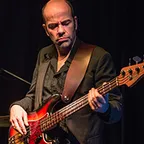
Blues Bass Crossover

10 Performance Studies For Honing A Classic Blues Bass Style

Marty FriedmanTommy EmmanuelSteve VaiEric GalesEric Johnson

Get this course and 1,000+ more with All Access

Try 14 days free. Cancel any time.

Purchase Individual Course for $5.00
Blues Bass Crossover

About this course

The Blues is one of the most loved and recognizable forms in all of popular music.  But the essence of the blues isn’t limited to a 3-chord, 12 bar structure. The Blues is a powerful construct of harmonic and rhythmic elements we can easily draw from to craft bass lines across Rock, Jazz, Funk and any other style of music you play.

Jeff Denson’s Blues Bass Crossover, will explore applications for some of his favorite blues elements, across ten different performance studies in a variety of keys and styles. Each of the studies focuses on feels from some of the most popular songs played at gigs and jam sessions every day.

”Blues is a word that has different meanings to people when they hear it, and understanding their meaning depends on context. Blues is a style of music that is at the core of almost all US American music, from jazz to rock, funk, folk, country, bluegrass and more.

When referred to as a style, names like Robert Johnson, B.B. King, Albert King, Buddy Guy, etc. come to mind, but even then, there are technically different sub-styles within, such as “Delta Blues,” “Texas Blues,” “Electric Blues,” etc. Sometimes the word refers to a sound or inflection heard in a musical phrase sung or played by a voice or musical instrument, like the bending note. It can be used when talking about music theory, as in the “blues scales” or the use of “blue notes.”  This course delves into looking at the “blues” as a musical form.”


Jeff kicks off the course with a handful of traditional electric blues jams like Walkin’ for the King, Albert’s Saw, and the Windy City Shuffle. You’ll then shift focus to blues applications for rock grooves played by groups like Led Zeppelin and Cream. Then you’ll examine funk flavored blues grooves with studies inspired by James Brown, Herbie Hancock and the Headhunters, and then round out your studies with both major and minor jazz-blues forms.

Grab your bass and let’s play the blues with Jeff Denson!

What you'll learn

  • Perform doubles (rapid repeated notes) accurately in time
  • Play bass lines in traditional electric blues style
  • Apply blues bass concepts across multiple genres including rock, jazz, and funk
  • Maintain rhythmic integrity while playing complex patterns
  • Understand the harmonic and rhythmic elements that define blues music
Release date: 03/16/2020 • 1h 52m runtime
Start Course
Sample lessons
Albert's Saw
Albert's Saw
Overview
Albert's Saw
Albert's Saw
Performance
Albert's Saw
Albert's Saw
Breakdown
Melon Hunter Groove
Melon Hunter Groove
Overview

What's included

32 lessons • 10 charts • 10 Jam Tracks

Blues Bass Crossover
Hi, I'm Jeff Denson. Welcome to Blues Bass Crossover!

"Blues" is a word that has different meanings to people when they hear it, and understanding their meaning depends on context. Blues is a style of music that is at the core of almost all US American music, from jazz to rock, funk, folk, country, bluegrass and more. When referred to as a style, names like Robert Johnson, B.B. King, Albert King, Buddy Guy, etc. come to mind, but even then, there are technically different sub-styles within, such as "Delta Blues," "Texas Blues," "Electric Blues," etc. Sometimes the word refers to a sound or inflection heard in a musical phrase sung or played by a voice or musical instrument, like the bending note. It can be used when talking about music theory, as in the "blues scales" or the use of "blue notes." This course delves into looking at the "blues" as a musical form.

The most common blues form that you'll encounter is the 12-bar blues, so most of the examples will be using this form, though not all. We will work through ten different styles of blues basslines and I'll introduce you to the concepts in the overview, perform them for/with you and then break them down. We'll kick it off with two basslines in the style of the "electric blues" in the vein of B.B. King and Albert King. Next, we'll look at a Chicago blues style shuffle, followed by two rock style blues lines, one in the style of Led Zeppelin and the other, a riff-based line in the style of the band Cream. From there we'll head into two very different funk style lines, one in the style of a classic James Brown groove and the other will be a 16-bar blues with a bridge based on Paul Jackson's killer bassline on Herbie Hancock's "Watermelon Man" as played by the Head Hunters. We'll finish off the course with two jazz blues forms, the chord progression used in a standard major jazz or bebop blues and a minor blues.

Grab your bass and let's get started!
Walkin' for the King
This example is a slow walking bassline like you'd hear in some of B.B. King's songs. This is a 12-bar blues using three chords: I, IV and V.
Walkin' for the King
Here's the performance of "Walking for the King."
Walkin' for the King
Here in this example I walked a slow 12-bar major blues in the "electric blues" style that you'd hear in some of B.B. King's tunes. Walking a slow blues can be trickier than you may think because everything you do is very exposed...your note choice, your time, duration of notes and even sound.

A key harmonic component to the blues, as a form, is the movement of the I chord to the IV chord. This example is a standard 12-bar blues where the first four bars are on the I chord and then in bar 5 we move to the IV chord. This harmonic movement is really important to be conscious of. Learn to hear this in the music you play and listen to because it's the harmonic soul of the blues form. There can be substitutions used in place of the IV chord, but those are the "exceptions to the rule." In fact, the movement of the I chord to the IV chord is so intrinsic to the blues form, that going to any other chord is probably an intentional "surprise" planned by the composer! OK, where was I? ;-) After bars 5 & 6 on the IV chord we return back home to the I chord for two more bars. Bar 9 starts us on the turnaround (Get used to this term "turnaround" because it's a common phrase that could mean any progression that leads you back to the home key). In this example, we use the V – IV – I turnaround.

In a slow song, it's very important for us as bass players to find the subdivision that best fits the feel of the groove as fast as we can. As I mentioned above, slow tunes can be tricky because our time is very exposed. By "time," in this context, I am referring to the consistency of our placement of the beat and the subdivision that we are feeling. In a quarter-note walking line, the subdivision you are feeling will be most apparent in any fills you may play, so be cognizant of that.

In this example, which is extremely common in a slow blues, the subdivision that the band and I were feeling was the triplet. That means that we are feeling three equal beats inside of every quarter note. I&a 2&a 3&a 4&a, etc. All of my fills in my line either articulated every partial of the triplet ("partial" here means each of the subdivisions, so here we are subdividing in triplets, so there are three equal partials) or articulated the first and third partial (i.e. if you count the triplet like 1&a, 2&a, etc., then I played 1 a, 2 a, etc.).

What is a "walking bassline?" A walking bassline is a quarter-note bassline that outlines the chord progression of a tune. Playing a great line is a challenging job to do! Ideally what you want to do is to play a line that clearly outlines the chord progression, but also leads your ear to each chord in the tune. If you do this well, the musicians in the band will be able to hear where they are going before they get there. How do you do that?

A line consists of three possible ingredients: scale, arpeggio or chromaticism. Meaning you can play an ascending or descending line choosing notes in order from the scale that best fits the chord you are playing over. Another approach would be to use the appropriate arpeggio to outline the chord. You wouldn't want to always do one or the other because it would probably sound pretty boring or stale. By mixing scale and arpeggio lines you can really start to create more interesting lines. But with the addition of the third option, chromaticism, you have the seasoning! You can't have a meal with just seasoning alone, but when you use the right amount, you can have a really tasty dish – this is the same for the use of chromaticism!

Another musical tip is to think about note length – be aware of the length of your notes and be able to control them for a musical purpose. For example, check out the way I play the V chord on the last bar of the blues. I use staccato (or short) notes for a percussive purpose and then legato (long singing) notes when playing a more melodic figure. Always be aware of your sound! Your sound on your instrument is the first thing that people will hear when you play...only musicians will analyze your note choices and rhythmic variation. EVERYONE will hear your sound and feel your time-feel.

Throughout this bassline I chose to play it in one position across the neck. The advantage to this is that it eliminates shifting, which is something to consider since most mistakes on the bass occur either due to a shift or string crossing. There is a sonic difference between each string though, so you should be aware of that. The strings get progressively darker as you go down to the lower strings. Positional playing has some great advantages too, including when reading written music, since you can't take your eyes off the page. I'm just throwing this out there as food for thought. (My TrueFire course Bass Soloing Studies Vol. 1 really focuses on playing positionally, so please check that out if you're interested digging into playing across the neck.)

To summarize:
  1. Stay in the pocket with the drums. Really enjoy the space and the feeling of locking with the drummer.
  2. Subdivide. Find the right subdivision that is called for the song you're playing and make sure that it's the same that drummer is feeling! (In this slow walking blues we're using the triplet.)
  3. Focus on giving a strong melodic direction to your line. Be sure you are not only outlining the chord changes, but also melodically leading everyone to the next chord.
  4. Think about the use of chromatic passing tones and blue notes. (Use these carefully.)

Albert's Saw
This is based on the drum groove of Albert King's famous tune "Crosscut Saw." I'm using a very pattern-based line based on the major pentatonic scale (major pentatonic scale: 1, 2, 3, 5 & 6). This is a 12-bar blues using three chords: I – IV – V.
Albert's Saw
Here's the performance of "Albert's Saw."
Albert's Saw
This a pattern-based baseline that outlines the notes of the major triad (1, 2, 3 plus the major 6th). "Pattern-based" means that it is a repeating riff-like pattern that is used over the chord changes.

Musical tip: Basses (and guitars) are very shape-friendly instruments, meaning that you can take a shape and move it around on the instrument to play something like this line. That's a fine approach as long as you're really hearing the notes that you're playing – ultimately hearing the music that you're playing (as opposed to moving your hands in shapes) is the most important part of becoming a good musician. Like I did in the last example, I played this line in position instead of moving the shapes around.

To summarize:
  1. This is a pattern-based line so the strength of the line is the fact that you hear the same pattern over and over again. By doing this, the bassline becomes something that the song is based around...it gives a sense of cohesion to the tune. With that in mind, you should be careful about your fills. Don't play too many fills because that could dilute strength of the line.
  2. If you want to play fills you could use notes from the major pentatonic scale, since that's already in the sound of the line you're playing (Of course, you could always go "outside" the sound, but in this style you'd want to stick closer to the sound). Use rhythm as a way to fill – you don't always have to play a bunch of notes. Using varied rhythms on a single note, while being sure to stay locked with the drums can be a great way to fill as well! Never loser the pocket! It's always better to play in the pocket (being locked with the drummer) than to try to play flashy techniques or fast lines! Playing in the pocket with the drummer is what's going to get you gigs...everything else is just "icing."

+ 25 more lessons

Start Course

Reviews

7 results

CalvinHeadrick

Verified buyer

12/26/25

Blues crossover

Mr. Denson is a great teacher and has chosen a fun variety of grooves to help students have a well rounded learning experience.

deluc

Verified buyer

03/23/23

great course fresh material

barzo

12/28/22

More Jazz Blues, please.

This is a great intro to Jazz Blues stylings. Clear instruction in both tab as well as standard notation. It's good for understanding the proper rhythmic nuances of playing expressions.

RJJ

09/23/21

Easy to Understand, Fun to Play

Jeff Denson is a great instructor with a nice, mellow, calm vibe. In his "Blues Bass Crossover" course, he keeps his song examples simple to understand so the student is not overwhelmed, adds in some tasty morsels to keep it fun, like triplets here and there, then explains why and how he added those embellishments so we know not only how to play one song, but the principle behind WHY we are choosing these particular notes and patterns as bass players. I also like that he explains when you SHOULDN’T embellish too much, if your job on a particular song is to anchor the pattern-oriented bass line. The light bulb really went on for me because of his lessons, and I'm having a great time finally being able to keep up with more than just root notes!

Ivar N.

08/24/21

Useful and fun Blues studies

Jeff explains well what is going on in these fun and musical studies. He is good at explaining what and why the lines are what they are. He is good at referencing the actual function of the notes like chord tones and not just the note names as some reference. It is really useful to know you are playing the minor 3rd instead of just a C for example. The playing is nice and the songs selected are good and well presented. Recommended!

Stop searching. Start improving with All Access.

Try 14 days free. Cancel any time.