




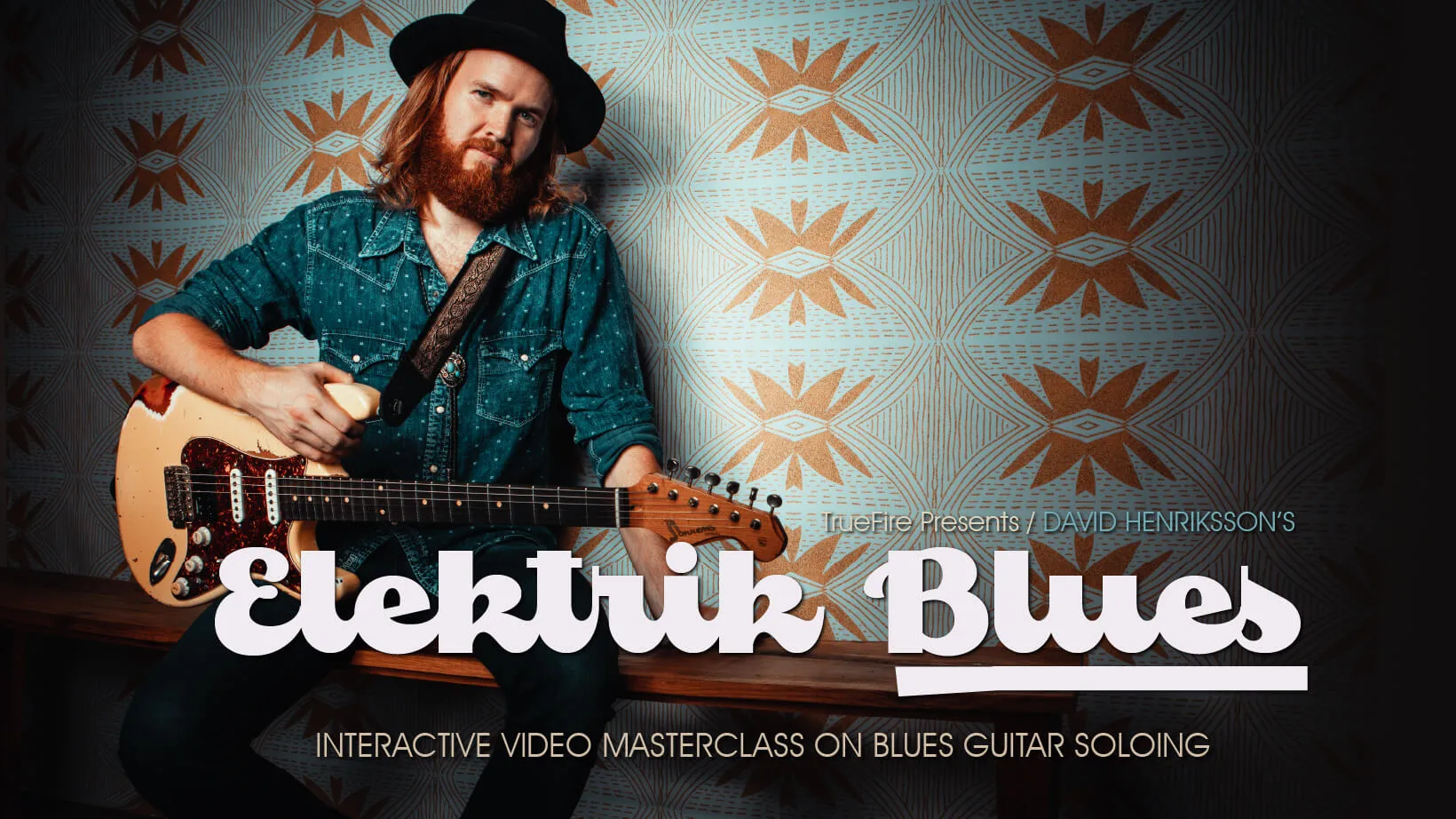

Elektrik Blues

Interactive Video Masterclass on Blues Guitar Soloing

Marty FriedmanTommy EmmanuelSteve VaiEric GalesEric Johnson

Get this course and 1,000+ more with All Access

Try 14 days free. Cancel any time.

Purchase Individual Course for $14.99
Elektrik Blues

About this course

Growing up in Sweden, David Henriksson was heavily influenced by American Roots music played on electric guitar, especially the blues, but he also studied country, rock, and jazz. His ears have always gravitated towards more sophisticated melodic and improvisational approaches played over simpler chord progressions like the ones you find in the blues.

In this course, David will share 10 key approaches and techniques that made a big impact on his playing. Then, he’ll apply each of these approaches in a soloing performance study using backing tracks. He performs the solo first and then breaks it down for you in detail.

"The course is organized the following way: First, there's an insight section where I talk about and demonstrate a concept in a more general way. These concepts range from double stops to pedal steel-inspired bends to suspended voicings and more. Then I perform a solo over a backing track, and finally I break down and explain what I did, why I did it and how it works from a theoretical and harmonic standpoint. I hope you'll find many ideas you can add to your own toolbox. The ideas are more important than the specific licks here, so don't necessarily focus on learning every lick in every solo here. Understanding what's going on and how all of the ideas are connected is more important. Have fun!"

You’ll work on techniques like double stop applications, dominant harmony approaches, and pedal steel bends. You'll also cover open string lines, tonal variations for the right hand, and ways to add more dissonance and tension to your blues. David will show you applications for triads and triple stops, suspended voicing options, symmetrical fingering patterns, and we’ll look at some of my favorite ways to incorporate contrary motion.

David will explain and demonstrate all of the key concepts and approaches along the way. You’ll get standard notation and tabs for all of the performance studies. Plus, you’ll be able to use TrueFire’s learning tools to sync the tab and notation to the video lesson. You can also loop or slow down the videos so that you can work with the lessons at your own pace. All of the backing tracks are included to work with on your own as well.

Grab your guitar and let’s get 'elektrik' with David Henriksson!

What you'll learn

  • Apply sus voicings to create harmonic interest over static minor chord vamps
  • Use delay and effects to enhance sus chord textures
  • Move sus voicings up and down the scale for varying degrees of tension
  • How to create and control dissonance over a 12-bar blues progression
  • Techniques for balancing dissonant and consonant sounds
Release date: 02/10/2020 • 3h 35m runtime
Start Course
Sample lessons
Triads and Triple Stops
Insight 7: Demo
Half Time Triple in A
Overview
Half Time Triple in A
Performance
Half Time Triple in A
Breakdown

What's included

42 lessons • 20 charts • 10 Jam Tracks

Elektrik Blues
Hey, I'm David Henriksson. I want to welcome you to my first TrueFire course: Elektrik Blues. During these ten segments we'll take a closer look at approaches and concepts I've used over the years to carve out my style of playing. You can use many of these ideas in many different styles of music and you'll hopefully hear influences from a wide variety of genres, but in this course we'll apply these ideas over backing tracks with a bluesy vibe and mostly 1,4,5 chord progressions.

The Elektrik Blues course is organized the following way: First, there's an insight section where I talk about and demonstrate a concept in a more general way. These concepts range from double stops to pedal steel-inspired bends to suspended voicings and more. Then I perform a solo over a backing track, and finally I break down and explain what I did, why I did it and how it works from a theoretical and harmonic standpoint. I hope you'll find many ideas you can add to your own toolbox. The ideas are more important than the specific licks here, so don't necessarily focus on learning every lick in every solo here. Understanding what's going on and how all of the ideas are connected is more important. Have fun!!
Double Stop Applications
A double stop means that you're playing two notes at the same time, therefore you have to visualize and memorize patterns on different string sets. A good way to start is to play a harmonized major scale with double stops in thirds on an adjacent set of strings. Then you can take it from there with bigger intervals and non-adjacent string sets. For me double stops are a good way to outline the chord progressions, add harmonic color and to make it sound fuller if you're playing in a smaller setting like a trio or a quartet.
Two Stop Shuffle in A
This track is a medium tempo 12 bar shuffle in the key of A. It's the beginning of this course so this is hopefully something easy and comfortable to start exploring ideas over.
Two Stop Shuffle in A
This track is a medium tempo 12 bar shuffle in the key of A. I'm showing some different double stop ideas that you can start to implement in your own playing. Simpler things like parallel thirds and sixths moving within the scale but also call-and-response phrases where I mix single note lines and double stops.
Two Stop Shuffle in A
I explain in detail what I played over the track, how I transition between the different chords and what kind of double stops/intervals I use for different purposes.
Dominant Harmony Approaches
In blues it's very common that we're playing over dominant chord functions. That means we have a chord including the root, major third and flat seventh degree. Thanks to the tritone dissonance between the major third and the flat seventh, a dominant chord lends itself well to highlight some tension notes - as long as you bring it back ”home” with the release. Here I'm showing how you can use three different scales that work over a dominant chord, adding an increasing amount of tension. Mixolydian doesn't offer much tension, the sharp 4th degree of the lydian dominant steps it up a little while the diminished half step/whole step scale also adds the flat nine and sharp nine - giving you the opportunity to sound a little bit like you're playing ”outside” in a jazzy way while actually staying within the diminished scale. Remember that the diminished scale has 8 notes compared to the other two that has only 7.
Funky Dominant Vamp in E
This track features a funky groove over a static E7 chord. Since it's only one chord we don't have to worry about resolving our lines to a new chord every few bars, I think it's a good way to explore more exotic note choices.

+ 35 more lessons

Start Course

Reviews

8 results

peyosyl

Verified buyer

03/22/20

I found ideas, but not so much, some good double stops series, a good sound but at final, I am a bit disappointed. No common thread, to put licks side by side doesn't make global sens. In French we say "sans queue ni tête". Doesn't make me dream. That's my fault, lured by the teasings. I hope the best to David Henriksson, but for my personal point of view, that's not what I was looking for.

Matthias

03/14/20

Bright shining new blues instructor - my favourite course so far

Contemporary Blues playing flavoured with some spicey country moves. Absolutely no boring stuff here. All performances sound authentic and are well arranged. Most important to me: the concepts can be easyily integrated in your every-day blues playing. David‘s explainings are clear and accurate, and his enthusiasm is permanently percebtible. I just finished only four lessons (double stops, pedal steel bends and right hand tonal variations) and already hear a difference in how my playing sounds. And I really enjoy practicing again! Thanks to David Henriksson and Truefire for my favourite course so far.

Angry B.

03/06/20

Great teacher and course

I watched David's TrueFire live and was really like what I saw. David's approach to the guitar is very musical and very usable - it's not based on having jaw dropping technique but on making sounds with the instrument that are interesting and draw the listener in. His playing is creative and his teaching gives you ideas you can put to use right away.

Peter

02/21/20

Great course

Just started this course and I'm really glad I bought it! David is great in teaching and sharing his musical ideas. This course would fit the intermediate player as well as an advanced player. Great course so far!

gianluca

02/18/20

very useful for intermediate blues players - if you want to learn how to play/improvise over a backing track using different cool approaches this is the place for you. David is a great teacher and also the way the course is structured and organised is definitely making things better. A great value for any intermediate player approaching some intermediate to advanced topics which are widely discussed in a very smart way

Stop searching. Start improving with All Access.

Try 14 days free. Cancel any time.