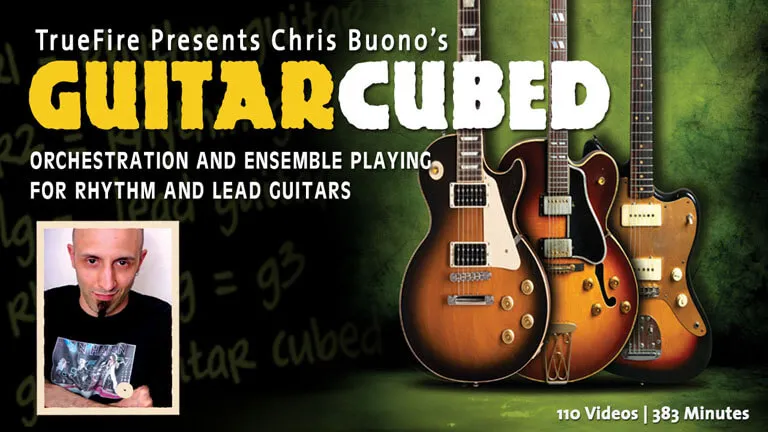
The art of orchestration and ensemble playing is a bit of a challenge for most guitar players, especially those that don't play out all that much. We guitarists tend to either play too much, play conflicting parts, play in the same register, play the same exact voicing as the other guitarist, or play when we really shouldn't be playing anything at all. We've all been there and that's what Guitar Cubed is all about — a course of study focused solely on orchestrating multiple guitar parts in contemporary music.
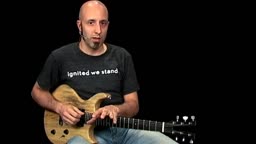
Recording artist, stunt guitarist and TrueFire's Professor of Guitaristics pulled all the stops out on Guitar Cubed with over six hours of footage completely devoted to orchestrating multiple guitars with riffs, leads and rhythm guitar parts. Guitar Cubed is organized into a dozen lesson sets where each set features a different contemporary arrangement for bass, drums and three guitar parts. Lesson sets are comprised of eight in-depth video lessons examining every nuance of the three guitar parts, along with the why and how they work so well together.
For each of the twelve sets of eight lessons, Chris first analyzes the backing track thoroughly and then examines Guitar 1 and Guitar 2 individually.
Guitar 1 serves as the 'foundational rhythm part' while Guitar 2 provides the 'complementary rhythm part'. These sections are worth the price of admission alone as they reveal best practices for locking up with another rhythm guitar player, as well as locking up with the drummer and bass player — essential skills for anyone playing in a band situation or at a jam session.
In addition to honing your rhythm section chops, Buono also guides you through the process for crafting or improvising lead guitar parts.
Once he reveals how the two rhythm guitars work together and interacts with the rhythm section, he'll probe into the chameleon-like Guitar 3 to illustrate how to create a third part and how to improvise a solo over the existing parts.
As usual, Buono went beyond the call of duty with the practice rhythm tracks, tab and notation that accompany the course:
Guitar 1 Tracks Features: Just bass and drums and no other guitar parts. How to Use: Use these tracks to practice any of the three guitar parts on their own, or invent new parts, or just improvise over.
Guitar 2 Tracks Features: Bass, drums and the Guitar 1 part How to Use: Use these tracks to practice the Guitar 2 parts over, or invent new parts, or just improvise over.
Guitar 3 Tracks Features: drums, bass, Guitar 1 and Guitar 2 parts How to Use: Use these tracks to practice the Guitar 3 parts over, or invent new parts, or just improvise over.
Track Mixes The tracks were mixed with Guitars 1 and 2 panned hard left and right respectively. With bass and drums sitting dead center you can freely toggle between having just Guitar 1 or just Guitar 2 in the mix simply by adjusting the balance (pan) knob on your monitoring system.
As with every TrueFire course you'll have the tab, notation and Power Tab at your disposal.
Each chart includes all the parts as they accumulate. For instance, Guitar 1 will display just that, but Guitar 2 will have the part by itself on the top of the chart and then Guitars 1 and 2 doubled-staffed directly below so you can vertically examine how the parts line up. When you make it to Guitar 3, you'll see the same setup as Guitar 2, except below the lone Guitar 3 part will be a triple-staff made up of all three parts for maximum notation geek-out.
What's more, as with many of Buono's courses the audio path in Guitar Cubed was recorded direct. To do this a POD XT Live was used and all of the Tone files are included for you to load into your unit if you're a POD owner (models and compatibility may vary).
Playing with other musicians, and making great music, is the ultimate reward for all of the practice hours that we guitarists invest in our craft. Guitar Cubed will exponentially increase that reward by teaching you how to listen and how to orchestrate your parts.
What you'll learn
Analyze and identify kick drum patterns in a rhythm section
Observe bossa nova rhythm application in context
Understand how to translate drum patterns to guitar riffs
Learn to lock in with both bass and drums simultaneously
Develop the ability to play behind the beat for a relaxed feel
It's safe to say that for most guitarists, there's no greater rush than a great jam session! From every which way you look at it, it's awesome: loud guitars, screaming solos, pounding drums, deep bass grooves--all of it! Heck, it's so cool it makes that dank basement stench smell as sweet as that fresh pizza you will inevitably order. That said, you gotta wonder: What could possibly make a hang consisting of your guitar, your best buds and favorite beverages go wrong? Aside from too many of those favored spirits, it's when your best buds are other guitar players. All too often we guitarists get geared up for a night of productive noise making only to spend much of it trying to find something to play. Sure, you can rock out on "Smoke on the Water" for the billionth time, but there's something nearly indescribable that takes over when you're playing your own music. Even better is when your fellow man gets down with your vision and brings fresh ideas to the table. With that said, now you gotta wonder the following: How can I make this happen? How do I write solid riffs? What do I listen for?How do I construct secondary parts so we're not all playing the same thing like we always do?!Can I get some help here?!!You bet--welcome to Guitar Cubed. This is Chris Buono and I'll be your guide through this multi-faceted journey that will lead you to near jam session perfection. Guitar Cubed is about making the time you play with other guitarists, as well as drummers and bass players alike, the best it could possibly be. To do that we're going to explore not just one, not even two; but three-part riff writing and playing. From what to listen for in the rhythm section to coming up with secondary parts that go beyond just playing different inversions all the way to organizing your improvisations, this course will give you the goods that you always wish you had and more! In celebration of the ultimate jam--the 12 bar blues--Guitar Cubed is split up into a dozen lesson sets for you to sink your head and hands into. Each of the 12 grooves are broken down into eight in-depth discussions that focus on every last nook and crannie of what's makes up the music you have before you. And that's what it's all about--music. The all-encompassing goal in Guitar Cubed is to show you to create just that.After a short introduction kicking each set off will be a split screen performance of the first two parts aptly called Guitars 1 & 2. Before diving into the dissection of those parts with tried-and-true TrueFire-style "breakdowns" you will first be walked through what's happening in the rhythm section in Rhythm Track Analysis segments where I will literally talk you through the backing tracks sans guitar and hip you to what's going on. For some, this could be the price of admission, as all too often this type of discussion is never, well, discussed. After you've gained some much-needed insight as to how to appreciate what's going on in the background, then we jump into Guitars 1 & 2 individually through separate performance and breakdown segments leaving no note un-turned. Here you will learn about Guitar 1's role as the "foundational rhythm part" and Guitar 2's role as the "complementary rhythm part". Directly following these revelations will be the introduction and continued in-depth probe into the chameleon-like Guitar 3. In these concluding two segments you'll learn how to approach constructing and/or improvising a third part--whether part-based or solo based--over what may seem like an overwhelming throng of great ideas that you couldn't possibly fit into. To help make your practice time as effective as possible I designed the backing tracks as follows:Guitar 1 – This will just have the bass and drums and no other guitar parts. Use this track to practice any of the three parts on their own.Guitar 2 – This will have bass and drums plus Guitar 1 so you really hone in on practicing Guitar 2 to lock up with Guitar 1 as well try Guitar 3 with just one part.Guitar 3 – This track will feature bass, drums and Guitars 1 & 2 so you can shed Guitar 3 over all the parts. As an added bonus these tracks were mixed with Guitars 1 & 2 panned hard left and right respectively. With the bass and drums still sitting dead center you can freely toggle between having just Guitar 1 or just Guitar 2 in the mix simply by adjusting the balance (pan) knob on your monitoring system.As with every TrueFire course you'll have the power of Power Tab at your disposal, as well as PDF files, where you can view every last note played during the performances either on your computer or a pristine print out. Taking things to the next level each chart will include all the parts as they accumulate. For instance, Guitar 1 will display just that, but Guitar 2 will have the part by itself on the top of the chart and then Guitars 1 & 2 doubled-staffed directly below so you can vertically examine how the parts line up. When you make it to Guitar 3 you'll see the same setup as Guitar 2, except below the lone Guitar 3 part will be a triple-staff made up of all three parts for maximum geek-out.What's more, as with many of my courses the audio path in Guitar Cubed was recorded direct. To do this a POD XT Live was used and all of the Tone files are included for you to load into your unit if you're a POD owner (models and compatibility may vary). These Tone files were consciously created to suit each part specifically allowing them to sit within the mix as best they can. Guitar Cubed is the most complex endeavor I've entered into here at TrueFire and it's a course I feel very strongly about. Playing with other musicians is the ultimate form of expression to me and has made playing music completely awesome throughout these 20+ years as a guitarist. I sincerely hope Guitar Cubed helps you kick out the jam like never before.Rock on!
You never know where a riff is going to come from. Be it one inspired from another riff, or one that comes to you as you're practicing a new scale or maybe one that gets into your head via your favorite video game! Spy Hunter is all about the latter instance, but on the serious side it serves up some foundational concepts that will be ever-present throughout Guitar Cubed. First, a good idea when bringing in a riff idea to any playing situation is to have them be simple and that's where this Am jaunt shines. Both rhythm parts will prove to be a quick teach so you and everyone in the band can get right to rockin' it. While Guitar 1 slickly strolls along with consecutive 1/8 notes, Guitar 2 chops things up a bit more with 16ths. Another important attribute to Guitars 1 & 2 are the absense of chords as Spy Hunter is a single note riff manifesto based more on a tonal center than a specific chord. This element affords you the luxury of choosing whether to solo in major or minor tonalities since there's no concrete harmonic devices to say otherwise. Perhaps the crowning jewel is the introduction of motivic development heard in Guitar 3, which be will delved into throughly in the corresponding breakdown segment.
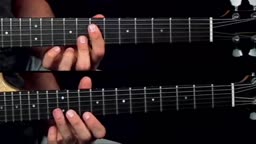
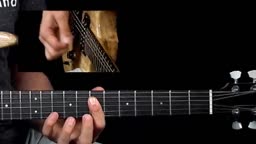
Guitar Cubed makes a little bit of TrueFire history with it's unique split screen view allowing you to view both Guitars 1& 2's neck view simultaneously. This will serve as a superb learning tool when first hearing these parts as well as coming up with your own. In regards to the latter, when composing multiple parts on guitar, especially when the tones will be similar, it's a good idea to make use of the timbral differences the neck affords you. Meaning, even when you play the same exact note, if it's played on a different string (which is inevitably played on a different part of the neck), it's gonna sound different. And, that's a good thing.
In these Rhythm Track Analysis segments I will walk and talk you through each and every backing track in Guitar Cubed. After letting the groove play out so you get a clear picture as to what it's all about, I will break down both the drums and bass parts piece by piece. This will give you valuable insight pertaining to what is really going on back there so you too can approach your riff writing, as well as your playing of those riffs, with the same intel a seasoned pro does.
Here in Spy Hunter the "backbeat" is under the spotlight. You'll discover what that is and how Guitar 1 plays opposite of the backbeat making for a very cool rhythmic push-and-pull effect. All together this straight-ahead rock groove is a perfect primer for what's to come.
After checkin' out the split screen performances both Guitars 1 & 2 will be performed separately so you can get a clear picture as to how to play them. Honing in on Spy Hunter's Guitar 1 part you'll notice a fair amount of pitch modulation applied as well as unabashed palm muting to this quasi-chromatic riff in Am. About that muting stuff, listen closely and you'll hear a fine line between muted and un-muted notes. "Huh?", you say? The next segment doles out the skinny...
Guitar 1 unapologetically doubles the bass here in Spy Hunter. In order to pull that off some not-so-obvious playing provisions are put into place. What's NOT happening is a barrage of stiffly played 1/8 notes nor is there a series of metal-muted ones either. To avoid both stylistic impotence and lost-in-the-mix syndrome, a technique I call "bounce muting" is employed to solve both ailments. Accenting beats 1 and 3 (opposite of the backbeat--beats 2 and 4) each attack made with the pick hand is partially muting the 6th string, but the kicker is the way the pick hand bounces off the string immediately after (hence the name). This approach gives an otherwise bland riff character and helps make it cut through the mix even though it’s played in the guitar’s low register AND doubling the bass.
Speaking of cutting through the mix while adding life, check out the 1/4-step pulls that are applied throughout Guitar 1 as well as the slight emphasis sans bounce mute on the downbeats of beats 1 and 3. Both approaches further distance Guitar 1 from the bass line without alienating it making them work together perfectly. Additionally, these inflections help mark key rhythmic landmarks making sure you, or anyone else playing with you for that matter, doesn't get lost as this vertigo-inducing riff roles along. On that tip: It doesn't hurt that everytime beat 1 rolls around that the slightly accented note is the root (A) and is basically un-muted all together. But, there's is a curve ball in terms of predictability as the root is also un-muted at the downbeat of beat 4 as well. Pretty sneaky, right? Well, it is called SPY HUNTER.
Whenever we take a look into the Guitar 2 parts we will do so with the rhythm track once again consisting of the bass and drums only. This allows you a clear picture as to how this riff is meant to be played and may give you some ideas for new Guitar 1 parts--hey, you never know. In Spy Hunter, Guitar 2 has an ending slide into a hanging b7th (G) that could have been played in a more vertical position by planting it on the 5th fret of the D string. Instead, this slippery maneuver is placed as such for more glissando (slide) action as well as taking advantage of the added control from applying vibrato with the fret hand 3rd finger supported by the 2nd finger. In the next segment we'll take this apart and see how it works.
Chris teaches some really good lessons about playing with others. Great for someone like me who’s used to playing by myself.
E
EddieFast
02/15/22
Awesome concept!
Chris Buono has an all-in, no-nonsense approach to teaching guitar that challenges you and illuminates every dark corner of your learning experience. As a result, he can simplify and expand complex nuances of playing. The concept of this course is to open doors in the player's mind to composing multi-layered guitar parts—intricate parts that lock up tight harmonically, rhythmically, and in exciting ways. Chris presents the material in the context of playing with other guitarists, but the benefits go far beyond that—a beneficial course for the studio or loopers and bandmates.
A
andy02259
Verified buyer
04/03/21
Another great course from Truefire
Always looking for ways to improve my playing. This one hits the mark for fitting your playing into different situations without overpowering the rest of the band. A+
R
rickygol
11/26/19
Great lesson.
Great to see how a professional fits together different guitar parts. Definitely worth getting.