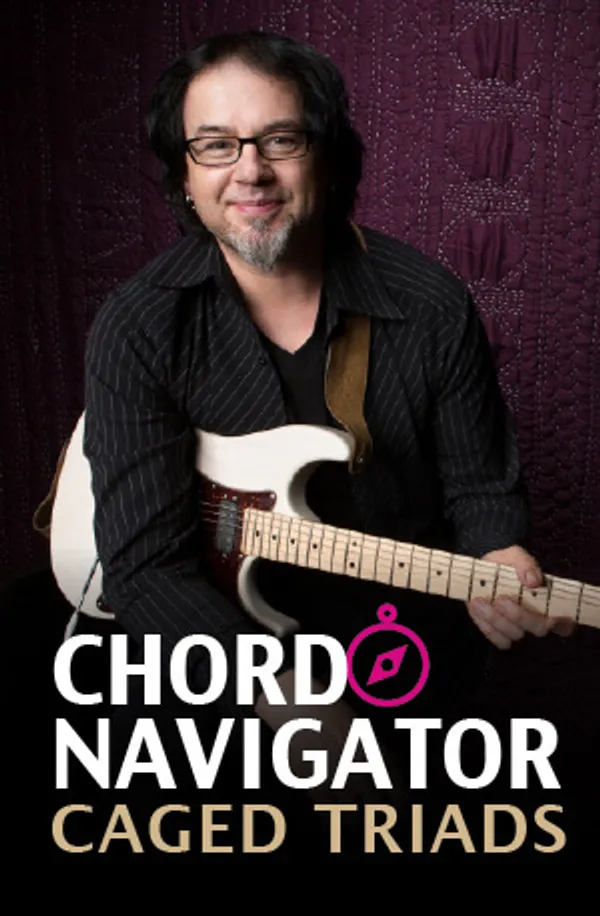
Take 5: Chord Tone Soloing

Chord Tone Soloing Essentials for Guitarists

Marty FriedmanTommy EmmanuelSteve VaiEric GalesEric Johnson

Get this course and 1,000+ more with All Access

Try 14 days free. Cancel any time.

Purchase Individual Course for $19.99
Take 5: Chord Tone Soloing

About this course

Whether you’re composing melodies, crafting a solo, or improvising, targeting chord tones is the most essential melodic device. Chord tones are the very notes that form the chords that you’re playing over. Targeting or resolving your lines to a chord tone is a very powerful approach for playing a melodic solo -- much better than just running scales -- and its melodic solos that really connect a player to their listening audience. 

Rob Garland’s Chord Tone Soloing edition of Take 5 reveals a very simple method for crafting melodic solos by targeting and resolving your lines to a chord tone. Use this approach and you won’t need a backing track or rhythm section to hear the underlying chord changes.

"Emphasizing chord tones is a simple and powerful approach for playing melodic solos and connects the player and the listener in a more effective way than only playing a scale. I’ll show you how quickly identify chord tones, find them on the fretboard and relate them to a position on the neck. I like to combine a CAGED triad, an arpeggio, a pentatonic scale, and a major scale. This gives me a lot of fretboard visualization and I'm able to connect chord tones and create licks based off of what I'm seeing.”

After Rob outlines his chord tone soloing approach, he’ll then guide you through 5 Chord Tone Soloing performance studies from basic to more sophisticated and challenging approaches, across a variety of musical styles.

Rob will explain and demonstrate all of the key concepts and approaches along the way. You’ll get standard notation and tabs for all of the key examples and performances. Plus, you’ll be able to use TrueFire’s learning tool to sync the tab and notation to the video and can also loop or slow down the videos so that you can work with the lessons at your own pace. All of the backing tracks are included to work with on your own as well.

Grab your guitar and let's solo melodically with Rob Garland!

What you'll learn

  • Create melodic solos by targeting specific chord tones (roots, thirds, fifths, sevenths)
  • Solo over complex chord progressions using chord tones instead of scales
  • Practice chord tone soloing in multiple neck positions
  • Follow and emphasize voice leading in chord progressions
  • Understand how to continue developing chord tone soloing skills after completing the course
Release date: 08/15/2019 • 1h 23m runtime
Start Course
Sample lessons
Level 4: Chord Tone Soloing
Overview & Chord Analysis
Level 4: Chord Tone Soloing
Performance
Level 4: Chord Tone Soloing
Breakdown

What's included

18 lessons • 11 charts • 5 Jam Tracks

Take 5: Chord Tone Soloing
Hi, I'm Rob Garland. Welcome to Take 5: Chord Tone Soloing.

Whether you're composing melodies, crafting a solo or improvising, targeting chord tones is the most essential melodic device. Chord tones are the very notes that form the chords that you're playing over.

Therefore, targeting or resolving your lines to a chord tone is a very powerful approach for playing a melodic solo - much better than just running scales - and its melodic solos that really connect a player to their listening audience.

And using this simple method - which I'll show you here in this course - you can even take the backing track away and still hear the chord changes beneath your solo!

After I outline my chord tone soloing approach, I'll then guide you through 5 chord tone soloing performance studies across a variety of musical styles, from basic to more sophisticated and challenging approaches.

All of the performance studies are tabbed and notated, and you'll have the jam tracks to work with on your own. You can loop and slow down the videos so you can work with the lessons at your own pace.

Grab your guitar, and let's get started!
What Are Chord Tones?
A chord tone is a note that's part of a chord. Emphasizing chord tones is a simple and powerful approach for playing melodic solos and connects the player and the listener in a more effective way than only playing a scale. If you don't know the notes that make up chords, this is a good time to start working on them! For example, a C major chord is made up of the notes C-E-G, the root, 3rd and 5th of the C major scale, therefore these are the chord tones. So now that we know the notes, you need to find them on the fretboard and relate them to a position on the neck. I like to combine a CAGED triad, an arpeggio, a pentatonic scale and a major scale. This gives me a lot of fretboard visualization and I'm able to connect chord tones and create licks based off of what I'm seeing.

Remember, a MAJOR triad has Root-3rd-5th from the major scale and a minor triad has Root-b3-5.
Level 1: Chord Tone Soloing
Our first song uses a popular chord progression, a I-V-vi-IV in the key of A, namely A-E-F#m-D. Let's play some chord tones over the song and then examine where I'm getting them from.
Level 1: Chord Tone Soloing
For our Level 1 performance study, I'll play a simple melody created from chord tones over A-E-F#m-D.
Level 1: Chord Tone Soloing
The chords are diatonic, meaning they all belong to the same key, in this case A, (A-E-F#m-D). Look at the notes in the A major pentatonic scale: A-B-C#-E-F# How do these notes relate to the chords? C# is the 3rd of the A chord, B is the 5th of the E chord, A is the 5th of the F#m chord and F# is the 3rd of the D chord. So, we could play C# to B to A to F#, and by doing so, we're targeting chord tones. See how the pentatonic scale sounds more melodic because we are actually thinking about which notes we play. You can also experiment with playing the root and 5th of the chords as well, remember each of these chords is a triad, 3 notes, 3 chord tones.
Level 2: Chord Tone Soloing
This chord progression is in the key of C and has a bluesy shuffle feel, but isn't a standard 12-bar. The chords move from a I to a IV7 chord followed by a ii-V-I7 in G,which leads us back to C, the tonic: C-C-F7-F7-Am7-D7-G7-G7. Let's play some chord tones over the song and then examine where I'm getting them from.
Level 2: Chord Tone Soloing
I'll play a solo extracting chord tones from C-C-F7-F7-Am7-D7-G7-G7 with a shuffle feel.

+ 11 more lessons

Start Course

Reviews

14 results

odalovic

Verified buyer

01/05/22

Eyes wide open

Dave58

Verified buyer

11/15/21

Very interesting.

I have now purchased 2 courses from Rob and I am amazed how instructive they are. The right note in the right place at the right time. Fun melodic exercises that will blow your mind. Mr Garland is a virtuoso guitar player and teaches you a lot in technique and modal improvisation. It does take some time to master his style. Huge variety in this course.

tomac

Verified buyer

10/20/21

Great

PinoNasti

Verified buyer

04/09/21

a good course that is very useful for understanding approach to chord tones.

vprice

Verified buyer

06/22/20

The path to cohesive solos

Rob provides lots of ideas for targeting chord tones to build more engaging solos. This course pairs well with his Melodic Soloing: Major Scale course

Stop searching. Start improving with All Access.

Try 14 days free. Cancel any time.