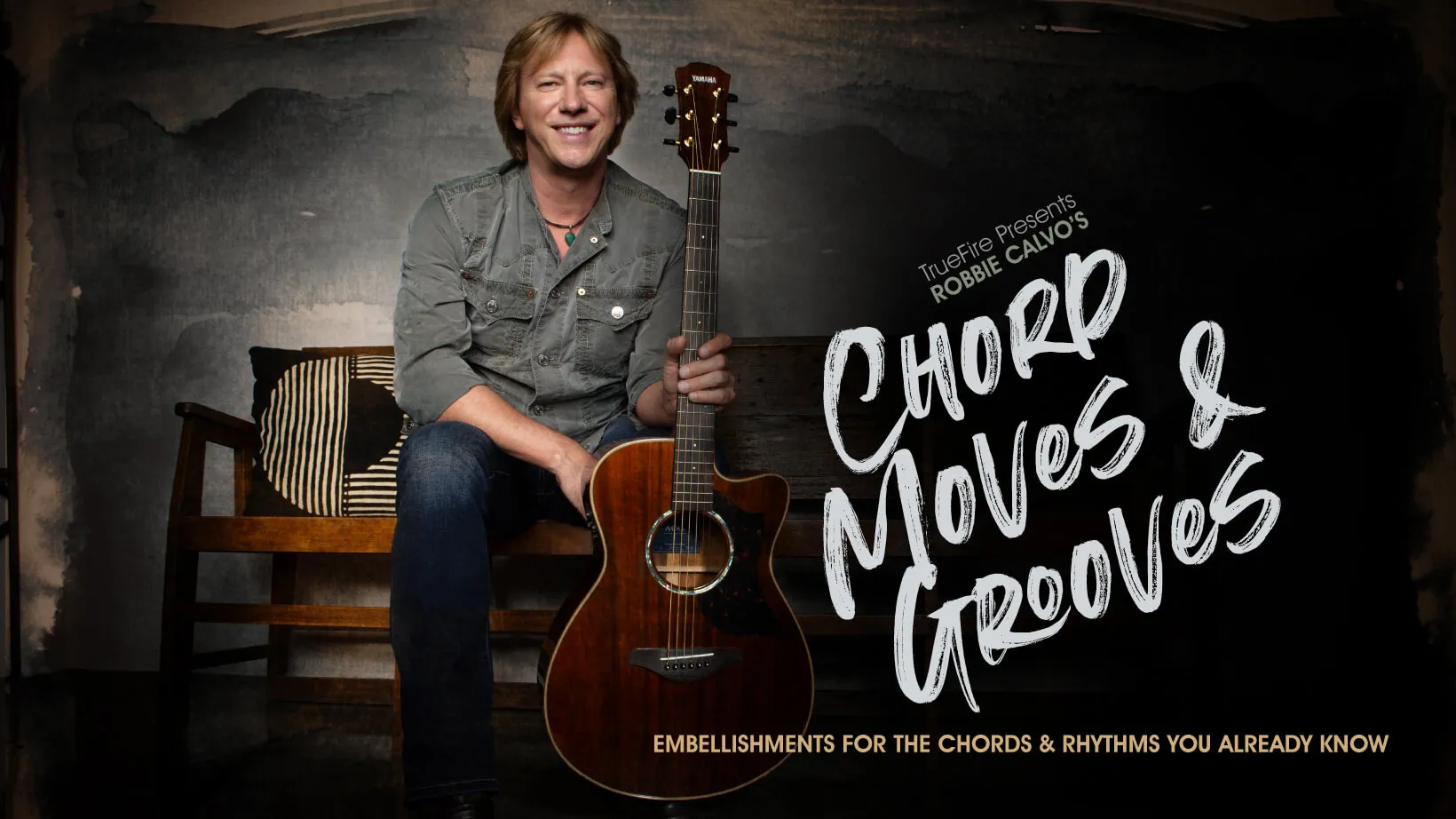
Embellishing open position chords simply by lifting, shifting, or adding a finger can open up a whole new world of rich sonic treasures that sound fresh, contemporary, and unique to your style of playing.
Robbie Calvo’s Chord Moves & Grooves reveals the simple, yet very effective techniques that make the real difference between the songs you are just strumming along to and the way those songs are actually being played on the radio by your favorite artists and singer-songwriters.
”In Chord Moves & Grooves, I’ll show you a variety of chord moves for each of the basic major and minor open position chord shapes. We’ll then string these embellished chords and moves together to create a virtually unlimited palette of grooves and progressions.
Use these moves and grooves to enhance cover tunes you play, or better yet, use them to write your own original songs -- either way, I promise -- you’ll be creatively inspired!”
Robbie kicks off the course with a series of lessons focused on key concepts, approaches, and techniques: Why You Need This Course, Maximize the Grooves, Re-Harmonization, PDF Diagrams & Charts, Building Dexterity, Open Position Chords, and Using a Capo.
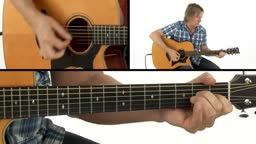
In the Major Moves & Grooves section, Robbie demonstrates and then breaks down 18 major chord moves and grooves that will greatly expand your major palette of chord and rhythm options. You will work through variations and approaches for A major, B major, C major, D major, F major, and G major chords. Each of the 18 studies feature a performance and a breakdown lesson video.
”If you are a singer/songwriter, this course is going to open up cool new ideas to inspire and motivate you towards writing fresh chord progressions, melodies and ultimately the next favorite song. If you accompany an artist, play in a band or record music with the guitar, this course will give you the additional flavors and spice needed to bring a classic song to life or an abundance of options for layering guitar parts in the studio.”
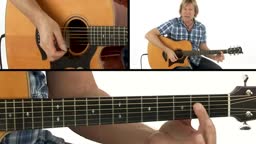
In the Minor Moves & Grooves section, Robbie demonstrates and then breaks down 6 minor chord moves and grooves that likewise will greatly expand your minor palette of chord and rhythm options. You will work through variations and approaches for A minor, B minor, C minor, D minor, and E minor chords. Each of the 6 studies features a performance and a breakdown lesson video.
"For every example in this course, I’ve provided the groove track and the groove and guitar part as separate audio files. Why not try each of the chord moves that you like, with some of the other groove tracks. This is going to change the feel and tempo of those ideas…you may even find that the fresh rhythmic approach inspires you to play the ideas differently too!”
These 24 performance studies and breakdowns will provide you with a pro-level vocabulary of chord moves and options. Use them to compose your own songs or apply them with cover tunes. Either way, the results will be ear-opening!
Robbie will explain and demonstrate all of the key concepts and approaches along the way. Robbie includes PDF chord diagrams for each example and you’ll get standard notation and tabs for all of the key examples. Plus, all of the rhythm tracks are also included for you to work with on your own. In addition, you’ll be able to loop or slow down any of the videos so that you can work with the lessons at your own pace.
Grab your guitar and let’s make some chord moves with Robbie Calvo!
What you'll learn
Apply rhythmic articulation and accenting to chord progressions
Create verse and chorus variations using the same chord movement
Use optimal fingerings for smooth chord transitions
Identify the correct scale for improvisation over modal progressions
Understand the difference between Aeolian and Dorian minor progressions
Hi, I'm Robbie Calvo. Welcome to Chord Moves & Grooves.
When we start to play the guitar, we're typically given a set of simple open chord shapes to learn from a book, a friend, family member or teacher and then left to our own devices to practice those shapes. I teach a lot of guitar players who use those simple chord shapes verbatim without ever enhancing or experimenting with options in and around each chord shape. Sometimes one finger lifted, shifted or added can make the difference between standard sounding chord passages and a whole new world of rich sonic treasures that sound fresh, contemporary and unique to your style of playing.
Given that most of us have learnt these "standard" open position chord shapes I thought it would be a great idea to expand your horizons with some new approaches to each shape and give you musical examples and chord passages to inspire your own sense of exploration and progression from this point forward.
Once you've got a handle on some of the moves I show you, start to experiment and string other chords together...of course, I'll show you a bunch of cool moves but the real fun starts when you dig deeper and create your own new palette of colors. We'll look at moves in the bass notes and upper voicings to really get your fingers moving in and around the standard chord shapes.
Once you've gone through each section, why not start combining some major and minor chord moves into larger progressions...in fact, why not take a few of your favorites and write a song!
I've formulated this course to be a gentle nudge towards new chordal ideas for you. The "chord moves" in this course are pretty simple, but I think you'll agree, make the difference between average rhythm chops and exceptional, pro level, chord chops.
It made sense to me to isolate and concentrate on the typical open position chords first, as this is often where limitations begin and where vocabulary is limited most. If you're a singer/songwriter, this course is going to open up cool new ideas to inspire and motivate you towards writing fresh chord progressions, melodies and ultimately the next favorite song.
If you accompany an artist, play in a band or record music with the guitar, this course will give you the additional flavors and spice needed to bring a classic song to life or an abundance of options for layering guitar parts in the studio.
For every example in this course, I've provided the groove track and the groove and guitar part as separate audio files. Why not try each of the chord moves that you like, with some of the other groove tracks. This is going to change the feel and tempo of those ideas...you may even find that the fresh rhythmic approach inspires you to play the ideas differently, too!
As you work through the course, take a song that you already know and add some of the chord move enhancements to those progressions. Try using enhanced versions of the original chords for an intro, for example and then revert back to the simple triads for the verse and chorus. You could also try singing the melody line with your new chords and see if those voicings inspire variations in your melodic approach. I have a feeling they will.
I've provided PDF chord diagrams for each example. The chord moves and examples are numbered to give you the order in which to play the sequence. Once you've played through the examples, why not mix up the sequence order and create a new flow in the sound? This is where I think you'll find the magic happens and the moves will become your own version of those shapes and ideas. I've also included blank diagrams so that you can make notes of any new ideas that you discover during the creative process.
But wait...haven't I covered every possible shape? I'd find that highly unlikely, and would be thrilled for you guys to explore deeper than I could go in just one course. So, please think of my ideas as inspirations...and then go in search of the shapes that I forgot to include or haven't even found yet!
Working through this course is going to broaden your harmonic knowledge, chord vocabulary and expand your fretting hand dexterity. I'll be showing you chord movement utilizing every one of your fingers. These ideas shouldn't be painful in any way, as I've kept them within the normal scope of fingerings that we can all reach without too much effort. We'll be looking at bass moves and upper voiced moves...plus movement from within the chords, too. This is going to be a great sounding, musical workout of useable chords that you can also use for jam sessions, songwriting and even your soloing practice sessions!
Open position means that the chords we'll be studying are found near the nut of the guitar and will incorporate open strings. I've included a couple of other chord forms to round out the shapes and played them in the keys you might find most useful. I also want to point out that this course is not an encyclopedia or chord dictionary...it's more about showing you useful "chord moves" than every conceivable shape on the fretboard.
Robbie is a really good teacher, but this was a very simple course compared to the others of his I've completed. I knew quite a bit of this already, and guess you will too. It was easily completed in an afternoon, which is fine for All Access, but wouldn't make a good buy.
H
Halmer
Verified buyer
09/12/21
The simplicity in the details.
Always like Robbie's melodic approach to his guitar. But, his ability to take a basic acoustic guitar and bring out a whole palette of sounds just off the chords certainly got my attention. Well done Robbie!!
M
marchale
Verified buyer
07/04/21
The new master
Robbie Opens new ways for playing , and expressing my own style .He's an excellant master innthe art of playing and being .
Don't hesitate , go play with him
M
Murfman
12/03/20
Chord moves and grooves
Loving this course Robbie! It's a great one to dip into during your coffee break when working from home! ;-) Grab the guitar and work though one of these lessons. Amazing what you can learn in just 10 Minutes!!
H
Hampton U.
04/23/20
Chord vocab expander
This course is great for late beginner or intermediate players who are looking for ways to be more creative in the way they play the songs they know, write their own songs, or add tonal variety when jamming with friends. It is also great practice for playing rhythm. Robbie presents the information in a very clear organized manner and has great suggestions for applying the information to your playing beyond the course.