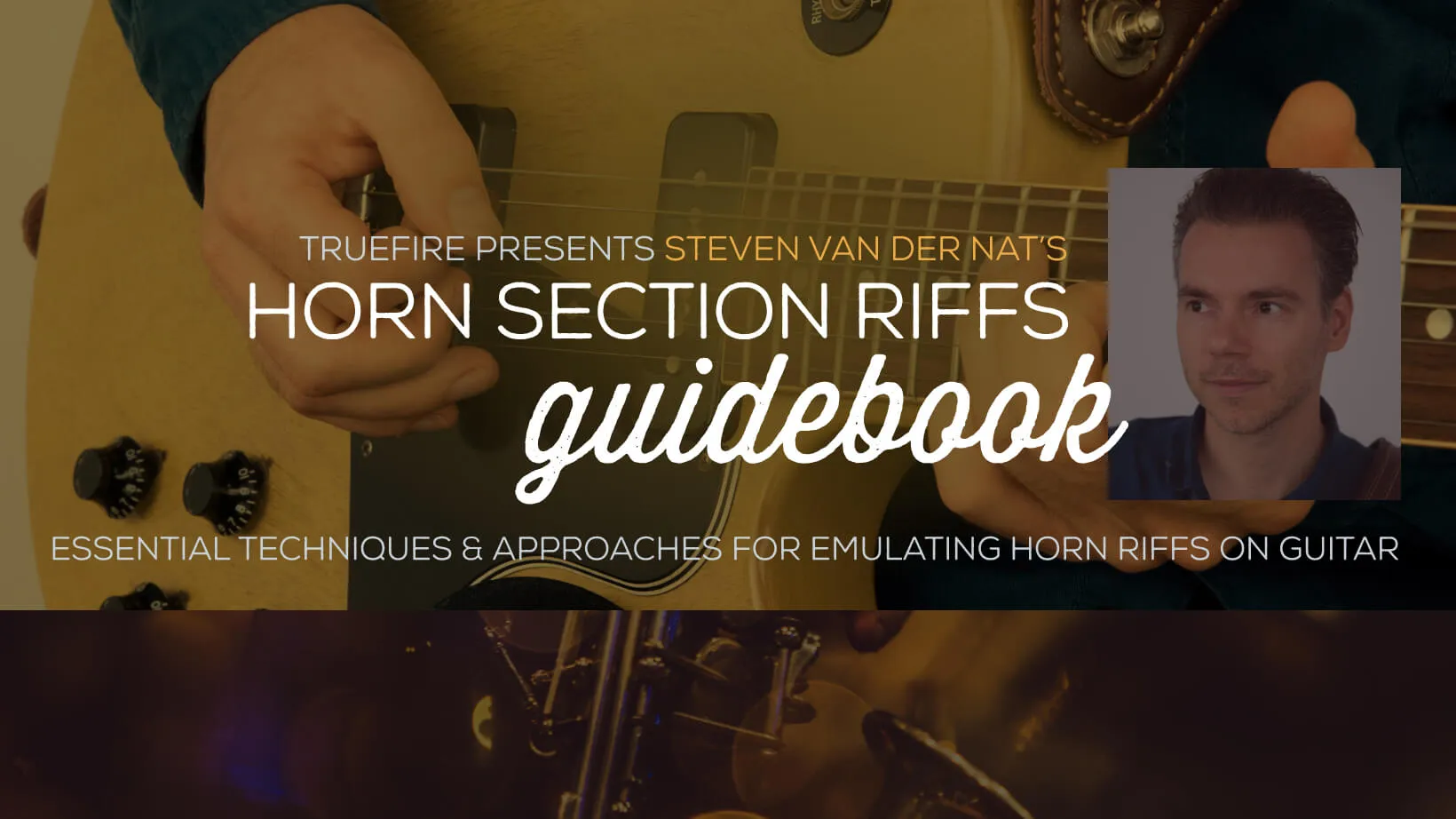
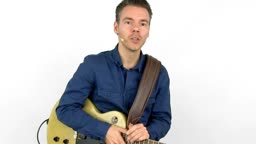
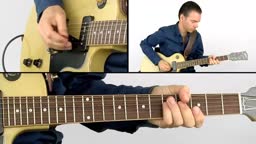
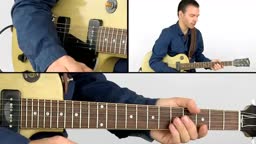
Horn section parts, punches, and fills add a whole new sonic dimension and excitement to any style of music especially blues, rock, and jazz. It’s rare that we get a chance to play with horns, which is why guitarists learn how to mimic a horn section to majorly liven up their comping, rhythm parts, and fills. Steven van der Nat’s Horn Section Riffs Guidebook is an accelerated curriculum focused on emulating horn section harmonizations, dynamics, and timing on guitar.
”I'll show you a variety of concepts and approaches for playing horn section parts on guitar. We’ll work on techniques like sliding chords, double stops, triads, and using repeating motifs — just like a horn section would play. We'll also look at playing off of a horn section by interacting and filling in the gaps. As a bonus, I'll show you how to sound like a Hammond organ and play some cool Hammond style grooves on guitar.”
Steven van der Nat is a guitarist, singer, and songwriter from the Netherlands. He's best known as the frontman of his band Little Steve & the Big Beat, with whom he has played many festivals throughout Europe since the band started in 2013. Throughout the years, Steven has also toured and recorded with bands such as Steven Troch Band (BE), Dede Priest, Mike & the Mellotones, The Backbones, and many others.
We’re thrilled to welcome Steven to the family with his first TrueFire course, Horn Section Riffs Guidebook. You will likewise be thrilled when you dig into his Guidebook and take a few of these moves to your next jam or gig!
Steven organized the curriculum into a series of playalong performance studies, where each study focuses on a particular horn section emulation concept or technique. Steven will first perform the study over a backing track and then he’ll break it down emphasizing the concept or technique being applied. You will play your way through the course!
Steven will explain and demonstrate all of the key concepts and approaches along the way. You’ll get standard notation and tabs for each of the licks. Plus, Steven includes all of the rhythm tracks for you to work with on your own (some include a real live horn section!). In addition, you’ll be able to loop or slow down any of the videos so that you can work with the lessons at your own pace.
Grab your guitar and let’s play some horn parts with Steven van der Nat!
What you'll learn
Play a Hammond-style chord groove using double-stops
Apply the same double stop shape to different chord functions
Navigate a 12-bar blues progression with this technique
Understand how to construct double stops from chord tones (third and fifth)
Hi, I'm Steven van der Nat and welcome to Horn Section Riffs Guidebook. As guitarists, we mostly listen to, well, guitar players. But in solos and backup playing, we often try to sound like a vocalist or a horn player. Now, not all of us are lucky enough to play with horns. But, we can get very close by imitating their phrasing, harmonizations, dynamics and timing by using some very specific guitar tricks.
In this course, I'll show you some of those concepts and tricks, like sliding chords, playing double stops and triads, and using repeating motifs. We'll also look at how to play off of a horn section, interacting and filling the gaps. As a bonus, I'll show you how to sound like a Hammond organ and play some cool Hammond style grooves on guitar.
This course comes with backing tracks that include a real live horn section. And, I'll give you the tabs, notation and some extra background information for each performance. So, let's get to it!
As guitarists, we tend to think like guitarists. By which I mean that we can often see a song as a piece of music that is divided between the parts where we play rhythm and parts where we play lead. To put it blatantly: we can sometimes see the rhythm part as nothing more than a way of killing time before it is time to finally play our guitar solo! A way of making it more interesting is by introducing motifs, which is a concept horn sections use all the time. Motifs are a small musical statement, often called a "theme", that gets repeated and developed throughout the song. In this piece, we'll be playing motifs, based on 6th chord triads to mimic a small horn section. Here we go!
As guitarists, we tend to think like guitarists. By which I mean that we can often see a song as a piece of music that is divided between the parts where we play rhythm and parts where we play lead. To put it blatantly: we can sometimes see the rhythm part as nothing more than a way of killing time before it is time to finally play our guitar solo! A way of making it more interesting is by introducing motifs, which is a concept horn sections use all the time. Motifs are a small musical statement, often called a "theme", that gets repeated and developed throughout the song. In this piece, we'll be playing motifs, based on 6th chord triads to mimic a small horn section. Here we go!
As guitarists, we tend to think like guitarists. By which I mean that we can often see a song as a piece of music that is divided between the parts where we play rhythm and parts where we play lead. To put it blatantly: we can sometimes see the rhythm part as nothing more than a way of killing time before it is time to finally play our guitar solo! A way of making it more interesting is by introducing motifs, which is a concept horn sections use all the time. Motifs are a small musical statement, often called a "theme", that gets repeated and developed throughout the song. In this piece, we'll be playing motifs, based on 6th chord triads to mimic a small horn section. Here we go!
Now let's focus on playing with horns. In a lot of R&B and soul bands from the 60's you had horns and guitar working together incredibly well. Just listen to some Otis Redding recordings for example, with the fantastic Steve Cropper on guitar. He had a way of playing simple, but highly effective riffs that worked incredibly well with the horns in the band.
Before we start, listen to the example from the previous lesson with the guitar part played by a real horn section. As guitarists, we use single note riffs mostly during solos. The challenge for this concept is to play mostly single note riffs for accompaniment. Play them groovy, and pay close attention to your timing.
Now let's focus on playing with horns. In a lot of R&B and soul bands from the 60's you had horns and guitar working together incredibly well. Just listen to some Otis Redding recordings for example, with the fantastic Steve Cropper on guitar. He had a way of playing simple, but highly effective riffs that worked incredibly well with the horns in the band.
Before we start, listen to the example from the previous lesson with the guitar part played by a real horn section. As guitarists, we use single note riffs mostly during solos. The challenge for this concept is to play mostly single note riffs for accompaniment. Play them groovy, and pay close attention to your timing.
Now let's focus on playing with horns. In a lot of R&B and soul bands from the 60's you had horns and guitar working together incredibly well. Just listen to some Otis Redding recordings for example, with the fantastic Steve Cropper on guitar. He had a way of playing simple, but highly effective riffs that worked incredibly well with the horns in the band.
Before we start, listen to the example from the previous lesson with the guitar part played by a real horn section. As guitarists, we use single note riffs mostly during solos. The challenge for this concept is to play mostly single note riffs for accompaniment. Play them groovy, and pay close attention to your timing.
Great course of lessons from Steven van der Nat, with good demonstrations and clear explanations of the concepts and techniques needed to emulate horn lines and riffs on the guitar. If you play blues, rock or jazz this is an excellent way to add life to your comping, rhythm parts and fills.
R
revman2015
05/31/20
Another mindset
Steven speaks of how he has made and used this Chord/ Horn hit structure. Watching whats available on the internet of his live performances really reinforces what good choices these would make for others playing live or in the studio. This course is an excellent calling card for Horn hits in the fifties style rock application. Very much hand in glove.
L
LinguaFranka
Verified buyer
11/14/19
Great for guitar playing and arranging
This course is good for not only demonstrating 'parts' but also for a real world insight into arranging horns for guitar players and composing.
B
boogie50
09/08/19
Horn Section Riff Guidebook
Steve van der Nat does a great job of teaching some really important and great guitar techniques which will allow you to incorporate horn-like lines in your playing. Steve is very thorough in his explanation of the material and by the time you complete this course, you’ll be able to “fill-in” the blanks with any band. Highly recommend.
A
Antony
05/12/19
I love this course
Very refreshing and easy to follow lessons. They definitely change the way you play guitar. Highly recommended. Please do a piano section next! :)