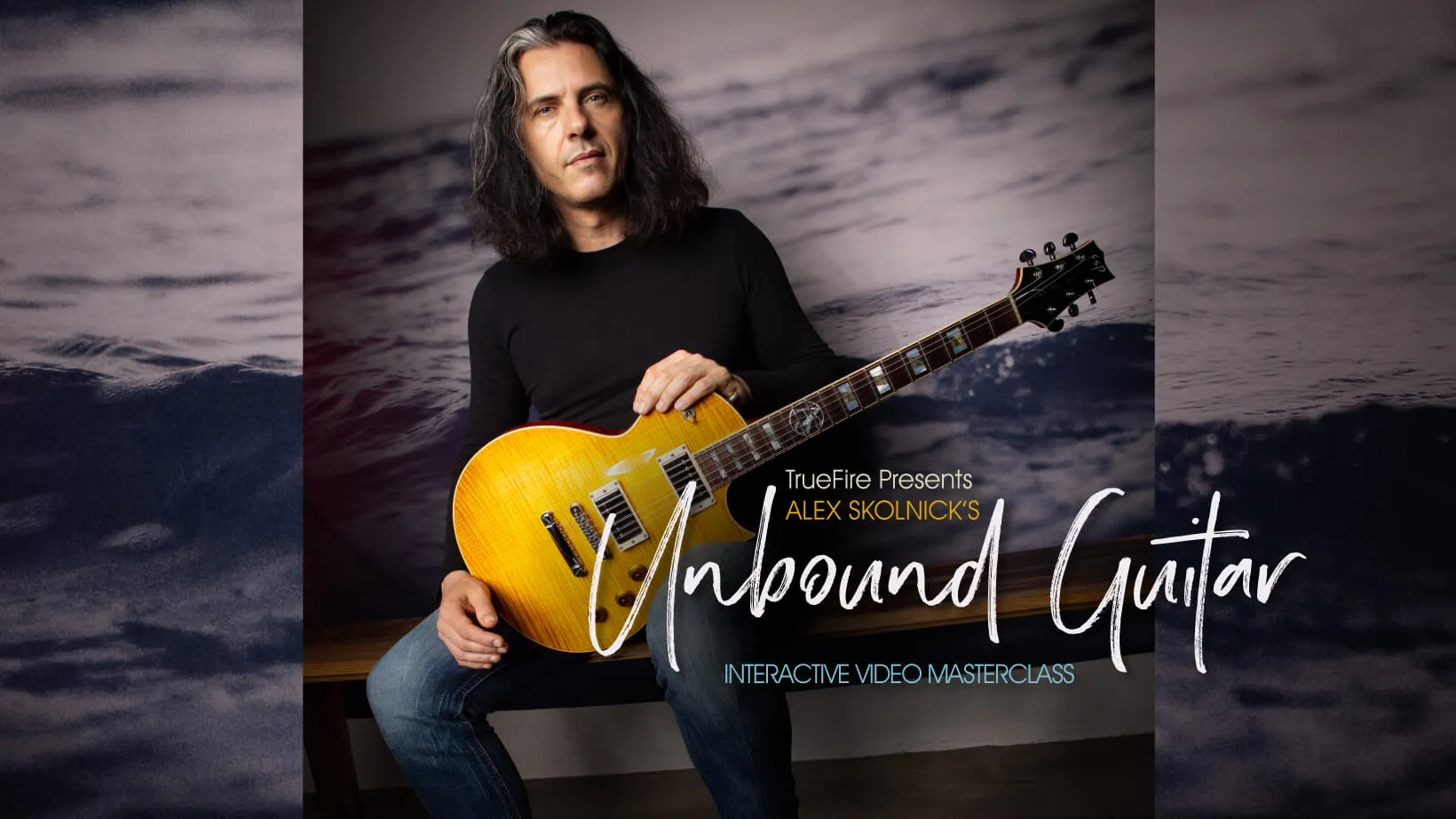
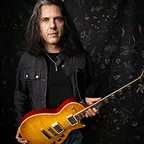
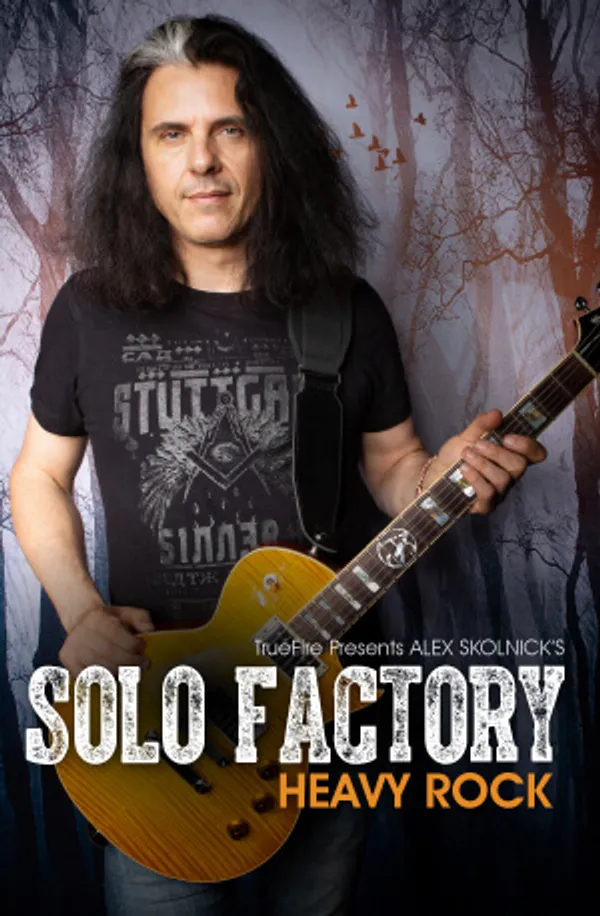
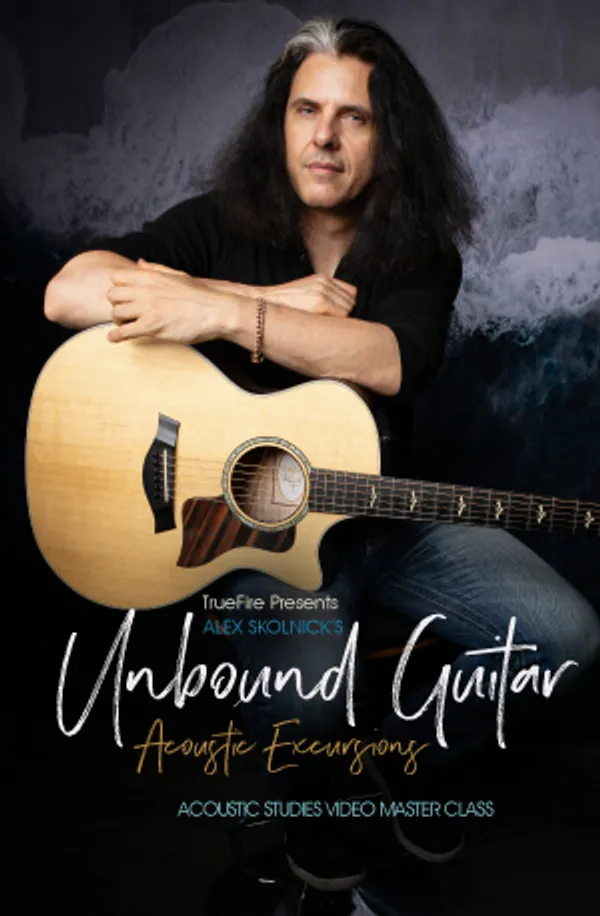
Emerging as one of the original melodic thrash guitarists (original member of Testament), Alex Skolnick also has released several critically acclaimed jazz albums with the Alex Skolnick Trio, is the leader of the critically acclaimed world acoustic project, Planetary Coalition, is a first call player for jazz/rock projects including the Stu Hamm/Alex Skolnick/Chad Wackerman power trio, Jane Getter Premonition, as well as “Celebrating Allan Holdsworth,” in which Alex is one of several guitarists with the prestigious position of filling in for the late, great Holdsworth. “Though he’s pretty much a household name in heavy metal, Alex defies categorization by musical genre.”
We’re thrilled to welcome Alex to the family with is first TrueFire course, Unbound Guitar. Whatever style you play, you will likewise be thrilled when you dig into Alex’s ear and eye-opening curriculum, which reveals the underlying harmonic, creative, and technical foundations of his multifaceted musicality and guitar prowess.
”Over the course of my career, I’ve played, recorded, and performed many different styles of music. What you might be surprised to know is that the building blocks of metal, jazz, acoustic, blues, world music (or really any style) relies on the same harmonic concepts, techniques, and expressive approaches at their foundational framework. I’m excited to share that framework with you here in Unbound Guitar.”
In Unbound Guitar, Alex presents these key building blocks, explains them thoroughly, and then puts them to work as performance studies, over six backing tracks, across different feels, tempos, and keys.
The course is organized into 5 sections. Harmonic basics are covered in the first section: Pentatonics Explained, Position Shifting & Pentatonics, One Octave Sliding Scale, Multi-octave Sliding Scale, Triads: Two Strings, Triads: Two Strings Workout Playalong, Triads: Three Strings, Triads: Three Strings Workout Playalong, Inversions, Seventh Chord Arpeggios, Seventh Chord Arpeggios Workout Playalong, and Melodic & Harmonic Intervals.
Essential techniques is focused on in the second section: Sliding Technique, Hammer Ons & Pull Offs, Simple Legato Jam, The Foundation of Bending, Extend Your Bends, Bringing it All Together, and Bring it Together Jam.
The third section features a series of harmonic demonstrations, Exercises and Playalongs: Modes Crash Course, Up The Triad, Down the Mode, Up the Mode, Down the Triad, Up the Mode, Down the Triad, Down the Triad, Up the Mode, Down the Mode, Up the Triad, Up the Arp, Down the Mode, Up the Mode, Down the Arp, Up the Mode, Down the Arp, Down the Mode, Up the Arp, Down the Arp, Up the Mode.
Stylistic approaches is focused on in the fourth section: Pinch Harmonics, Rakes Demonstration, Sweeps, Two-Handed Tapping, High Intensity Repetition, Melodic Expressionism, and Tone: Hands & Gear.
The fifth and final section puts all of the building blocks to work over 6 performance studies.
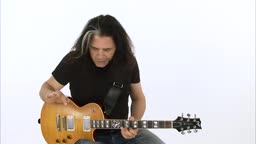
Alex will explain and demonstrate all of the key concepts and approaches along the way. You’ll get standard notation and tabs for each of the licks. Plus, Alex includes all of the rhythm tracks for you to work with on your own. In addition, you’ll be able to loop or slow down any of the videos so that you can work with the lessons at your own pace.
Grab your guitar and let’s get ‘unbound’ with Alex Skolnick!
What you'll learn
Master hybrid picking technique for expressive playing
Use volume and tone controls as performance tools
Skip the second scale degree to create even-numbered note groupings that land on downbeats
Understand how to create dynamic contrast using gear and technique
Develop awareness of tone options available on the guitar itself
Welcome to Unbound Guitar! This course is a study for "all around" guitar, or many styles. For the most part, we're keeping the music quite simple and straightforward - more so than what those of you who've heard me on albums or in concert are used to hearing. In other words, if you're here for the arpeggio in "A Trial by Fire" (Testament) or the slap-guitar harmonics in "Unbound" (AST), you're going to have to wait for more specific courses (which are planned for the future).
For now, we'll be exploring the building blocks behind those parts I've played professionally and familiarity with my work is not required. It is hoped the material covered will help players of all types find their own voices. On that note, let's begin!
A quick verbal rundown of the next few lessons, which are focused on groups of notes.
As guitarists, we often think of the term "pentatonic" or "pentatonic scale" a bit differently than pianists, brass and woodwind players or other instrumentalists. They tend to think of the primary pentatonic shape as one that we sometimes call "major pentatonic" (listen to the intro to the Motown classic "My Girl" by The Temptations, which is in C).
We tend to think of the shape of that defines too many guitar solos to name (a couple iconic examples: the finales of "Stairway to Heaven" by Led Zeppelin, which is in Am). "Minor pentatonic" is the term applied to these types of licks. However, it's important to realize there is more to "pentatonics" than "minor pentatonic".
The terms "major pentatonic" and "minor pentatonic" can be misleading. The reason: Both shapes are directly related and – depending on the chord or progression played underneath – both can sound major and minor. However, viewing the shapes in this segment as "C major pentatonic" and "A minor pentatonic" can be quite helpful for the purposes of memorization. It's also useful down the road, when we'll look at pairing pentatonic shapes with various modes (more on this later).
So, while we're using terms "major" and "minor," for organizational purposes, try to hear the two patterns as intertwined. This section demonstrates this concept sonically as well as covering the physical movement between the two shapes.
While the primary method for learning scales and patterns is across all six strings in two or more octaves, it's all too easy to overlook how much mileage one get within just one octave. This section breaks you out of "across the string" technique for a moment, and involves viewing just one single-octave pentatonic pattern, all over the neck. It also enables a position shift by sliding between the second and third notes the slide can be emphasized or disguised depending on whether one chooses to pick or not), hence my term "sliding scale" (which has nothing to do with cash transactions).
Here we take the one-octave sliding scales from the previous segment and blend them together. There are a couple fingering issues that arise depending on which position we are in and whether we are ascending or descending – these are addressed. The result is two-octave and three-octave patterns that not only go across the strings, but also move up and down the neck and sound quite effortless once you get the hang of it.
Introduction to triads, the building blocks of chords, arpeggios and melodies. Just as each note of the major scale represents a "degree" of the scale, the same is true of the triad built on each note (simply add every other note in the scale until you have a group of three notes). For this section, we're focusing exclusively on the seven relative triads in the key of C major, each one on two strings in the lower register.
First experience to the teachings of Alex Skolnick and I have to say I find his teaching style a pure joy the way he conveys the materiel in front of you is very inspiring. The course itself is full of crucial information and perfectly executed which allows the student to digest and put into practice the essential tools to have a much better understanding of the fretboard and the tools needed to take your playing skills to the next level including scales triads technique and guitar overall.
R
Randy16
Verified buyer
12/20/22
This is a real guitar course, you have to do homework, but it's what I was looking for ! Alex give clear explainations with greats examples for the differents topics. The triads workout are really great. I've not finish the course, but it already have help me a lot. Alex is a great teacher for making the connection between theory and real musical use !!
G
Gromolpian
Verified buyer
12/23/21
Unbound Guitar
Great teacher, good value tuition!
T
TomoStrat
06/25/21
Highly recommended for beginners and intermediate players
Even though Alex is known mainly for his complex solos in Testament, I highly recommend this course to intermediate and even beginner level guitarists that are just starting to discover the world of solo guitar. The way he started this course with basic, but not boring and repetitive explanations, is the perfect way of showing different pentatonic shapes (and much more) and how to combine them so that the beginner brain doesn't boil in the first few minutes which would cause them to lose interest.
As for intermediate players, learning those solos at the end of the course will take them right to the advanced level of phrasing and expression without even having to improve their technique.
S
Stonehammer
Verified buyer
04/10/21
Absolutely brilliant!
This is a great course that covers all the basics required to unlock the full fret board and get you playing some really tasty licks and solos.
There is so much information that it will take some time to absorb it all and will get you playing to a high intermediate standard. Even for a seasoned player, there are exercises here that will get you working up and down the neck in new ways and having to think about what you're doing.
The lessons are concise and clear and I would highly recommend the course to any beginner to intermediate player.